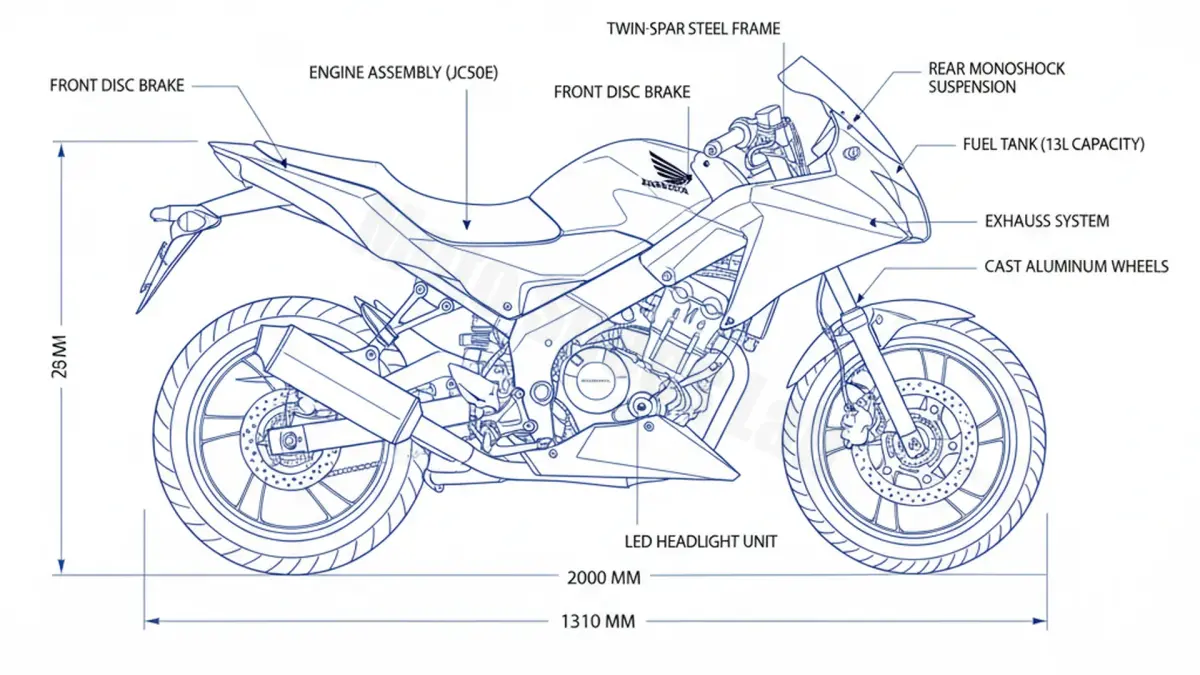
| Specification | Data |
|---|---|
| Model Series | JC50 (2011 – 2017) |
| Engine Oil | SAE 10W-30 (JASO MA) | 1.0 L (1.3 L dry fill) |
| Tire Dimensions | F: 100/80-17 | R: 130/70-17 (Tubeless) |
| Tire Pressure | F: 2.0 bar | R: 2.0 bar (2.3 bar passenger) |
| Battery | YTZ6V |
| Spark Plug | NGK CPR8EA-9 |
The Honda CBR 125 R (JC50) represents a pivotal moment in the evolution of the beginner-class sportbike. While its predecessors were often criticized for their slender, almost bicycle-like proportions, the JC50 introduced the “Layer-Style” fairing concept inspired by the VFR1200F and CBR250R. This engineering shift wasn’t merely aesthetic; it significantly enhanced aerodynamic stability and provided the 125cc class with the physical presence and wind protection of a much larger displacement machine.
Engineering & Performance
At the heart of the JC50 is a liquid-cooled, single-cylinder SOHC 2-valve engine equipped with Honda’s proprietary PGM-FI (Programmed Fuel Injection). This system ensures optimal combustion efficiency and cold-start reliability. The JC50 produces a steady 9.8 kW (13.1 hp), delivered through a 6-speed gearbox that offers precise engagement, making it an ideal platform for both urban commuting and spirited weekend riding.
Maintenance & Fluid Specifications
As the Editor-in-Chief of MotoSpecsLab, I emphasize that the longevity of the JC50 depends on strict adherence to fluid intervals. The engine requires SAE 10W-30 oil meeting the JASO MA standard. A standard oil change requires exactly 1.0 liter, though a complete engine teardown (dry fill) requires 1.3 liters.
The ignition system utilizes the NGK CPR8EA-9 spark plug. Given the high-revving nature of a 125cc engine, regular inspection of the electrode gap is critical to prevent misfires and maintain fuel economy. For the electrical system, the YTZ6V battery provides the necessary cranking amps while maintaining a compact footprint within the subframe.
Chassis and Handling
The JC50 moved to wider tires compared to the JC34/39 models, utilizing a 100/80-17 front and a 130/70-17 rear. This change dramatically improved mechanical grip and cornering confidence. For optimal handling, maintain tire pressures at 2.0 bar (29 psi) for the front and rear when riding solo. If carrying a pillion, the rear pressure must be increased to 2.3 bar (33 psi) to account for the additional load and maintain tire profile integrity.
MotoSpecsLab Verdict
The Honda CBR 125 R JC50 remains a benchmark for reliability in the A1 license category. Its combination of full-sized ergonomics, fuel-injected efficiency, and accessible maintenance makes it a premier choice for enthusiasts seeking a machine that bridges the gap between a learner bike and a mid-range supersport.
Frequently Asked Questions
Q: How often should I check the engine oil?
A: We recommend checking the oil level via the sight glass or dipstick every 500km, as small displacement engines can consume oil at sustained high RPMs.
Q: Is the JC50 compatible with E10 fuel?
A: Yes, the JC50’s PGM-FI system is designed to handle modern fuel blends, though premium unleaded is often preferred for long-term storage to prevent ethanol degradation.