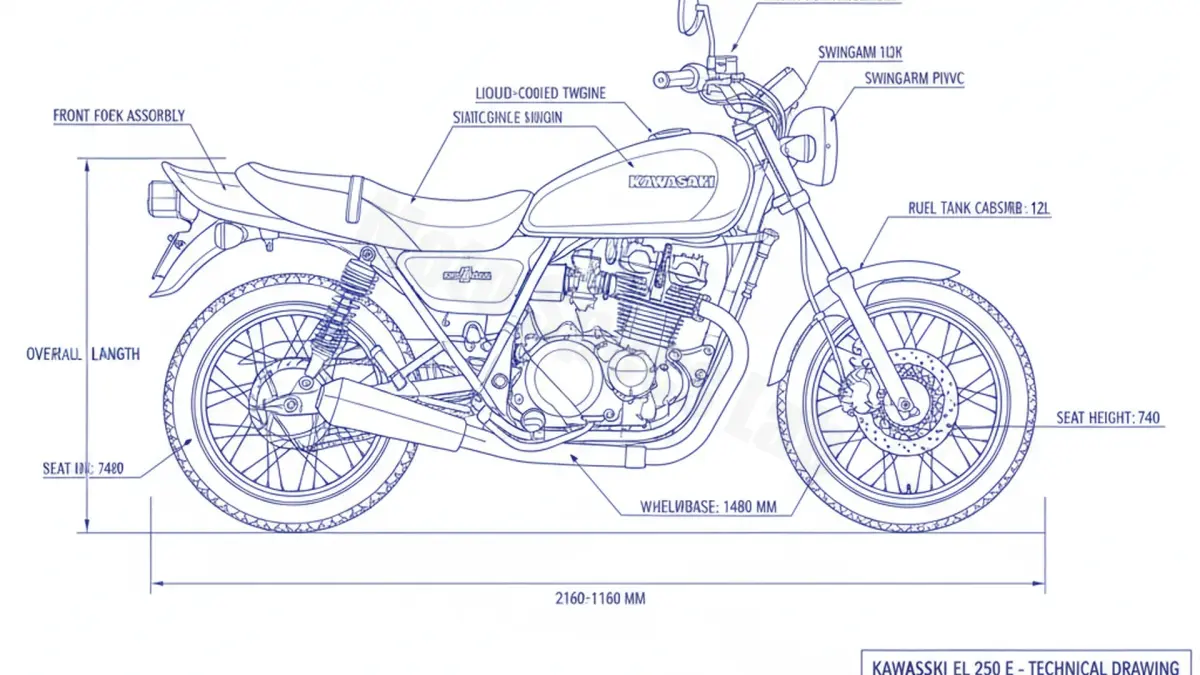
| Specification | Value |
|---|---|
| Production Years | 1988-1995 |
| Engine Type | Liquid-cooled Parallel Twin |
| Engine Oil | SAE 10W-40 (JASO MA2) / 1.7 Liters |
| Tire Dimensions (F/R) | 100/90-17 55S / 140/90-15 70S |
| Tire Pressure (F/R) | 2.0 bar / 2.25-2.5 bar |
| Spark Plug | NGK CR9E (0.7-0.8 mm gap) |
| Battery Type | YB9L-A2 |
Engineering Highlight: Unlike its contemporaries in the 250cc cruiser segment that favored low-revving V-twins, the Kawasaki EL 250 E utilized a high-performance, liquid-cooled parallel-twin engine directly derived from the GPX250R (Ninja 250). This choice gave the Eliminator a unique “sport-cruiser” DNA, allowing it to scream toward a 14,000 RPM redline—a rarity for the cruiser aesthetic.
Technical Overview
The EL 250 E, often designated under the EL250B and E chassis codes, represents a bridge between Kawasaki’s sportbike engineering and its cruiser styling. The DOHC 8-valve engine is the heart of this machine, offering a linear power delivery that rewards riders who aren’t afraid to work the gearbox. At MotoSpecsLab, we classify this model as a high-authority benchmark for small-displacement reliability.
Maintenance & Lubrication
To maintain the high-revving nature of the EL 250 E, lubrication is critical. The system requires 1.7 liters of SAE 10W-40. It is imperative to use oil with the JASO MA2 specification to ensure the wet clutch operates without slippage, especially given the engine’s high-RPM operating range.
Chassis, Tires, and Handling
The EL 250 E features a staggered wheel setup that defines its stance. The 17-inch front (100/90-17) provides stable tracking, while the 15-inch rear (140/90-15) offers the classic cruiser look. Proper inflation is vital for handling: 2.0 bar (28 psi) for the front and 2.25 to 2.5 bar (32-36 psi) for the rear depending on load.
Electrical System and Ignition
Cold starts and throttle response are heavily dependent on the ignition system. The EL 250 E utilizes NGK CR9E spark plugs. For optimal combustion, the electrode gap must be precisely set between 0.7 and 0.8 mm. The electrical system is supported by a YB9L-A2 battery, which provides sufficient cranking amps for the high-compression twin.
Expert Verdict
The Kawasaki EL 250 E remains a favorite for those seeking a lightweight cruiser that doesn’t sacrifice mechanical sophistication. Its Ninja-sourced engine makes it more engaging than its rivals, provided the owner adheres to a strict maintenance schedule regarding valve clearances and high-quality synthetic oils.