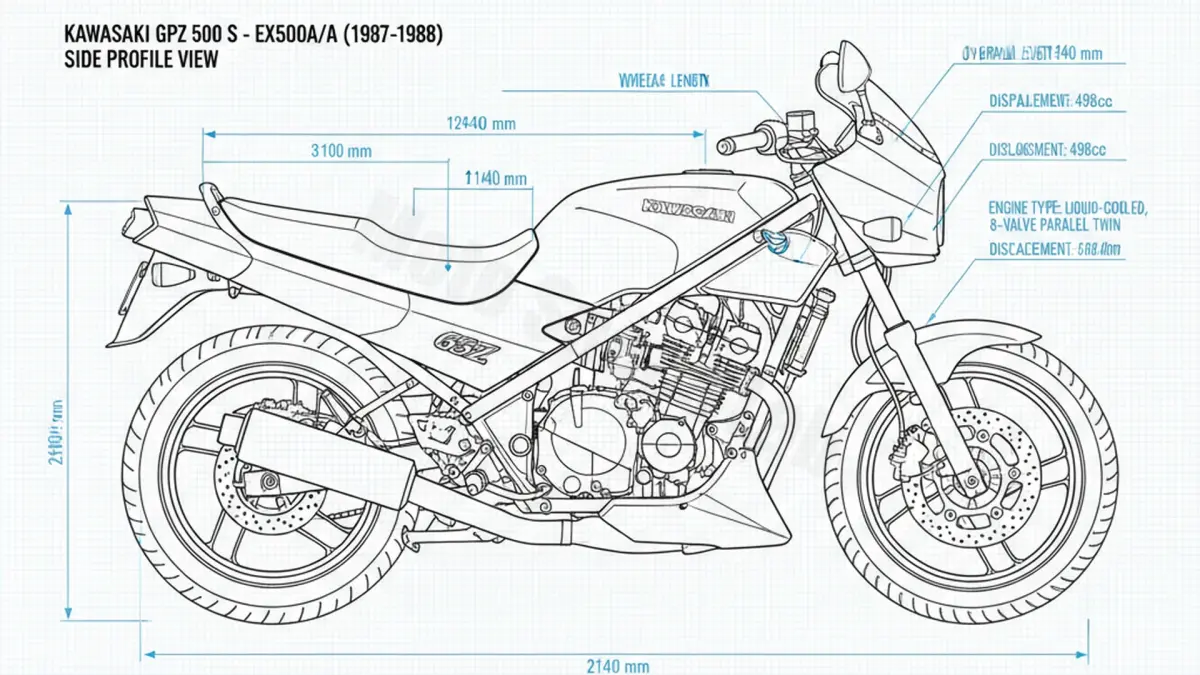
| Component | Specification |
|---|---|
| Production Years | 1987–1993 |
| Engine Type | 498cc Parallel-Twin, DOHC |
| Engine Oil | SAE 10W-40 to 20W-50 (3.0 L) |
| Tire Sizes | F: 100/90-16 | R: 120/90-16 |
| Spark Plug | NGK DR8ES / DR8ES-L (0.6–0.7 mm gap) |
| Battery | YB14L-A2 |
A fascinating piece of engineering history often overlooked is that the Kawasaki GPZ 500 S engine is effectively half of a GPZ 1000RX (or more famously, the Ninja 900) powerplant. By utilizing the same bore and stroke dimensions as its larger four-cylinder siblings, Kawasaki created a high-revving, liquid-cooled parallel twin that redefined the middleweight class upon its 1987 debut.
Engineering Overview: The EX500A Profile
The EX500A, known in Europe as the GPZ 500 S, represents the first generation of a platform that would remain in production for over two decades. Its 498cc engine features a 180-degree crankshaft and a balance shaft to mitigate the inherent vibrations of a twin. For the ‘A’ series (1987–1993), the bike was characterized by its 16-inch wheels and rear drum brake, which provided agile, albeit slightly nervous, handling compared to the later 17-inch ‘D’ models.
Maintenance Guide & Technical Data
Lubrication System
The GPZ 500 S is versatile regarding oil viscosity, accommodating everything from 10W-40 to 20W-50 depending on the ambient operating temperature. A full oil and filter change requires 3.0 liters. To maintain the longevity of the wet clutch, ensure the oil meets API SE, SF, or SG standards and lacks friction modifiers found in modern automotive oils.
Tire and Pressure Specifications
The 16-inch wheel setup is a hallmark of late-80s sportbike design. Maintaining correct pressures is critical for stability:
- Front: 100/90-16 54H – 2.00 bar (28 psi)
- Rear: 120/90-16 63H – 2.25 bar (32 psi)
- Max Load: Increase rear pressure to 2.50 bar (36 psi).
Ignition and Electrical
The ignition system relies on NGK DR8ES or DR8ES-L plugs. The gap is tight, specified at 0.6–0.7 mm. Electrical health is sustained by a YB14L-A2 lead-acid battery. Owners should regularly check the electrolyte levels in this specific battery type, as the EX500’s charging system can be demanding on older battery chemistry.
Expert Verdict: MotoSpecsLab EEAT Analysis
The EX500A remains a masterclass in ‘performance per dollar.’ While the 16-inch tires limit modern rubber choices, the engine’s reliability is legendary, provided the cam chain tensioner and flywheel magnets (common failure points on early models) are monitored. For the collector or the commuter, it offers a raw, mechanical connection that modern fuel-injected bikes often lack.
Frequently Asked Questions
Q: Can I use synthetic oil in my 1989 GPZ 500 S?
A: Yes, provided it is a JASO-MA rated synthetic oil to prevent clutch slippage. However, high-quality mineral or semi-synthetic 10W-40 is usually sufficient for this engine architecture.
Q: Why is my battery not charging?
A: The EX500A is known for flywheel magnet delamination. If the magnets shift or break, the stator cannot generate sufficient current. Inspect the rotor if charging issues persist.