| Specification | Data |
|---|---|
| Production Years | 1977 – 1998 |
| Gearbox Oil | SAE 10W-40 (0.7 L) |
| Front Tire | 2.75-18 4PR (1.75 bar / 25 psi) |
| Rear Tire | 3.00-18 4PR (2.00 – 2.25 bar) |
| Spark Plug | NGK BR8ES / B8ES (0.7-0.8mm gap) |
| Battery | 6N6-3B (Early) / YB4L-B (Later) |
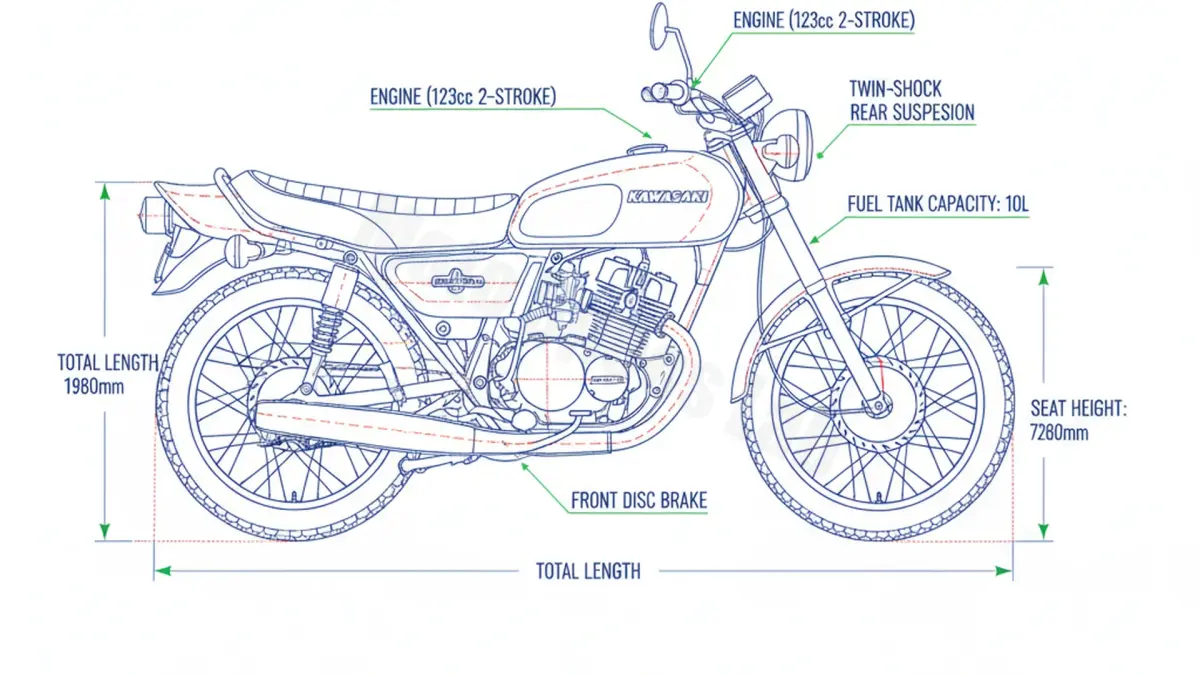
The Kawasaki KH 125 holds a unique position in motorcycle history as one of the longest-surviving two-stroke commuters, remaining in production for over two decades. While competitors transitioned to four-stroke technology, the KH125 persisted due to its exceptional engineering highlight: the Rotary Disc Valve induction system. Unlike traditional piston-port designs, the rotary valve allowed Kawasaki engineers to precisely time the intake cycle, resulting in a broader powerband and superior fuel efficiency for a small-capacity two-stroke.
Engineering Excellence and Performance
At the heart of the KH125 is a 124cc single-cylinder engine that delivers a punchy yet manageable power delivery. The inclusion of Kawasaki’s “Superlube” oil injection system ensured that the engine received optimal lubrication without the need for premixing fuel, a significant convenience factor for daily riders in the late 20th century. The bike’s lightweight chassis and 18-inch wheels provided the agility needed for urban navigation, while its mechanical simplicity made it a favorite for home mechanics.
Maintenance Guide & Technical Specs
Lubrication System
For the gearbox, the KH125 requires 0.7 liters of SAE 10W-40 oil. It is critical to use oil meeting API SE or SF classifications to ensure the wet clutch operates without slipping. Regularly checking the sight glass or dipstick is essential, as two-stroke gearboxes are sensitive to oil levels.
Tires and Handling
The KH 125 utilizes a classic 18-inch setup. The front tire should be a 2.75-18 4PR, maintained at 1.75 bar (25 psi). The rear requires a 3.00-18 4PR. Pressure management is vital for safety: 2.00 bar (28 psi) is recommended for solo riding, but this should be increased to 2.25 bar (32 psi) when carrying a pillion passenger to maintain carcass stability.
Electrical and Ignition
The electrical system evolved over the production run. Early models typically utilized a 6N6-3B battery, while later versions moved to the YB4L-B. For ignition, the NGK BR8ES (or the non-resistor B8ES) is the standard. Ensuring a precise gap of 0.7-0.8mm is paramount for consistent combustion and preventing fouling, a common issue in older two-stroke engines.
MotoSpecsLab Verdict
The Kawasaki KH 125 is more than just a commuter; it is a masterclass in longevity and practical engineering. Its rotary valve design remains a point of interest for enthusiasts today. By following the specified maintenance intervals—particularly regarding oil quality and tire pressures—owners can ensure this vintage machine continues to provide the reliable, “ring-ding-ding” performance it is famous for.