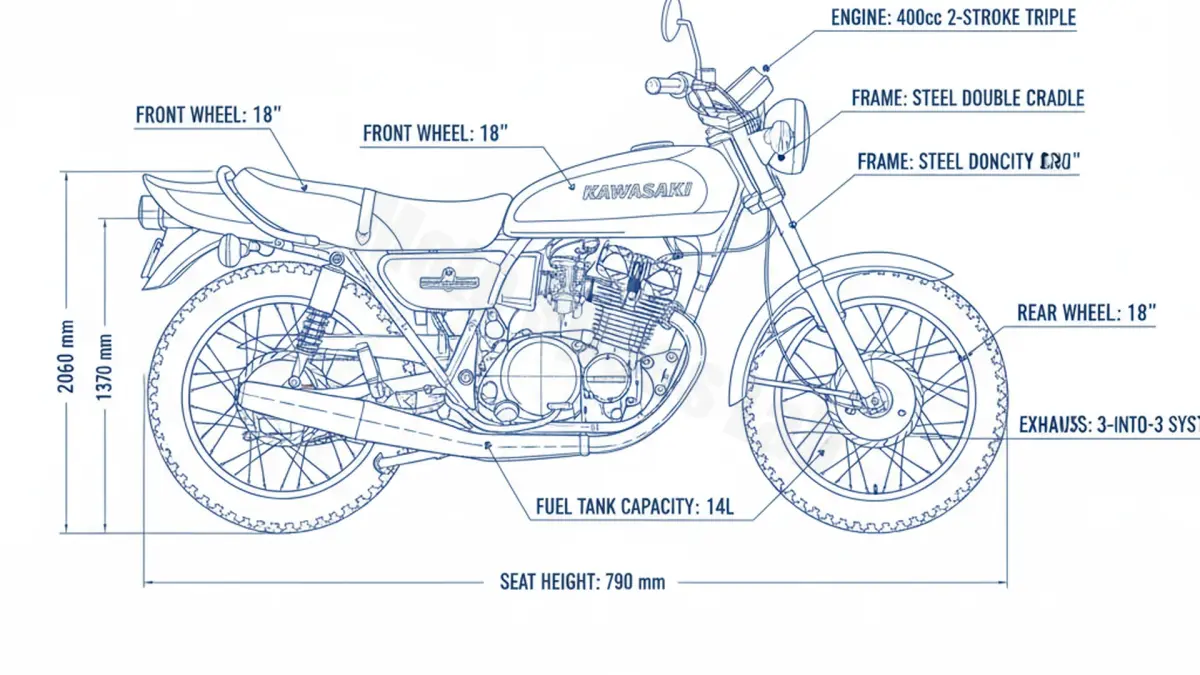
Historical Engineering Highlight: While its predecessors were known as the ‘Widowmakers’ for their unpredictable power bands, the Kawasaki KH 400 – S3F marked a pivotal engineering shift. It was the first in the mid-sized triple series to fully embrace a Capacitor Discharge Ignition (CDI) system across its production run, significantly improving the reliability of the three-cylinder timing and smoothing out the erratic low-end performance that plagued earlier two-stroke designs.
| Component | Specification |
|---|---|
| Model / Year | Kawasaki KH 400 – S3F (1976-1978) |
| Engine Oil | SAE 10W-30 or 10W-40 (API SE/SF) |
| Oil Capacity | 0.7 L (Change) / 0.8 L (Dry) |
| Tires (Front/Rear) | F: 3.25-18 4PR / R: 3.50-18 4PR |
| Tire Pressure | F: 1.8 bar (26 psi) / R: 2.0 bar (28 psi) |
| Battery | 12N7-4A |
| Spark Plug | NGK B8HS (0.6mm-0.7mm gap) |
Technical Overview & Engineering
The KH 400 – S3F represents the final evolution of Kawasaki’s 400cc air-cooled, two-stroke triples. By 1976, Kawasaki had refined the S3 architecture to meet tightening emissions and noise regulations, resulting in the S3F designation. The engine features a 57.0 x 52.3 mm bore and stroke, providing a balanced power delivery that prioritizes mid-range torque over the peaky, high-RPM scream of the earlier 350cc variants.
Maintenance Guide: Professional Standards
Lubrication System
For the gearbox, MotoSpecsLab recommends using a high-quality SAE 10W-40 oil meeting API SE or SF standards. During a standard service, the drain will yield approximately 0.7 liters. It is critical not to overfill, as the dry capacity is only 0.8 liters. Ensure the motorcycle is level when checking the sight glass or dipstick.
Ignition and Spark Plugs
The CDI system on the S3F is robust, but the health of the three NGK B8HS plugs is paramount. Maintaining a precise gap of 0.6mm to 0.7mm ensures consistent combustion across all three cylinders, preventing the ‘loading up’ of the center cylinder—a common issue in air-cooled triples during low-speed idling.
Chassis and Tires
The S3F utilizes a traditional tube-type setup. For optimal handling and to prevent wallowing in corners, maintain the front tire (3.25-18) at 1.8 bar (26 psi) and the rear (3.50-18) at 2.0 bar (28 psi). Given the age of these machines, checking the 12N7-4A battery’s electrolyte levels is a mandatory monthly task to ensure the CDI receives stable voltage.
Editorial Review: The MotoSpecsLab Verdict
The Kawasaki KH 400 – S3F is often overshadowed by the larger 500cc and 750cc triples, yet it is arguably the most balanced of the family. From a technical perspective, the S3F is easier to tune and significantly more stable at speed than the H1. It offers a unique mechanical symphony that only a two-stroke triple can provide, packaged in a chassis that—while dated by modern standards—offers a raw and engaging feedback loop for the vintage enthusiast.
Frequently Asked Questions
Q: Can I use modern synthetic oils in the KH 400 gearbox?
A: While modern oils are superior, ensure they do not contain ‘friction modifiers’ that could cause the wet clutch to slip. An API SF-rated mineral or semi-synthetic oil is generally safest.
Q: Why is the spark plug gap so specific?
A: The 0.6mm-0.7mm gap is optimized for the CDI’s output voltage. A larger gap may cause misfires under high compression, while a smaller gap may lead to plug fouling in two-stroke engines.