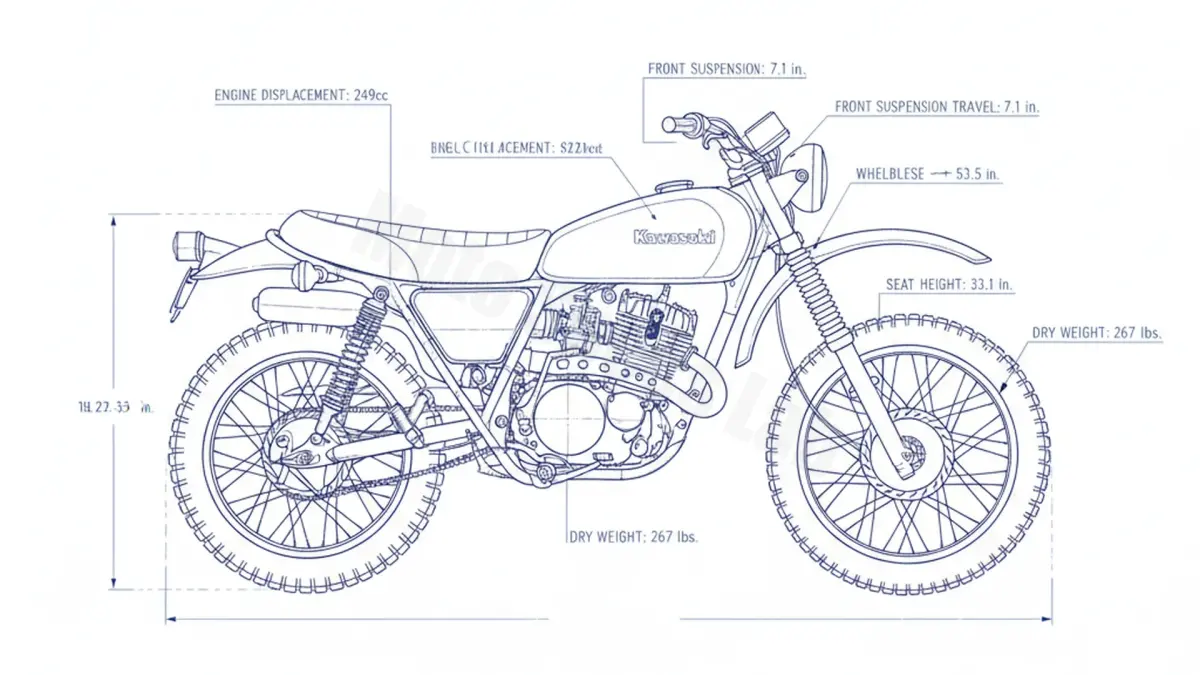
| Specification | Value |
|---|---|
| Production Years | 1978–1982 |
| Engine Type | 249cc SOHC Single-cylinder, 4-valve |
| Oil Type | SAE 10W-40, 10W-50, 20W-40, or 20W-50 (API SE/SF) |
| Oil Capacity | 1.5 L (periodic), 1.7 L (filter), 2.0 L (dry) |
| Tires (F/R) | 3.00-21 4PR / 4.00-18 4PR |
| Spark Plug | NGK B8ES |
| Battery | 6N6-3B (6V) |
Historical Engineering Highlight: The Kawasaki KL 250 (KL250A) holds a prestigious place in motorcycling history as Kawasaki’s first serious entry into the four-stroke dual-purpose market. While competitors were still refining two-stroke enduro bikes, Kawasaki engineered the KL250A with a sophisticated 4-valve head design—a rarity for small-displacement singles in the late 1970s—providing a broader powerband and superior fuel efficiency for its era.
Technical Overview
The KL250A was designed to bridge the gap between street legality and off-road capability. Its heart is a 249cc SOHC engine that delivers reliable torque. Unlike many modern bikes, the KL250A utilizes a 6-volt electrical system, powered by a 6N6-3B battery, which requires diligent maintenance of the electrolyte levels to ensure lighting and ignition consistency.
Maintenance Guide
Lubrication System
To preserve the longevity of the SOHC valvetrain, regular oil changes are non-negotiable. The KL250A is versatile regarding viscosity, supporting 10W-40 up to 20W-50 depending on ambient temperature.
- Periodic Change: 1.5 Liters
- With Filter Replacement: 1.7 Liters
- Dry Engine: 2.0 Liters
Ensure the oil meets API SE or SF standards to protect the vintage clutch friction plates.
Chassis & Tires
The KL250A features a classic 21-inch front and 18-inch rear wheel setup, optimized for trail stability. Maintaining the correct tire pressure is vital for both rim protection and handling. We recommend 1.5 bar (21 psi) for the front and 1.75 bar (25 psi) for the rear for general dual-sport use.
Ignition and Electrical
The NGK B8ES spark plug is the standard requirement. Given the 6V system, ensure that the spark plug gap is precisely set to factory specifications to prevent misfires under load. The 6N6-3B battery is a lead-acid type; owners should periodically check for terminal corrosion and fluid levels.
Frequently Asked Questions
Can I use modern synthetic oil?
While modern synthetics offer superior protection, ensure they do not contain friction modifiers (energy conserving labels) that could cause the wet clutch to slip. An API SE or SF rated mineral or semi-synthetic oil is generally preferred for these vintage seals.
What is the fuel requirement?
The KL250A was designed for leaded fuels of the era. Modern 91+ octane unleaded fuel is typically sufficient, though some owners prefer lead substitutes or octane boosters to protect valve seats during high-temperature operation.