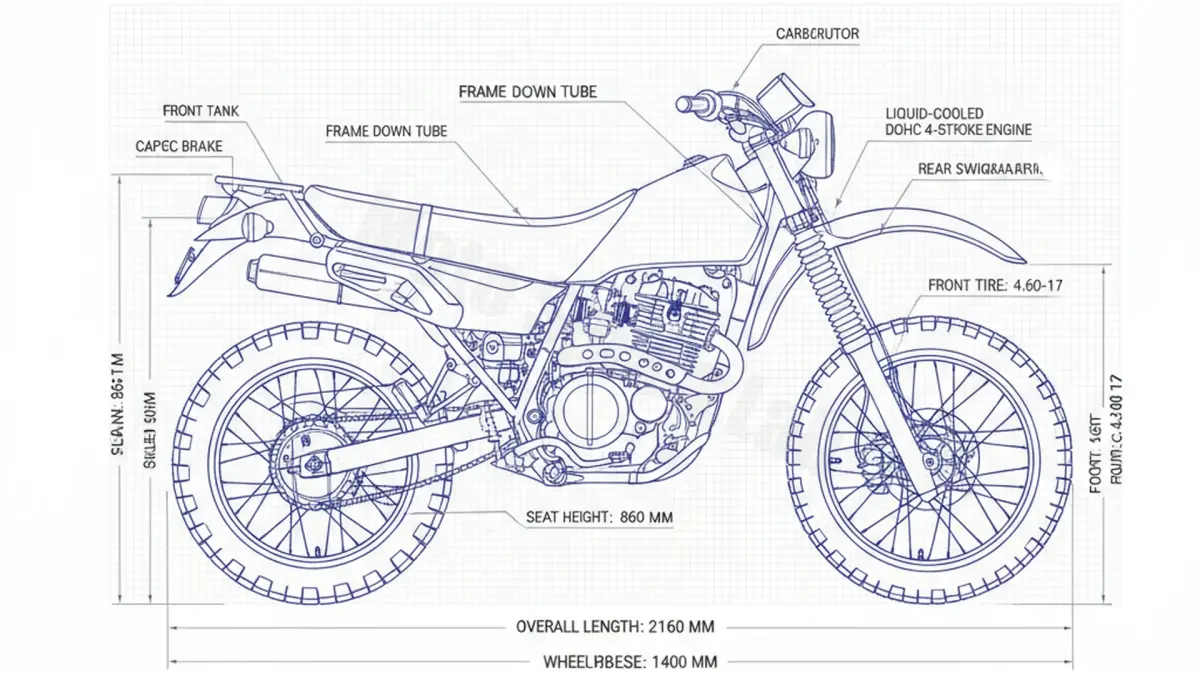
| Specification | Value |
|---|---|
| Production Years | 1985 – 2005 |
| Engine Type | 249cc, Liquid-cooled, DOHC, 4-valve Single |
| Oil Capacity | 1.4 Liters |
| Oil Grade | SAE 10W-40, 10W-50, 20W-40, 20W-50 (JASO MA) |
| Tires (Front/Rear) | 3.00-21 4PR / 4.60-17 4PR |
| Spark Plug | NGK DPR9EA-9 (Gap: 0.8 – 0.9 mm) |
| Battery | YB4L-B |
At MotoSpecsLab, we evaluate motorcycles based on their mechanical longevity and engineering integrity. The Kawasaki KLR 250 (KL250D) holds a unique distinction in motorcycling history: it was the primary light reconnaissance vehicle for the United States Marine Corps (USMC), designated as the M1030. Unlike many of its contemporaries that relied on air-cooling, the KLR 250 featured a sophisticated liquid-cooled DOHC engine, making it a high-performance outlier in the dual-sport world for over two decades.
Engineering Profile: The DOHC Advantage
The heart of the KL250D is its 249cc liquid-cooled, four-valve, Dual Overhead Cam (DOHC) engine. This configuration allowed for higher RPM potential and better thermal management than the air-cooled Honda XR250R or Suzuki DR250 of the era. The engine’s ability to maintain consistent power under heavy loads or slow-speed technical trails made it an ideal candidate for military and utility applications.
Maintenance Essentials
Lubrication System
The KLR 250 requires 1.4 liters of oil. Given its high-revving nature and shared sump with the transmission, using a motorcycle-specific oil is critical. We recommend a JASO MA/MA2 certified oil to ensure wet-clutch compatibility. In temperate climates, 10W-40 is standard, while 20W-50 is preferred for desert or high-heat environments.
Ignition & Electrical
Reliable starting is contingent on the NGK DPR9EA-9 spark plug. Technicians must ensure the gap is precisely set between 0.8 and 0.9 mm. Electrical power is managed by a YB4L-B lead-acid battery; however, many modern owners opt for AGM equivalents to better handle the vibrations inherent in off-road riding.
Chassis and Contact Patch
The KLR 250 utilizes a classic 21-inch front and 17-inch rear wheel setup, providing excellent roll-over capability. Tire pressures are critical for performance: 1.5 bar (21 psi) is the standard for both ends, but the rear should be increased to 1.75 bar (25 psi) when carrying luggage or a passenger to prevent pinch flats and sidewall wallowing.
MotoSpecsLab Verdict
The Kawasaki KLR 250 remains a pinnacle of mechanical reliability. Its 20-year production run is a testament to a design that was ahead of its time in 1985. For the modern enthusiast, it offers a lightweight, street-legal platform that is equally capable of commuting and back-country exploration, provided the DOHC valvetrain and cooling system are maintained with professional rigor.