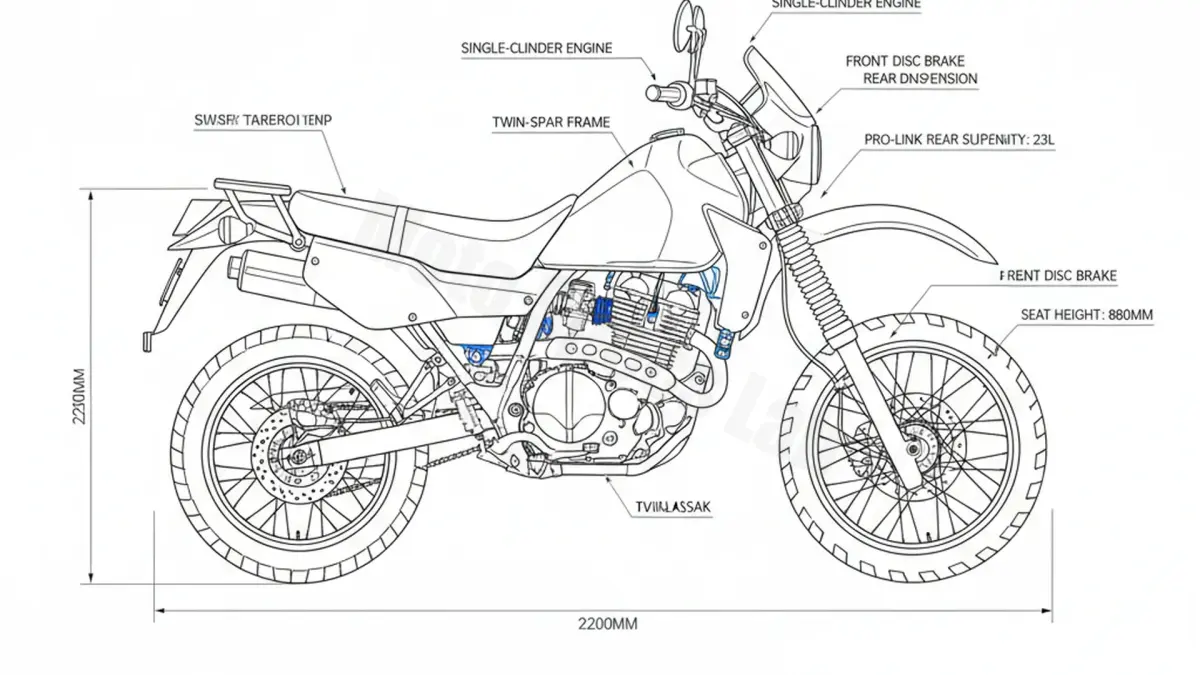
While most motorcycle models undergo radical redesigns every four to five years, the Kawasaki KLR 650 (KL650A) achieved legendary status by remaining virtually unchanged from 1987 to 2007. This mechanical “cockroach” of the dual-sport world was so reliable and versatile that the United States Marine Corps eventually commissioned a modified version (the M1030M1) to run on JP-8 diesel fuel, cementing the KLR’s legacy as the ultimate survivalist machine.
| Production Years | 1987–2007 |
|---|---|
| Engine Type | 651cc, Liquid-cooled, 4-stroke Single |
| Oil Specification | SAE 10W-40, 10W-50, 20W-40, or 20W-50 (API SE, SF, SG) |
| Tire Size (Front/Rear) | 90/90-21 54S / 130/80-17 65S |
| Battery | YB14L-A2 |
| Spark Plug | NGK DPR8EA-9 (Gap: 0.8–0.9 mm) |
Engineering Overview: The “Thumper” Philosophy
The KL650A is defined by its 651cc DOHC four-valve engine. It utilizes a counter-balancer system to mitigate the inherent vibrations of a large-displacement single-cylinder engine. Known affectionately as a “Thumper,” the KLR 650 was designed for utility over performance. Its long-travel suspension and 6.1-gallon fuel tank made it the de facto choice for transcontinental adventure riders long before the “ADV” segment was a marketing powerhouse.
Maintenance Essentials
Lubrication System
The KLR 650 is remarkably tolerant of various oil viscosities, but consistent changes are critical for engine longevity.
- Dry Fill: 2.5 Liters
- Filter Change: 2.2 Liters
- Drain Only: 1.9 Liters
We recommend high-quality 10W-40 for most climates, moving to 20W-50 for high-heat desert environments.
Tires and Pressure
Equipped with a 21-inch front and 17-inch rear wheel, the KL650A offers a vast selection of rubber from aggressive knobbies to street-biased touring tires.
Standard pressure for both front and rear is 1.50 bar (21 psi). However, for high-load scenarios or two-up riding, the rear should be increased to 2.00 bar (28 psi).
The “Doohickey” Factor
No technical review of the KL650A is complete without mentioning the balancer chain adjustment lever, known in the community as the “Doohickey.” The factory part was prone to failure, often leading to catastrophic engine damage. MotoSpecsLab recommends that any owner of a 1987-2007 model verify if this part has been replaced with an aftermarket machined version to ensure long-term reliability.
Technical FAQ
What is the recommended spark plug for the KLR 650?
The standard plug is the NGK DPR8EA-9. It is essential to verify the gap is between 0.8–0.9 mm before installation to ensure optimal combustion and easy cold starts.
Which battery does the KL650A require?
The Gen 1 KLR uses a YB14L-A2 lead-acid battery. Owners looking for weight savings may opt for a Lithium-Iron (LiFePO4) equivalent, though the charging system on early models is best suited for traditional lead-acid or AGM chemistry.
What are the torque specs for the oil drain plug?
While the KLR is rugged, the aluminum cases are soft. Always use a new crush washer and torque the drain plug to 23 N·m (17 lb-ft) to avoid stripping the threads.