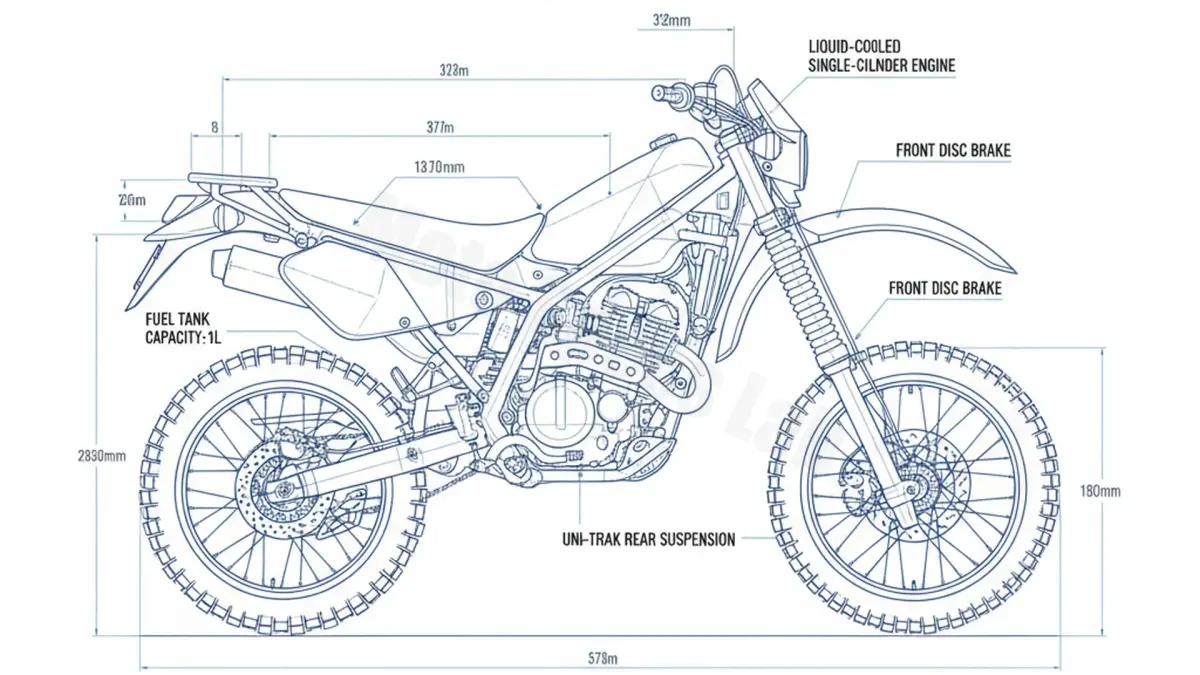
| Quick Specs: Kawasaki KMX 200 (MX200A) | |
|---|---|
| Production Years | 1987 – 1991 |
| Engine Type | Liquid-cooled, 2-stroke Single |
| Transmission Oil | SAE 10W-40 (0.7 L) |
| Spark Plug | NGK BR9ES (0.7–0.8 mm) |
| Tire Size (F/R) | 2.75-21 / 4.10-18 |
| Battery | YB4L-B (12V) |
Historical Engineering Highlight: Unlike many of its contemporaries that were merely bored-out 125cc models, the Kawasaki KMX 200 (MX200A) was engineered to exploit the Kawasaki Integrated Powervalve System (KIPS) to its fullest potential. This system mechanically varied the exhaust port height and volume, allowing the KMX 200 to achieve a torque curve that was uncharacteristically broad for a small-displacement two-stroke, effectively bridging the gap between trail-friendly utility and motocross-grade aggression.
Technical Review: The MX200A Legacy
The KMX 200 remains a cult favorite among enthusiasts for its exceptional power-to-weight ratio. While the 125cc version was the high-volume seller due to licensing restrictions, the 200cc variant offered a significant jump in mid-range punch. Its liquid-cooled engine and Uni-Trak rear suspension provided a level of sophistication that made it a formidable competitor to the Yamaha DT200R.
At the heart of the MX200A is a chassis designed for versatility. The long-travel suspension and 21-inch front wheel are optimized for off-road stability, yet the engine’s tuning allows for comfortable road legal speeds, making it one of the most balanced dual-sports of the late 80s.
Maintenance Guide & Technical Requirements
1. Lubrication System
The transmission requires a high-quality SAE 10W-40 oil meeting API SE, SF, or SG specifications and JASO MA compliance to ensure proper wet-clutch operation. A standard oil change requires 0.7 liters, while a complete engine rebuild (dry) requires 0.8 liters.
2. Ignition & Electrical
To maintain peak combustion efficiency and prevent fouling in the KIPS chamber, use the NGK BR9ES spark plug. The electrode gap must be precisely set between 0.7 and 0.8 mm. The electrical system is supported by a YB4L-B battery, which is standard for lightweight 2-stroke machines of this era.
3. Chassis & Tires
For optimal handling on mixed terrain, the KMX 200 utilizes a 2.75-21 45P front tire and a 4.10-18 59P rear tire. For standard dual-purpose use, the recommended pressure is 1.5 bar (21 psi) for both the front and rear. Lowering the pressure slightly for pure off-road use is common, but requires rim locks to prevent tire slippage.
Pro-Tip for Owners
The KIPS system is the soul of this machine. If you notice a flat spot in the power delivery or a lack of top-end “hit,” it is likely that carbon deposits have fouled the powervalve mechanism. Regular cleaning of the KIPS assembly is mandatory to maintain the MX200A’s legendary performance profile.