| Quick Specs & Maintenance Data | |
|---|---|
| Production Years | 2008–2012 |
| Engine Type | 249cc Parallel-Twin, Liquid-Cooled |
| Engine Oil | SAE 10W-40 (API SE-SM, JASO MA/MA1/MA2) |
| Oil Capacity | 1.3 L (change) / 1.6 L (filter change) |
| Tires (F/R) | 110/70-17 M/C 54S / 130/70-17 M/C 62S |
| Tire Pressure | F: 2.0 bar (28 psi) / R: 2.25 bar (32 psi) |
| Spark Plug | NGK CR8E or CR8EK (0.7–0.8 mm gap) |
| Battery | YTX9-BS |
The Kawasaki Ninja 250R EX250K represents a masterclass in platform revitalization. While its predecessor remained largely unchanged for two decades, the 2008 redesign utilized over 70% new engine components, specifically engineered to improve mid-range torque and modern emissions compliance. This generation effectively democratized the “supersport” aesthetic, proving that a lightweight displacement machine could command the same presence as its ZX-series siblings.
Technical Engineering Overview
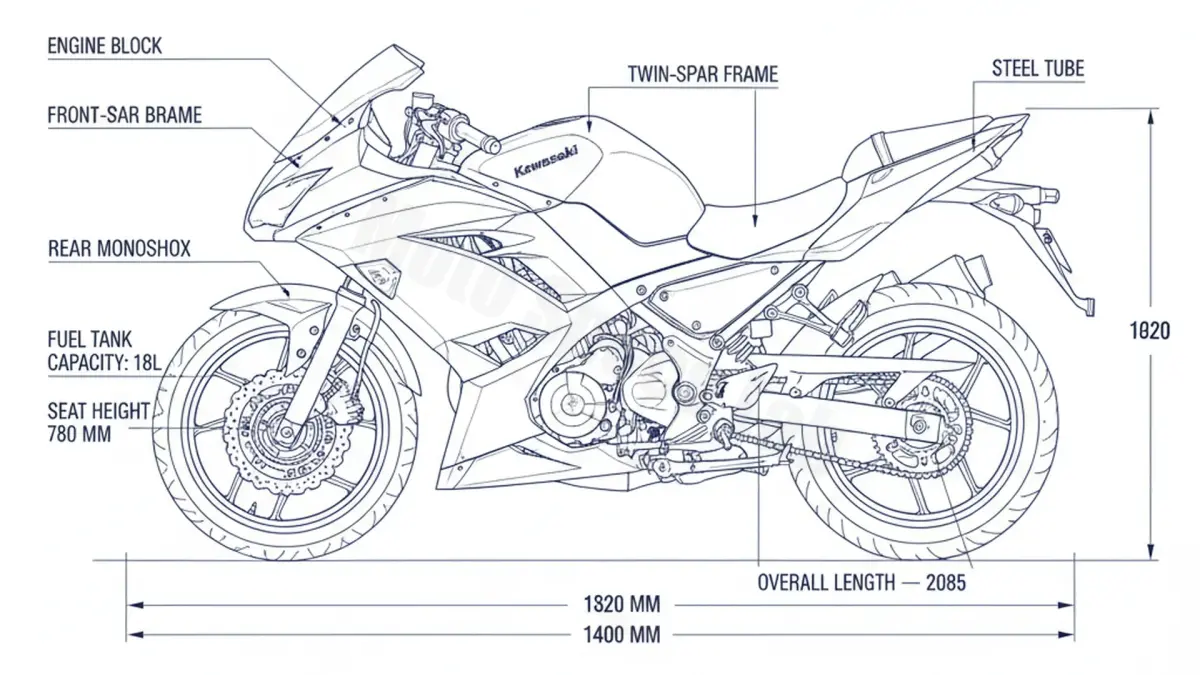
The EX250K is powered by a 249cc DOHC parallel-twin engine. Unlike the previous generation, the 2008-2012 models received revised cylinder heads and a new 2-into-1 exhaust system designed to enhance low-to-mid RPM response. From a metallurgical perspective, the use of sleeveless, chrome-composite plated aluminum cylinders provided superior heat dissipation and reduced weight, contributing to the bike’s exceptional reliability under high-revving conditions.
Maintenance Guide & Fluid Specifications
For the Editor’s choice at MotoSpecsLab, we emphasize strict adherence to the following service intervals to maintain the EX250K’s high-revving integrity.
Lubrication System
The Ninja 250R requires a high-quality SAE 10W-40 oil meeting JASO MA/MA1/MA2 standards. This is critical as the motorcycle utilizes a wet clutch system; non-MA rated oils with friction modifiers can lead to clutch slippage.
- Oil Change Only: 1.3 Liters
- With Filter Replacement: 1.6 Liters
Ignition & Electrical
The EX250K utilizes NGK CR8E or CR8EK spark plugs. For optimal combustion efficiency and throttle response, the electrode gap must be precisely set between 0.7 and 0.8 mm. The electrical system is supported by a YTX9-BS sealed AGM battery, which provides the necessary cold-cranking amps (CCA) for the high-compression twin.
Chassis & Tires
The handling characteristics of the EX250K are highly sensitive to tire pressure. Running the 110/70-17 front and 130/70-17 rear setup at the factory-recommended 28 psi (Front) and 32 psi (Rear) ensures the correct contact patch for both stability and agility. Over-inflating the rear tire often results in a “nervous” feel during lean transitions, a common complaint among new riders.
MotoSpecsLab Verdict
The Kawasaki Ninja 250R (EX250K) remains one of the most mechanically transparent motorcycles for the home mechanic. Its blend of simple architecture and robust engineering makes it an ideal candidate for long-term ownership. By following the precise specifications outlined above, owners can ensure this legendary quarter-liter machine continues to perform at its 11,000 RPM peak.