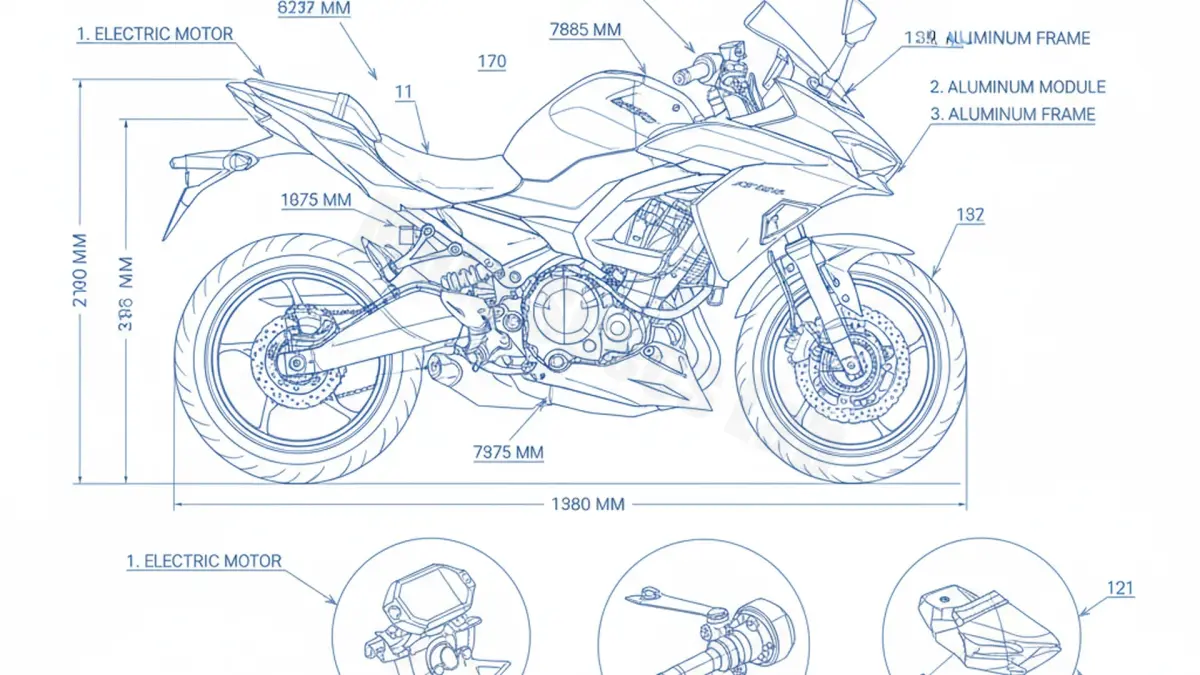
Engineering Highlight: The Kawasaki Ninja e-1 marks a historical milestone as the manufacturer’s first production electric sportbike, uniquely utilizing a dual-removable battery system paired with a ‘e-boost’ function that allows for a 15-second burst of increased power and top speed, a feature derived from Kawasaki’s heavy industries aerospace logic.
| Quick Specs: Kawasaki Ninja e-1 (NX011A) | |
|---|---|
| Production Years | 2024–Present |
| Reduction Gear Oil | SAE 10W-40 (0.16 L) |
| Front Tire | 100/80-17M/C 52S (29 psi) |
| Rear Tire | 130/70-17M/C 62S (33 psi) |
| Main Battery | BX030A (Dual Lithium-Ion) |
| Auxiliary Battery | YTX4L-BS (12V) |
Engineering Overview
The NX011A platform is built upon a trellis frame closely related to the Ninja 400 series, providing a familiar geometry for urban riders. However, the internal architecture is revolutionary for Kawasaki. The powertrain features an interior permanent magnet (IPM) synchronous motor, air-cooled for simplicity and weight reduction. Unlike traditional internal combustion engines, the maintenance focus shifts from thermal cycles to electrical continuity and gear reduction lubrication.
Maintenance Guide: Fluids and Lubrication
While the Ninja e-1 lacks a traditional transmission, it utilizes a reduction gear system to translate motor RPM to the drive sprocket. This system requires high-quality lubricant despite its small capacity.
- Capacity: 0.16 Liters
- Specification: SAE 10W-40. Ensure the oil meets API SG, SH, SJ, SL, or SM standards. Even though there is no wet clutch, Kawasaki specifies JASO MA/MA1/MA2 compatibility to maintain consistency with their global service standards.
The Dual-Battery Ecosystem
The NX011A employs a sophisticated power management system. The BX030A main batteries are removable 50.4V lithium-ion units. For technicians, it is vital to monitor the YTX4L-BS auxiliary battery. This 12V lead-acid unit powers the ECU, instrument cluster, and lighting; if this battery fails, the high-voltage system cannot be engaged, effectively bricking the vehicle despite fully charged main packs.
Chassis and Contact Patch
The Ninja e-1 maintains a lightweight profile, requiring specific tire pressures to optimize rolling resistance and range. The factory recommends 2.00 bar (29 psi) in the front and 2.25 bar (33 psi) in the rear. Given the instantaneous torque of the electric motor, tire wear should be inspected every 1,000 km to ensure the 100/80-17 and 130/70-17 profiles maintain their integrity.
MotoSpecsLab Editorial Verdict
The Ninja e-1 (NX011A) is a masterclass in transitional engineering. By utilizing the chassis of a proven sportbike and integrating a modular battery system, Kawasaki has lowered the barrier to entry for electric adoption. While the 0.16L oil change is a minor task, it remains the only ‘mechanical’ fluid service required, making this one of the lowest-maintenance platforms in the Kawasaki lineup.