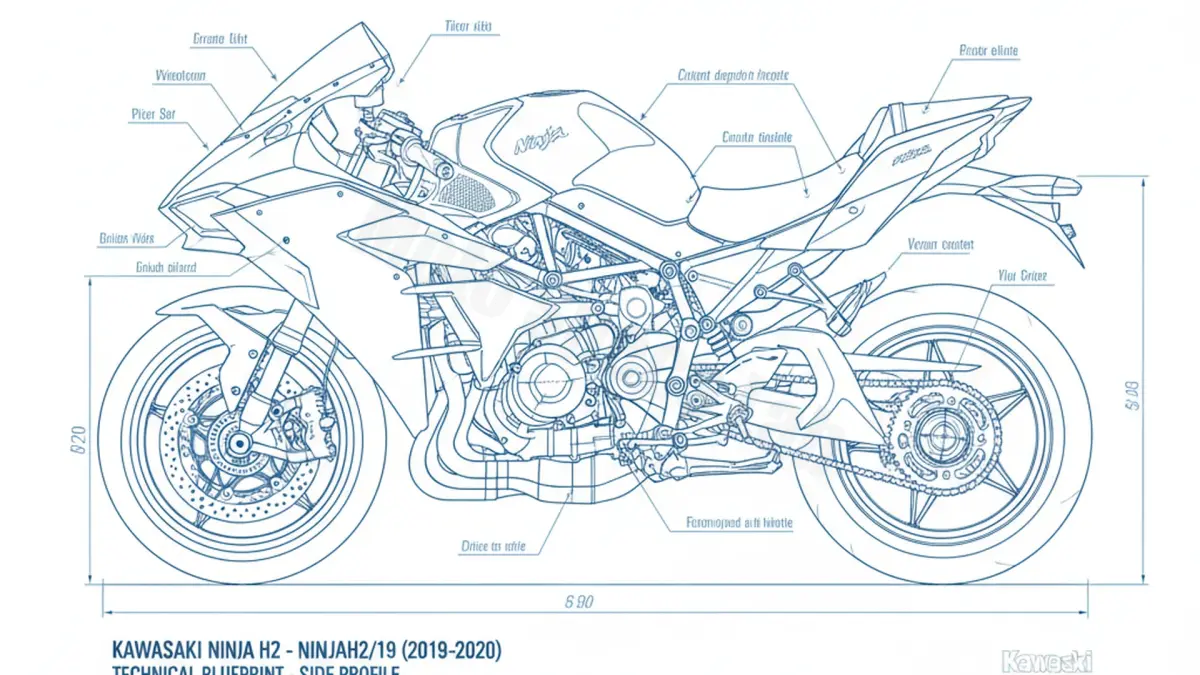
| Component | Specification |
|---|---|
| Engine Type | 998cc Supercharged Inline-4 |
| Engine Oil | SAE 10W-40 (API SG-SM, JASO MA/MA2) |
| Oil Capacity | 4.0 Liters |
| Front Tire | 120/70 ZR 17 |
| Rear Tire | 200/55 ZR 17 |
| Tire Pressure (F/R) | 36 psi / 42 psi (2.5 / 2.9 bar) |
| Battery Type | YTZ10S |
| Spark Plug | NGK SILMAR9B9 |
The Kawasaki Ninja H2 is not merely a motorcycle; it is a collaborative masterpiece of engineering. A unique historical highlight of the NINJAH2/19 model is its pedigree: it is the only mass-produced street-legal motorcycle to feature a centrifugal supercharger developed entirely in-house by Kawasaki Heavy Industries’ Aerospace and Gas Turbine divisions. Unlike traditional turbochargers, this system utilizes a planetary gear drive to spin the impeller up to 130,000 RPM, delivering linear power that defies conventional internal combustion limits.
Technical Engineering Analysis
The 2019 update (NINJAH2/19) marked a significant leap in performance, boosting output to 231 PS (without Ram Air). This was achieved by integrating the high-efficiency intake system from the H2 SX tourer, including a redesigned air filter, intake chamber, and spark plugs. The engine management system is highly sensitive; therefore, maintaining strict adherence to fluid specifications is critical for the longevity of the supercharger bearings.
Maintenance Guide & Fluid Specifications
Lubrication System
For the NINJAH2/19, oil is more than a lubricant; it is a coolant for the supercharger. Use 4.0 liters of SAE 10W-40. It is imperative to use oil meeting JASO MA2 standards to ensure the slipper clutch and the high-speed gear train of the supercharger receive adequate shear protection. We recommend a full synthetic ester-based oil for maximum thermal stability.
Chassis and Contact Patch
Handling such immense torque requires precise tire management. The factory recommends 2.5 bar (36 psi) in the front and 2.9 bar (42 psi) in the rear. Given the 200/55 ZR 17 rear profile, even minor pressure drops can lead to carcass deformation under hard acceleration, negatively impacting the KTRC (Kawasaki Traction Control) sensor accuracy.
Electrical and Ignition
The Ninja H2 utilizes the YTZ10S battery. Due to the high compression ratio and the drag of the supercharger drive, a healthy battery is vital for cold starts. For ignition, the NGK SILMAR9B9 iridium plugs are specifically gapped for the high-pressure environment of the combustion chamber; substitution with standard plugs can lead to pre-ignition under boost.
FAQ
Q: How often should I check the supercharger?
A: While the supercharger is designed to be maintenance-free for the life of the engine, the oil must be kept clean. Inspect the intake for oil residue every 12,000 km.
Q: Can I use 10W-50 oil?
A: Kawasaki specifies 10W-40. While 10W-50 may offer more protection in extreme heat, it can affect the flow rate to the supercharger’s oil-fed bearings during warm-up.