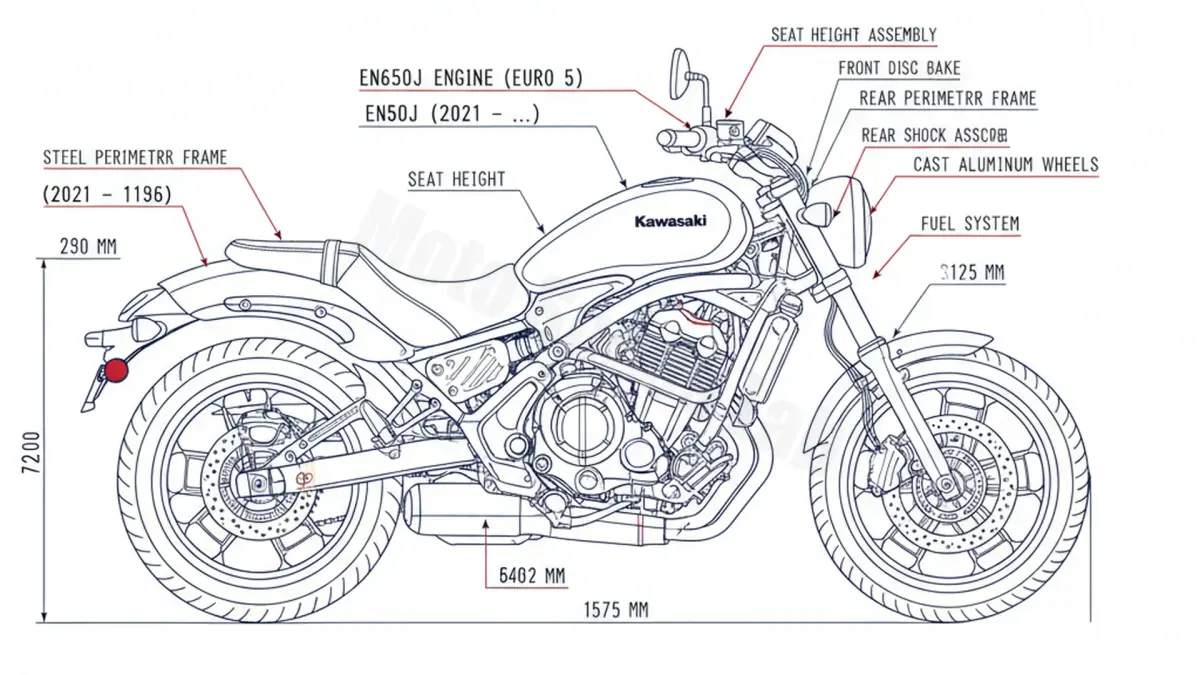
| Component | Specification |
|---|---|
| Engine Model | EN650J (Euro 5) |
| Engine Oil | SAE 10W-40 (JASO MA/MA2) | 1.8L (Filter Change) |
| Tires (F/R) | 120/70 R18 / 160/60 R17 |
| Tire Pressure | F: 32 psi / R: 36 psi |
| Spark Plug | NGK CR9EIA-9 (Gap: 0.8–0.9 mm) |
| Battery | YTX9-BS |
Unlike traditional cruisers that rely on air-cooled V-twins, the Kawasaki Vulcan S (EN650J) is built upon an engineering paradox: it utilizes the high-revving 649cc parallel-twin engine derived directly from the Ninja 650 sportbike. This architectural choice allows the Vulcan S to offer a unique performance profile in the mid-weight cruiser segment, prioritizing linear power delivery and mechanical reliability over traditional aesthetic tropes.
Technical Review: The Euro 5 Evolution
The transition to the EN650J designation marks the Vulcan S’s compliance with Euro 5 emissions standards. Kawasaki engineers achieved this without sacrificing the bike’s signature 61 Nm of torque by refining the exhaust system and optimizing the ECU mapping. The standout feature remains the Ergo-Fit system, which allows for adjustable footpegs, seat height, and handlebar reach—a modularity rarely seen in this class.
The chassis remains a high-tensile steel trellis frame, which provides the necessary rigidity to handle the 18-inch front wheel’s gyroscopic forces while maintaining a low center of gravity. This makes the EN650J one of the most accessible yet dynamically capable cruisers for both novice and experienced riders.
Maintenance Guide & Specifications
Lubrication System
For the Euro 5 EN650J, maintaining oil viscosity is critical for the integrated transmission and wet clutch. Use a high-quality SAE 10W-40 oil meeting JASO MA2 standards to prevent clutch slippage.
- Filter Change: 1.8 Liters
- No Filter Change: 1.6 Liters
- Dry Engine: 2.3 Liters
Ignition and Electrical
The Vulcan S utilizes an Iridium-tipped spark plug, the NGK CR9EIA-9. These plugs are designed for longevity, but the gap must be precisely maintained between 0.8–0.9 mm to ensure efficient combustion under Euro 5 lean-burn conditions. The electrical system is supported by a YTX9-BS battery, which requires periodic voltage checks if the bike is stored for long durations.
Running Gear: Tires and Pressure
To maintain the Vulcan S’s neutral handling characteristics, tire pressure must be checked weekly. The factory-recommended pressures are 2.25 bar (32 psi) for the front 120/70 R18 and 2.50 bar (36 psi) for the rear 160/60 R17. Deviating from these pressures can lead to “cupping” on the front tire or sluggish turn-in response.
Frequently Asked Questions (FAQ)
Q: Can I use synthetic oil in the EN650J?
A: Yes, as long as it meets API SG-SM and JASO MA/MA2 specifications. Synthetic 10W-40 is excellent for heat dissipation.
Q: How often should I check the spark plug gap?
A: It is recommended to inspect the plugs every 12,000 km (7,500 miles), though Iridium plugs often last significantly longer.