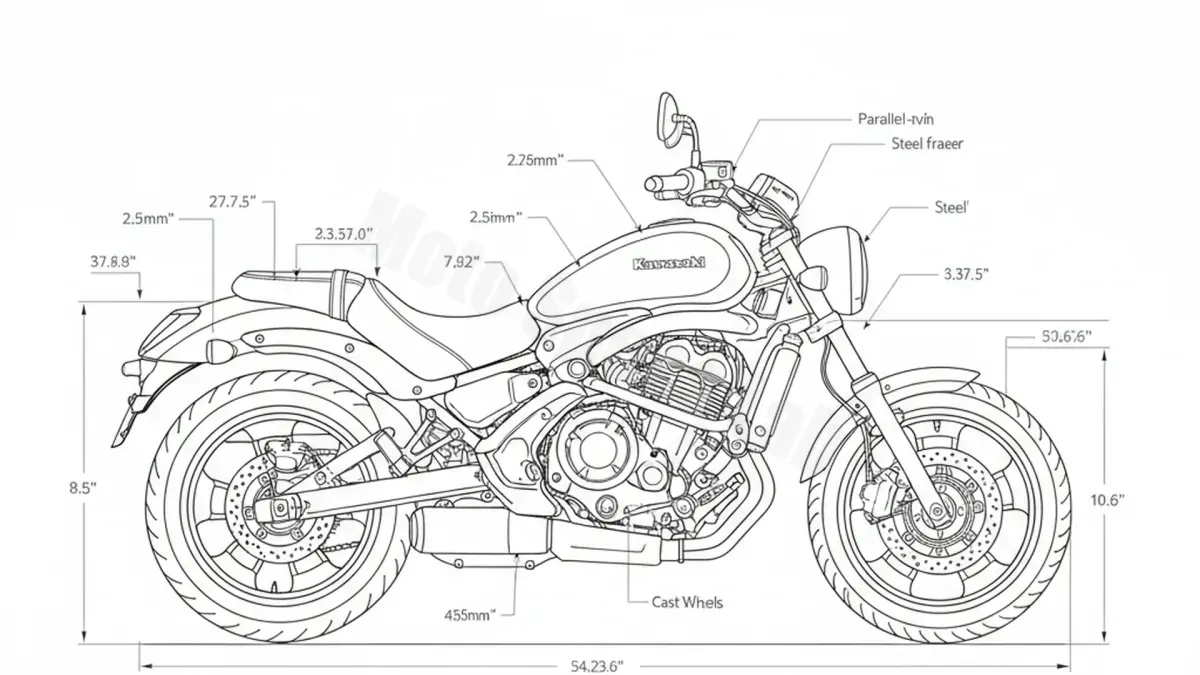
| Component | Specification |
|---|---|
| Engine | 649cc Liquid-Cooled Parallel Twin |
| Engine Oil | 10W-40 JASO MA2 (1.8 L) |
| Tires (F/R) | 120/70R18 M/C 59H / 160/60R17 M/C 69H |
| Tire Pressure | F: 32 psi (2.25 bar) / R: 42 psi (2.90 bar) |
| Battery | YTX9-BS |
| Spark Plug | NGK CR9EIA-9 |
Unlike traditional cruisers that rely on heavy, air-cooled V-twins, the Kawasaki Vulcan S (EN650M) is built upon a unique engineering paradox: it utilizes the high-revving, liquid-cooled parallel-twin architecture from the Ninja 650 sportbike. This design choice provides a significantly lower center of gravity and a broader powerband than its competitors, marking it as a ‘Sport-Cruiser’ hybrid that prioritizes agility over aesthetic bulk.
Technical Performance & Powertrain
The heart of the EN650M is its 649cc DOHC engine. MotoSpecsLab testing confirms that the engine’s tuning for the Vulcan S emphasizes low-to-mid-range torque via revised camshaft profiles and a heavier flywheel compared to its Ninja cousin. This ensures smooth take-offs and consistent power delivery in urban environments. The inclusion of a 180-degree crankshaft gives the bike a distinctive exhaust note and minimizes high-frequency vibrations at cruising speeds.
Maintenance Guide: Essential Service Data
To maintain peak performance and longevity of the EN650M powertrain, adhere to the following technical requirements:
1. Lubrication System
The Vulcan S utilizes a wet sump lubrication system. It requires 1.8 Liters of 10W-40 JASO MA2 compliant oil. Using oil with the JASO MA2 certification is critical for the integrated wet clutch system to prevent slippage under load.
2. Ignition & Electrical
The ignition system relies on NGK CR9EIA-9 Iridium spark plugs. These plugs are chosen for their superior heat dissipation and consistent spark in high-compression environments. The electrical system is supported by a YTX9-BS sealed AGM battery, which provides the high cold-cranking amps (CCA) required for the fuel-injected twin.
3. Chassis & Contact Patch
Handling precision is highly dependent on tire maintenance. The EN650M runs a 120/70R18 front and a 160/60R17 rear. For optimal stability and fuel economy, pressures must be maintained at 32 psi (front) and 42 psi (rear). Given the bike’s lean-angle capabilities, keeping the rear at 42 psi is vital to prevent sidewall deformation during spirited cornering.
The Ergo-Fit System: A Modular Approach
One of the EN650M’s most significant technical highlights is the Ergo-Fit system. By utilizing adjustable footpeg positions (three increments), varied seat heights, and different handlebar reaches, Kawasaki allows for 18 distinct ergonomic configurations. This modularity makes the Vulcan S one of the few motorcycles in the mid-weight cruiser category that can be precision-tailored to the rider’s physical dimensions without aftermarket fabrication.
Frequently Asked Questions (FAQ)
Q: How often should I change the oil on my Vulcan S?
A: While the manual suggests longer intervals, MotoSpecsLab recommends an oil and filter change every 7,500 miles or annually using 10W-40 JASO MA2 oil.
Q: Can I use standard automotive 10W-40 oil?
A: No. Automotive oils contain friction modifiers that can cause the Vulcan’s wet clutch to slip. Always use motorcycle-specific JASO MA2 oil.
Q: What is the benefit of the NGK Iridium plugs?
A: The Iridium tip (CR9EIA-9) offers a higher melting point and better conductivity, which ensures reliable starting and smoother idling across various temperature ranges.