| Model Years | 1977–1979 |
|---|---|
| Engine Oil | SAE 10W-40 (API SE/SF) (3.0 L) |
| Tire Size (F/R) | F: 3.25-19 4PR / R: 4.00-18 4PR |
| Tire Pressure | F: 1.8 bar (26 psi) / R: 2.0 bar (28 psi) |
| Battery Type | YB10L-A2 |
| Spark Plug | NGK B7ES (Gap: 0.7–0.8 mm) |
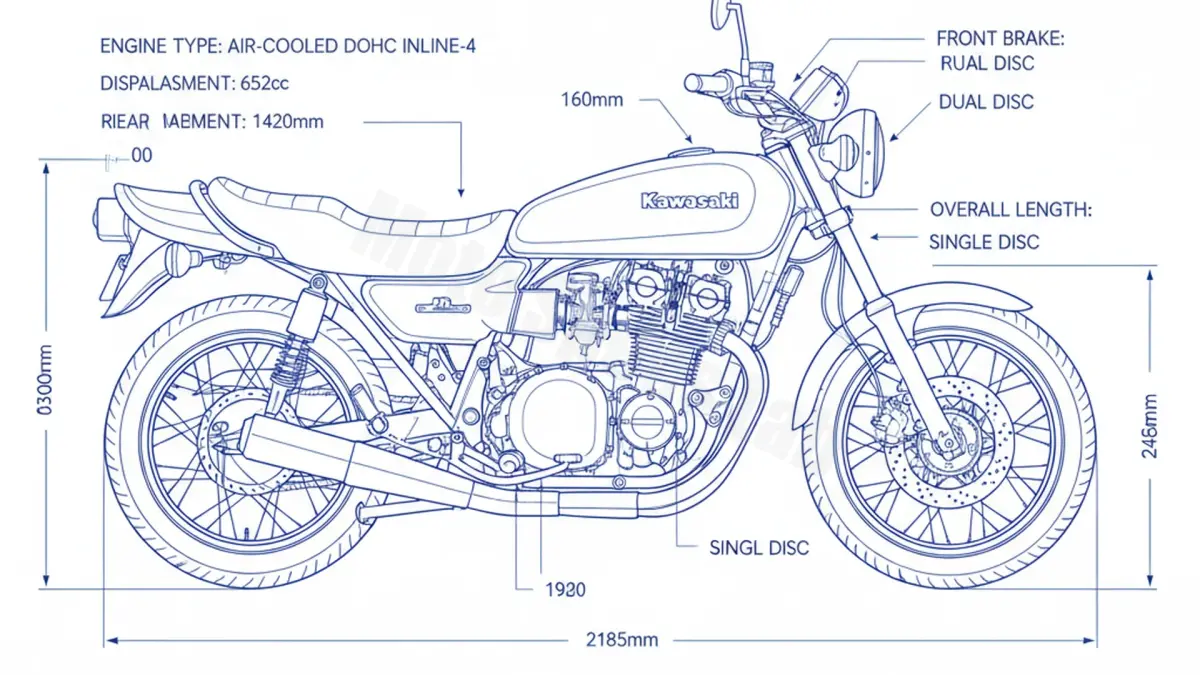
While the legendary Z1 captured the headlines for raw power, the Kawasaki Z 650 (KZ650B/C) is often cited by engineers as Gyoichi ‘Ben’ Inamura’s most balanced masterpiece. Unlike its larger siblings that relied on roller-bearing crankshafts, the Z 650 was the first Kawasaki multi-cylinder to utilize a plain-bearing crankshaft and a Morse-type Hy-Vo primary chain. This engineering shift allowed for a narrower engine profile and significantly quieter operation, effectively setting the blueprint for modern Japanese inline-four architecture.
Technical Review: Performance Meets Agility
Launched in 1977, the Z 650 occupied a unique ‘middleweight’ niche that offered the performance of a 750cc machine with the handling characteristics of a 500cc bike. The DOHC 652cc engine delivered a smooth 64 hp, which, when paired with its relatively light dry weight, produced a power-to-weight ratio that challenged the industry giants of the late 70s.
The KZ650B featured traditional wire-spoke wheels and a single front disc brake, while the KZ650C (Custom) introduced cast alloy wheels and a triple-disc braking system, enhancing both heat dissipation and structural rigidity during aggressive cornering.
Maintenance Guide & Technical Requirements
1. Lubrication System
The plain-bearing design of the KZ650 makes oil quality and pressure critical. Use a high-quality SAE 10W-40 meeting API SE or SF standards. The total capacity is 3.0 Liters. Given the vintage nature of the seals, ensuring the oil contains sufficient ZDDP (Zinc) is recommended for camshaft longevity.
2. Ignition & Electrical
Reliable combustion is managed by NGK B7ES spark plugs. For optimal throttle response and fuel efficiency, the gap must be precisely set between 0.7–0.8 mm. The electrical system is supported by a YB10L-A2 lead-acid battery; owners should regularly check the electrolyte levels due to the charging system’s output profile.
3. Chassis & Tires
To maintain the ‘flickable’ nature of the Z 650, tire pressures must be strictly adhered to. The factory recommends 1.8 bar (26 psi) for the front 3.25-19 tire and 2.0 bar (28 psi) for the rear 4.00-18 tire. Under-inflation leads to heavy steering and accelerated wear on the vintage-profile treads.
The MotoSpecsLab Verdict
The Kawasaki Z 650 (KZ650B/C) remains a high-water mark for 1970s engineering. It is a robust, over-engineered machine that rewards precise maintenance with modern-day reliability. For the collector or the vintage rider, it offers a more sophisticated riding experience than the larger, more cumbersome superbikes of its era.