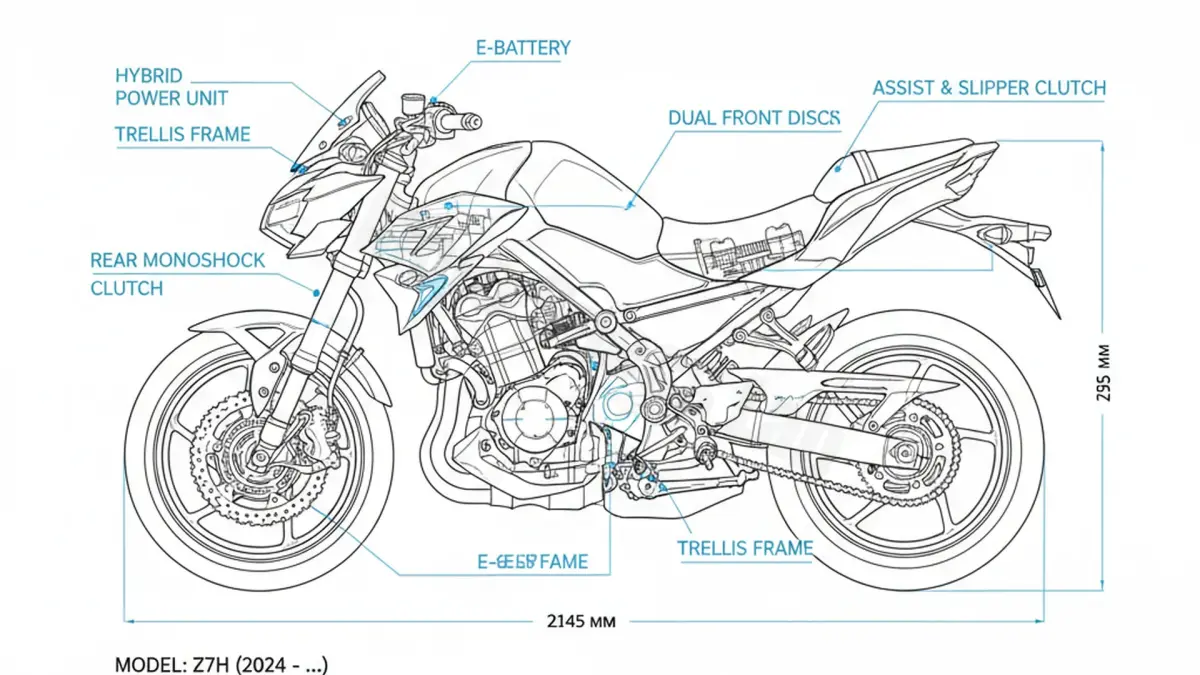
| Component | Specification |
|---|---|
| Engine | 451cc Parallel-Twin + 9kW Traction Motor |
| Oil Type | SAE 10W-40 JASO MA2 (API SG to SM) |
| Oil Capacity | 2.2 L (Filter Change) / 2.6 L (Dry) |
| Front Tire | 120/70 ZR 17 M/C (58W) @ 33 psi |
| Rear Tire | 160/60 ZR 17 M/C (69W) @ 36 psi |
| Spark Plug | NGK LMAR9G (0.7–0.8 mm gap) |
| Battery | FTZ10S (Low Voltage System) |
Engineering Highlight: The Kawasaki Z 7 Hybrid (Z7H) represents a historic milestone in motorcycling as the world’s first mass-produced “Strong Hybrid” (HEV). Unlike mild hybrids, the Z7H utilizes a liquid-cooled 451cc internal combustion engine (ICE) paired with a 9kW traction motor and a 48V lithium-ion battery pack, allowing for pure electric operation at low speeds and a combined “e-boost” function that provides liter-bike acceleration from a mid-weight chassis.
Technical Powertrain Analysis
At the heart of the Z7H is the Euro 5+ compliant parallel-twin engine, derived from the Ninja 500 platform but heavily modified to integrate with the electric traction motor. The transmission is an automated manual (AMT) that utilizes an electronic actuator for gear shifts, eliminating the clutch lever. This system manages the hand-off between the ICE and the electric motor seamlessly, particularly in ‘Eco-Hybrid’ mode.
Maintenance Guidelines
Maintaining the Z 7 Hybrid requires adherence to both traditional ICE protocols and specific hybrid-system inspections. The 10W-40 JASO MA2 oil is critical for the integrated transmission and wet clutch system. Given the high-revving nature of the 451cc engine and the added torque from the electric motor, chain tension and sprocket wear should be monitored every 1,000 km.
Lubrication & Filtration
The Z7H requires 2.2 liters of oil during a standard filter change. We recommend a high-performance synthetic oil meeting API SM standards to handle the frequent stop-start cycles inherent in hybrid operation. The dry capacity is 2.6 liters, which is only relevant after a complete engine teardown.
Electrical & Ignition
The ignition system uses NGK LMAR9G plugs. Due to the high-compression nature of the engine, the gap must be precisely set between 0.7 and 0.8 mm. While the traction motor is largely maintenance-free, the FTZ10S 12V battery must be kept at peak charge to manage the sophisticated ECU and actuator systems that initiate the hybrid transitions.
Chassis & Road Contact
The Z7H carries more weight than a standard Z500 due to the 48V battery located under the seat. Consequently, tire pressure is vital for handling geometry. Front pressure should be maintained at 2.25 bar (33 psi) and the rear at 2.50 bar (36 psi). The 160-section rear tire is specifically chosen to balance the instant torque of the e-boost function with flickable handling.
Conclusion
The Kawasaki Z 7 Hybrid is a masterclass in packaging. By combining a fuel-efficient twin with a high-torque electric motor, Kawasaki has created a machine that offers the fuel economy of a 250cc bike with the performance of a 700cc naked. For the technician, it requires a dual-minded approach: respecting the traditional mechanical requirements while ensuring the electronic infrastructure remains pristine.