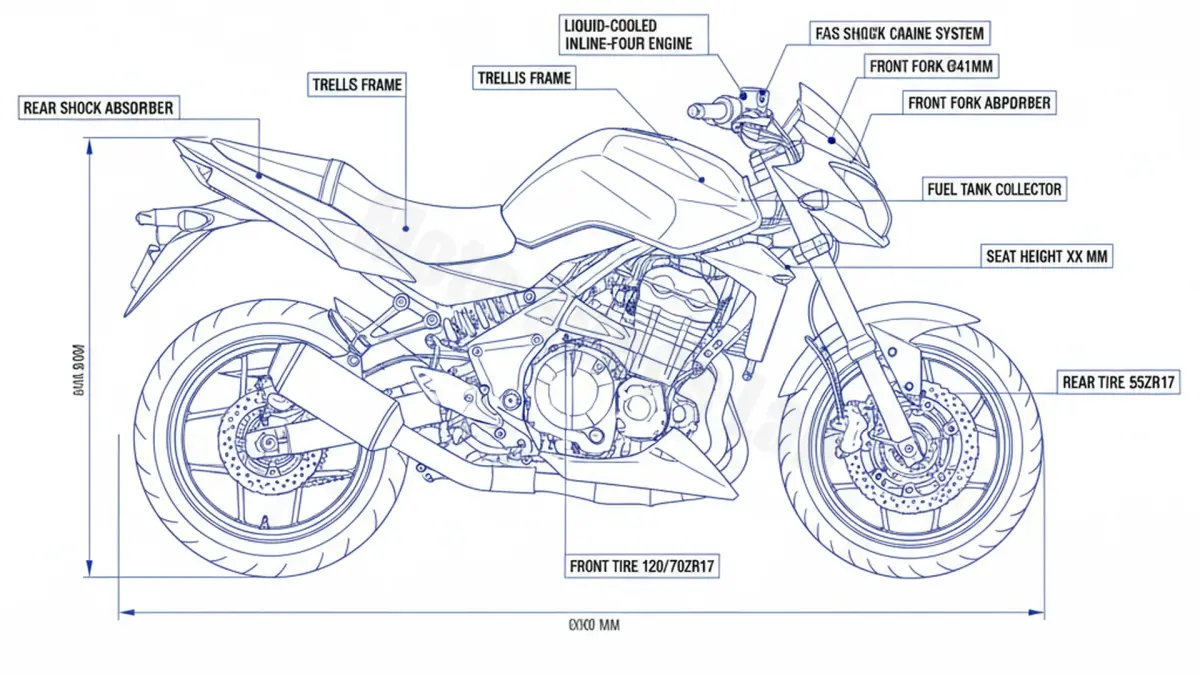
| Feature | Specification |
|---|---|
| Production Years | 2007–2012 |
| Engine Oil | SAE 10W-40 (2.9 L with filter) |
| Spark Plug | NGK CR9EK (0.7–0.8 mm gap) |
| Tires (F/R) | 120/70 ZR 17 / 180/55 ZR 17 |
| Tire Pressure (F/R) | 2.5 bar / 2.9 bar |
| Battery | YTX9-BS |
Engineering Heritage: The Mid-Weight Disruptor
While most manufacturers in the mid-2000s were locked in a 600cc supersport arms race, Kawasaki took a different path with the ZR750L. A unique engineering highlight of this generation was the decision to sleeve down the Z1000 engine architecture rather than boring out a 600. This resulted in a heavier-duty crankcase and a stroke profile that prioritized mid-range torque over peaky high-RPM performance, effectively rendering the Z 750 the ‘thinking rider’s’ streetfighter of its era.
Technical Specifications Analysis
The 2007–2012 iteration (ZR750L for the standard model and ZR750M for the ABS version) represented a significant refinement in fuel injection mapping and chassis rigidity. The liquid-cooled, 16-valve DOHC inline-four engine is renowned for its durability, provided the maintenance intervals are strictly observed.
Lubrication and Cooling
For optimal shear stability in the high-revving inline-four, MotoSpecsLab recommends a high-quality synthetic 10W-40 meeting JASO MA2 standards. The system requires 2.9 liters during a standard oil and filter change. Neglecting oil quality in these units can lead to premature wear on the cam lobes, a known sensitivity in high-mileage Z-series engines.
Ignition and Electrical
The Z 750 utilizes NGK CR9EK plugs. Achieving the precise gap of 0.7–0.8 mm is critical for maintaining the smooth idle characteristics this model is known for. The electrical system is supported by a YTX9-BS battery; given the high compression ratio, ensuring a healthy cold cranking amperage (CCA) is vital for reliable starting in colder climates.
Chassis and Handling Optimization
The ZR750L features a revised frame compared to its predecessor, offering better feedback through the 41mm inverted forks. To maintain the intended geometry, tire pressures must be kept at 2.5 bar (front) and 2.9 bar (rear). Deviating from these pressures significantly impacts the turn-in speed and can cause the bike to ‘stand up’ mid-corner under braking.
Maintenance FAQ
- What oil should I use? SAE 10W-40 (API SE-SM, JASO MA/MA1/MA2).
- What is the spark plug gap? 0.7–0.8 mm using NGK CR9EK.
- Is the ABS model different mechanically? Only in the braking system and weight distribution; the engine and drivetrain specs remain identical to the ZR750L.