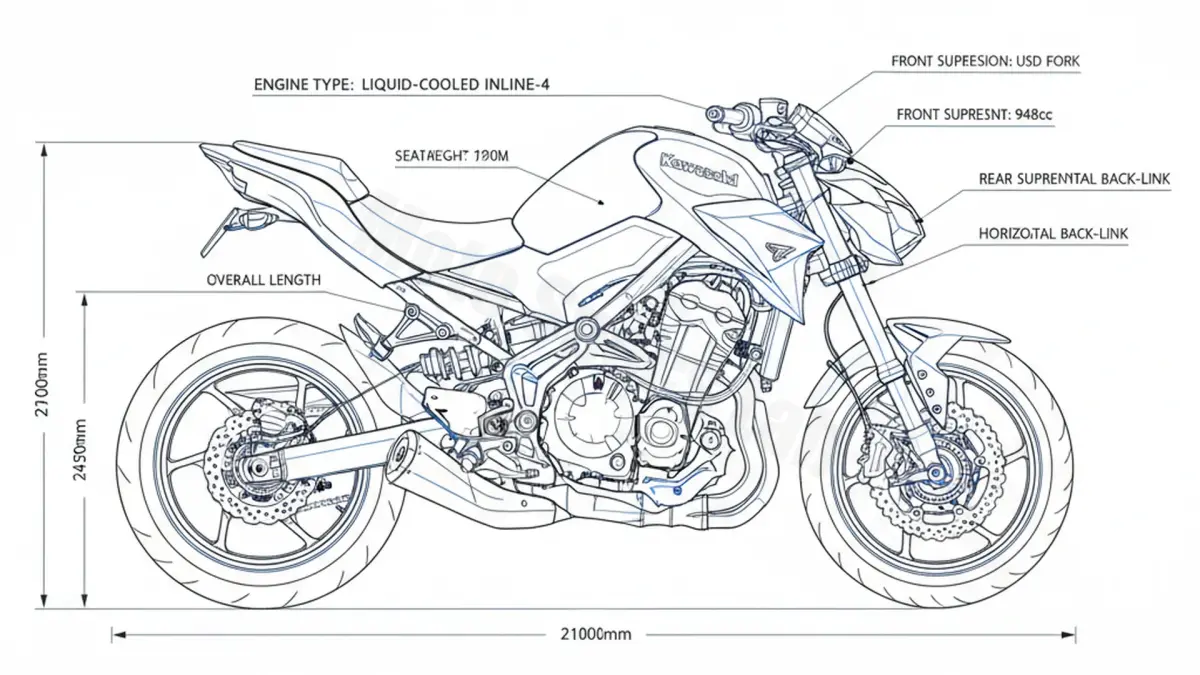
| Attribute | Specification |
|---|---|
| Engine Variant | ZR900H (A2-Compliant) |
| Production Years | 2018 – 2019 |
| Engine Oil | SAE 10W-40 JASO MA2 (3.2 L) |
| Front Tire | 120/70 ZR17 M/C (58W) |
| Rear Tire | 180/55 ZR17 M/C (73W) |
| Tire Pressure (F/R) | 2.5 bar / 2.9 bar |
| Battery Type | YTX9-BS |
| Spark Plug | NGK CR9EIA-9 |
A unique engineering highlight of the Kawasaki Z 900 (ZR900H) is its specific engine casting and ECU mapping. Unlike many manufacturers who simply restrict a high-output engine via software, Kawasaki developed the ‘H’ variant with a maximum ceiling of 70kW (approx. 95PS). This was a strategic engineering choice to ensure the bike remained legally eligible for the 35kW A2 restriction in Europe, which mandates that the restricted power cannot be less than half of the original output.
Technical Performance & Handling
The ZR900H utilizes the same high-tensile steel trellis frame as its unrestricted sibling, weighing in at only 13.5 kg. This provides the ‘Sugomi’ inspired naked bike with exceptional torsional rigidity. Despite the power cap for A2 compliance, the 948cc inline-four engine maintains a linear torque curve, making it one of the most tractable and user-friendly middleweight nakeds in the 2018-2019 market.
Maintenance Guide & Fluid Specifications
To maintain the longevity of the ZR900H engine, MotoSpecsLab recommends the following intervals and specifications:
- Lubrication: The system requires 3.2 liters of SAE 10W-40 oil meeting JASO MA2 standards. This ensures the wet clutch operates without slipping while providing optimal protection for the high-revving valvetrain.
- Ignition: The NGK CR9EIA-9 Iridium spark plugs are essential for maintaining the precise combustion required by the Euro 4 emission standards of the 2018-2019 models.
- Electrical: The YTX9-BS battery provides the necessary cold cranking amps (CCA) to power the digital instrumentation and ABS modules reliably.
Chassis and Safety
The ZR900H is equipped with 41mm inverted forks with adjustable rebound damping and spring preload. Maintaining correct tire pressures is critical for the bike’s tip-in characteristics. We recommend a strict 2.5 bar (front) and 2.9 bar (rear) to prevent uneven wear on the 180-section rear tire and to ensure the ABS sensors receive accurate rotational data during heavy braking maneuvers.
FAQ
Can I upgrade the ZR900H to the full 125PS?
No. Due to the hardware and homologation differences of the ZR900H variant, it is capped at a maximum of 70kW (95PS) when de-restricted, unlike the standard ZR900B/D models.
How often should I change the oil?
Kawasaki recommends every 12,000 km or annually, though for performance riding, MotoSpecsLab suggests a 6,000 km interval.