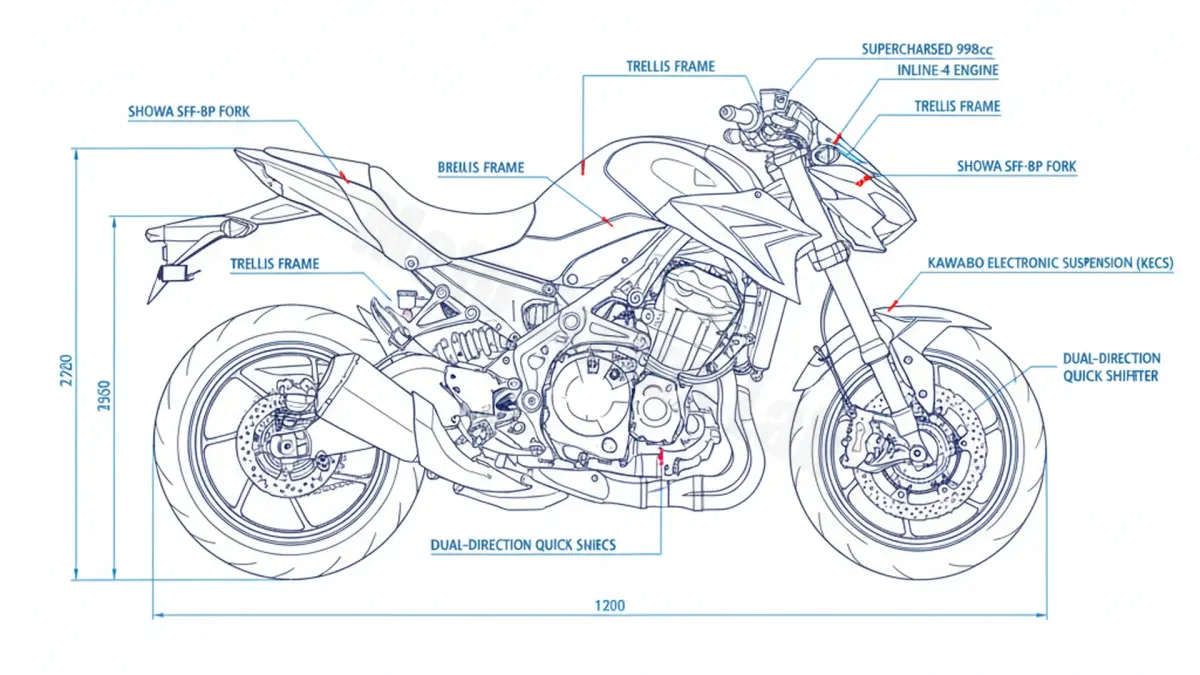
| Component | Specification |
|---|---|
| Engine Type | 998cc Supercharged Inline-4 (EURO 5) |
| Engine Oil | SAE 10W-40 (JASO MA/2) – 3.8 Liters |
| Spark Plugs | NGK SILMAR9B9 (Gap: 0.8–0.9 mm) |
| Tire Size | F: 120/70 ZR 17 | R: 190/55 ZR 17 |
| Tire Pressure | F: 2.5 bar (36 psi) | R: 2.9 bar (42 psi) |
| Battery | YTZ14S (12V 11.2Ah) |
Engineering Highlight: The Kawasaki Z H2 stands as a pinnacle of internal combustion engineering, being the only mass-produced naked motorcycle to utilize a centrifugal supercharger developed entirely in-house by Kawasaki’s Aerospace Division. Unlike traditional turbochargers, this system is driven by a planetary gear train from the crankshaft, allowing for linear power delivery and extreme thermal efficiency without the need for a heavy intercooler.
Technical Analysis: The ZRT00K/P Evolution
The transition to EURO 5 compliance (ZRT00K/P series) required Kawasaki to refine the exhaust system and ECU mapping without sacrificing the 200PS peak output. The SE (Special Edition) variant further distinguishes itself with the integration of Kawasaki Electronic Control Suspension (KECS) featuring Showa Skyhook EERA technology, providing real-time damping adjustments that counteract pitch during aggressive braking and acceleration.
Maintenance Deep-Dive
Maintaining a supercharged engine requires strict adherence to fluid specifications. The 3.8-liter oil capacity is critical; the high-speed impeller bearings rely on consistent oil pressure and thermal stability. We recommend a high-performance synthetic 10W-40 that meets JASO MA2 standards to protect the assist-and-slipper clutch under the massive torque loads (137 Nm).
For ignition, the NGK SILMAR9B9 iridium plugs are mandatory. These long-reach plugs are designed to withstand the increased cylinder pressures of forced induction. Ensure the gap is precisely 0.8–0.9 mm to prevent misfires under boost.
Chassis and Contact Patch
The Z H2 utilizes a trellis frame designed for high-speed stability. Given the bike’s 239kg (240kg for SE) curb weight and immense torque, tire health is paramount. The factory-recommended 2.5 bar front and 2.9 bar rear pressures are optimized for carcass stability. Deviating from these pressures can lead to premature wear or instability during the ‘boost’ phase of acceleration.
Editorial Review: The MotoSpecsLab Verdict
The Kawasaki Z H2/SE is not merely a motorcycle; it is a showcase of industrial might. While the aesthetic is polarizing (Sugomi design language), the mechanical execution is flawless. The SE version is the definitive choice for riders seeking a more composed ride, as the electronic suspension tames the chassis’s tendency to squat under the supercharger’s relentless drive. It remains the undisputed king of the ‘Hyper-Naked’ category for those who value engineering complexity and raw performance.
Frequently Asked Questions
Q: How often should the supercharger be serviced?
A: The supercharger itself does not have a separate service interval but relies on the engine’s oiling system. Regular oil changes are the most vital maintenance for supercharger longevity.
Q: Can I use 10W-50 oil?
A: While 10W-40 is the standard, 10W-50 may be used in extremely hot climates, provided it meets the JASO MA2 specification to ensure clutch compatibility.