| Production Years | 1994–1997 |
|---|---|
| Engine Oil | 3.5 L – SAE 10W-40 (JASO MA/MA2) |
| Tires (F/R) | 120/70 ZR17 / 180/55 ZR17 |
| Tire Pressure | F: 2.5 bar / R: 2.9 bar |
| Spark Plug | NGK CR9EK |
| Battery | YTX12-BS |
While the early 1990s were dominated by the lightweight Honda Fireblade, Kawasaki took a different engineering path with the ZX900B. A unique historical highlight of this model is its Ram-Air induction system, adapted directly from the ZXR750 racing technology. This system utilized the forward motion of the bike to pressurize the airbox, effectively increasing volumetric efficiency at high speeds—a feature that would become a staple of the Ninja legacy.
Engineering Heritage & Performance
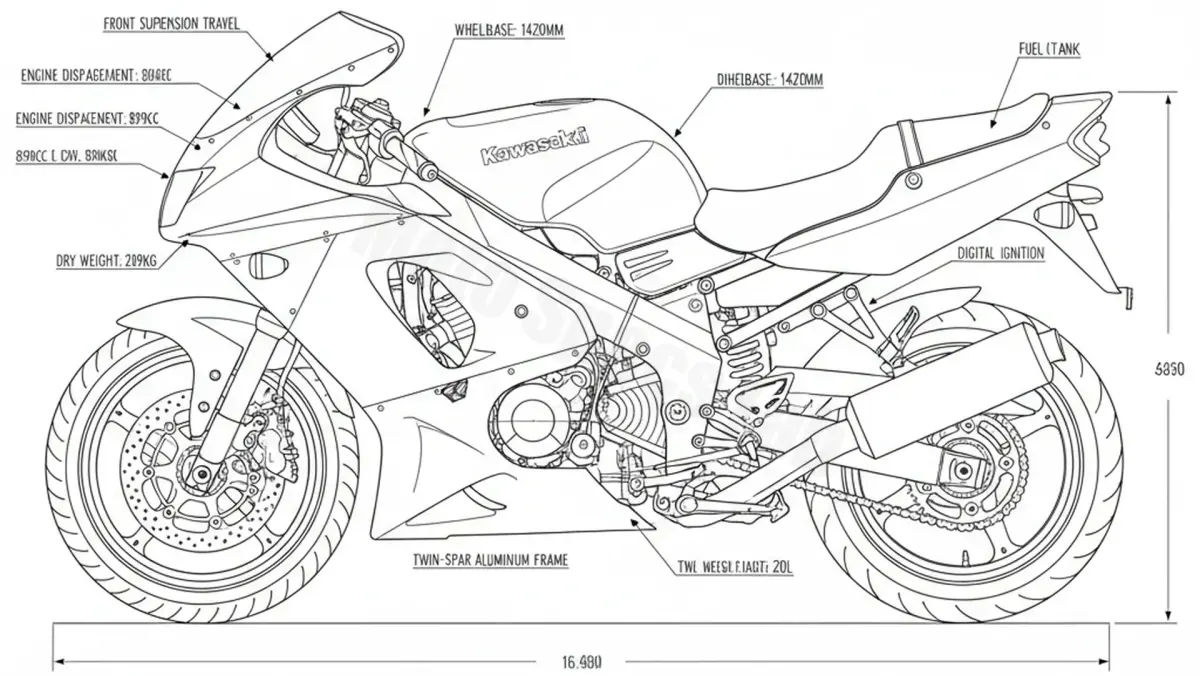
The ZX900B was Kawasaki’s heavy-hitter in the liter-class segment, though it displaced 899cc. Unlike its rivals, it maintained a sturdier steel frame (initially) and a more substantial physical presence, making it an exceptional high-speed tourer as much as a superbike. The liquid-cooled, 16-valve inline-four engine was renowned for its mid-range punch and top-end scream, delivering approximately 139 horsepower in its unrestricted form.
Maintenance Guide: Keeping the Ninja Sharp
For the ZX900B to perform at its peak, strict adherence to the maintenance schedule is required, particularly concerning the cooling and lubrication systems.
Lubrication System
The 899cc engine requires 3.5 Liters of high-quality SAE 10W-40 oil. Ensure the oil meets JASO MA or MA2 standards to prevent clutch slippage, as the ZX-9R utilizes a wet multi-plate clutch system. We recommend changing the filter every 6,000 miles (10,000 km).
Ignition & Electrical
The ZX900B utilizes NGK CR9EK spark plugs. These dual-ground electrode plugs are critical for consistent combustion under high compression. The electrical system is powered by a YTX12-BS battery; given the age of these machines, checking the regulator/rectifier output is a standard E-E-A-T recommendation for long-term reliability.
Chassis & Handling
The ZX-9R’s handling is highly dependent on tire condition and pressure. The factory-recommended sizes are a 120/70 ZR17 front and a 180/55 ZR17 rear. To maintain the intended geometry and prevent ‘heavy’ steering, maintain pressures at 2.5 bar (36 psi) in the front and 2.9 bar (42 psi) in the rear.
Expert Verdict
The Kawasaki ZX-9R ZX900B remains a masterclass in 1990s engineering. While heavier than the Fireblade of the same era, its superior wind protection and sophisticated Ram-Air system make it a formidable classic. Proper maintenance of the Keihin CVKD40 carburetors and regular valve clearance checks are the keys to longevity for this iconic Ninja.