| Component | Specification |
|---|---|
| Production Years | 2000 – 2001 |
| Engine Oil | SAE 10W-40 API SL JASO MA/MA2 (3.0 L) |
| Tire Dimensions | F: 120/70 ZR 17 / R: 190/50 ZR 17 |
| Tire Pressure | F: 2.5 bar (36 psi) / R: 2.9 bar (42 psi) |
| Battery Type | YTX9-BS |
| Spark Plug | NGK CR9EK |
Engineering Heritage: The ‘E’ Generation Redesign
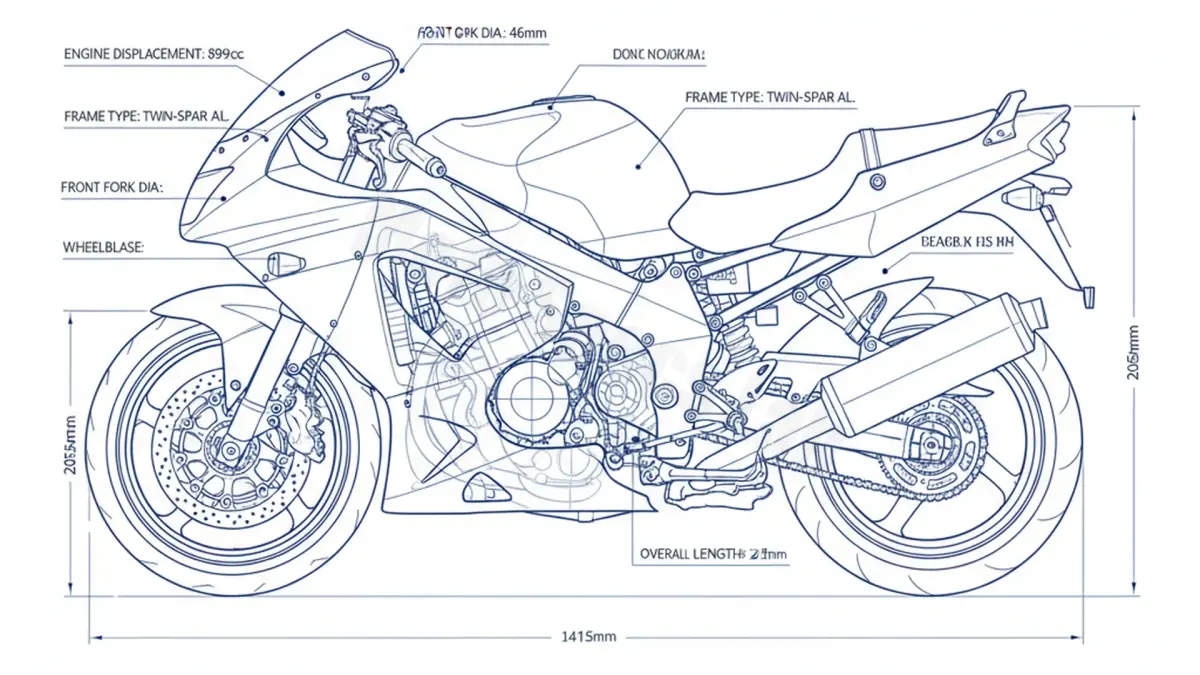
The 2000–2001 Kawasaki ZX-9R (ZX900EEA) represents a pivotal moment in the Ninja’s evolution. Unlike its predecessors, which were often criticized for being heavy compared to the competition, the ‘E’ model underwent a massive weight-saving program. A unique engineering highlight of this specific generation was the introduction of a new, stiffer bolt-on subframe and the move to a 190-section rear tire, which significantly improved high-speed stability and mechanical grip, cementing its status as the last great ‘real-world’ superbike before the industry pivoted toward extreme, track-only ergonomics.
Technical Review: Performance and Handling
The ZX900EEA is powered by a 899cc inline-four engine that remains a masterclass in mid-range torque. While the industry was moving toward fuel injection, Kawasaki perfected the Keihin CVRD 40mm carburetors for this model, offering a throttle response that many purists still prefer for its linearity. The chassis features a perimeter aluminum frame that provides excellent feedback, though it requires precise suspension setup to avoid the ‘front-end push’ common in older Ninja geometries.
Maintenance Guide: Keeping the Ninja Sharp
Lubrication System
For the ZX900EEA, using a high-quality SAE 10W-40 oil meeting JASO MA2 standards is critical for the wet clutch health. The total capacity is 3.0 Liters. We recommend changing the oil every 6,000 km (3,700 miles) or annually to prevent acid buildup from combustion byproducts.
Ignition and Electrical
The engine utilizes NGK CR9EK spark plugs. These are dual-electrode plugs designed to provide a more consistent spark in high-compression environments. Ensure the gap is checked before installation, although they are usually pre-gapped. The electrical system relies on a YTX9-BS battery; given the Ninja’s high compression ratio, a healthy cold-cranking amp (CCA) rating is essential for reliable starting.
Tires and Safety
The ZX-9R is sensitive to tire profile. Running the factory-recommended 2.5 bar (36 psi) front and 2.9 bar (42 psi) rear is vital for maintaining the intended turn-in characteristics. The 190/50 rear tire provides a large contact patch for acceleration, but many modern riders opt for a 190/55 to sharpen the steering—though this deviates from the OEM ZX900EEA specification.
Frequently Asked Questions
Q: Can I use synthetic oil in my ZX-9R?
A: Yes, as long as it meets the JASO MA/MA2 specification to ensure the wet clutch does not slip.
Q: Why does the ZX900EEA use dual-electrode plugs?
A: The NGK CR9EK dual-electrode design offers better ignitability and longer life under the high thermal loads of the 899cc engine.