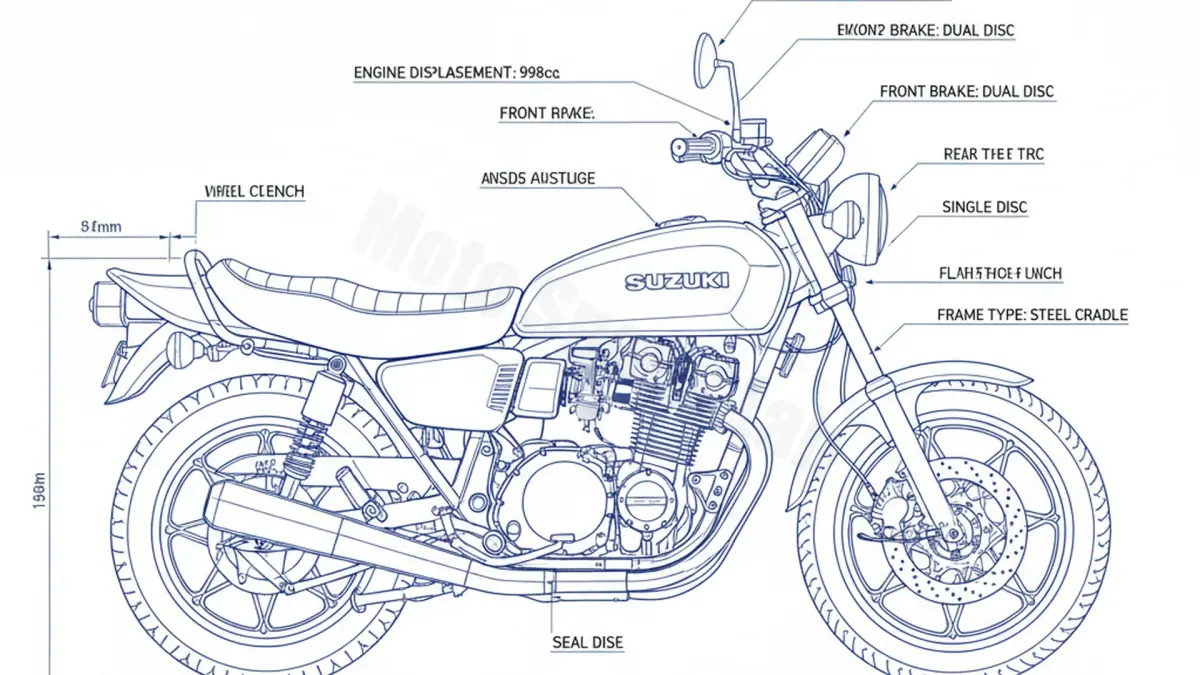
| Component | Specification |
|---|---|
| Production Years | 1980-1981 |
| Engine Type | DOHC 8-Valve Inline-Four |
| Oil Type/Capacity | SAE 10W-40 (3.5 L) |
| Spark Plug | NGK B8ES |
| Front Tire | 100/90-19 57H |
| Rear Tire | 130/90-16 67H |
| Battery | YB14L-A2 |
A unique engineering highlight of the Suzuki GS 1000 GL (GS100G-B) is that it was among the first Japanese motorcycles to successfully mate a high-performance, DOHC liter-class engine with a low-maintenance shaft drive, specifically optimized for the ‘L’ (Low) custom cruiser market. Unlike many competitors who saw significant power loss through shaft conversion, Suzuki’s spiral-bevel gear system maintained the GS series’ reputation for raw, linear acceleration while offering the touring longevity of a shaft-driven bike.
Engineering Overview
The GS100G-B variant represents the pinnacle of Suzuki’s early 80s ‘Custom’ styling. At its heart lies the legendary 997cc air-cooled DOHC engine. This powerplant is renowned in the industry for its over-engineered crankshaft and robust bottom end, which would later become the foundation for many drag-racing builds. In the GL configuration, the focus shifted toward torque delivery and reliability for the American and European touring markets.
The Shaft Drive System
The ‘G’ in the model designation signifies the shaft drive. This system was designed to be virtually maintenance-free compared to the chain-driven GS1000E. However, for modern owners, the secondary gear unit and final drive gear oil must be monitored to prevent seal failure—a common point of neglect on vintage survivors.
Maintenance Guide
Lubrication System
The GS 1000 GL requires 3.5 Liters of SAE 10W-40 oil. Given the age of the engine and the presence of a wet clutch, it is imperative to use oil meeting API SE, SF, or SG standards. Modern ‘Energy Conserving’ oils containing friction modifiers must be avoided as they can cause clutch slippage.
Ignition & Electrical
The NGK B8ES spark plugs are the standard fitment. Owners should check for consistent gapping to ensure the transistorized ignition system operates at peak efficiency. The electrical system relies on the YB14L-A2 battery; given the GS series’ historically sensitive charging systems (stator/regulator-rectifier), maintaining a healthy battery charge is critical to preventing component burnout.
Chassis & Tires
The GL model features a 19-inch front and a 16-inch rear ‘leading axle’ fork setup to provide that signature cruiser stance. Recommended tire pressures are 2.0 bar (28 psi) for the front and 2.3 bar (32 psi) for the rear. Under-inflating the rear 130/90-16 tire can lead to ‘wallowing’ in high-speed corners, a known characteristic of heavy vintage cruisers.
MotoSpecsLab Verdict
The Suzuki GS 1000 GL (GS100G-B) is a masterpiece of transitional engineering. It offers the bulletproof reliability of the GS engine with the relaxed ergonomics of a custom cruiser. For the collector or vintage rider, it remains one of the most accessible and maintainable ‘super-cruisers’ of the era, provided the shaft drive and charging system receive the professional attention they deserve.