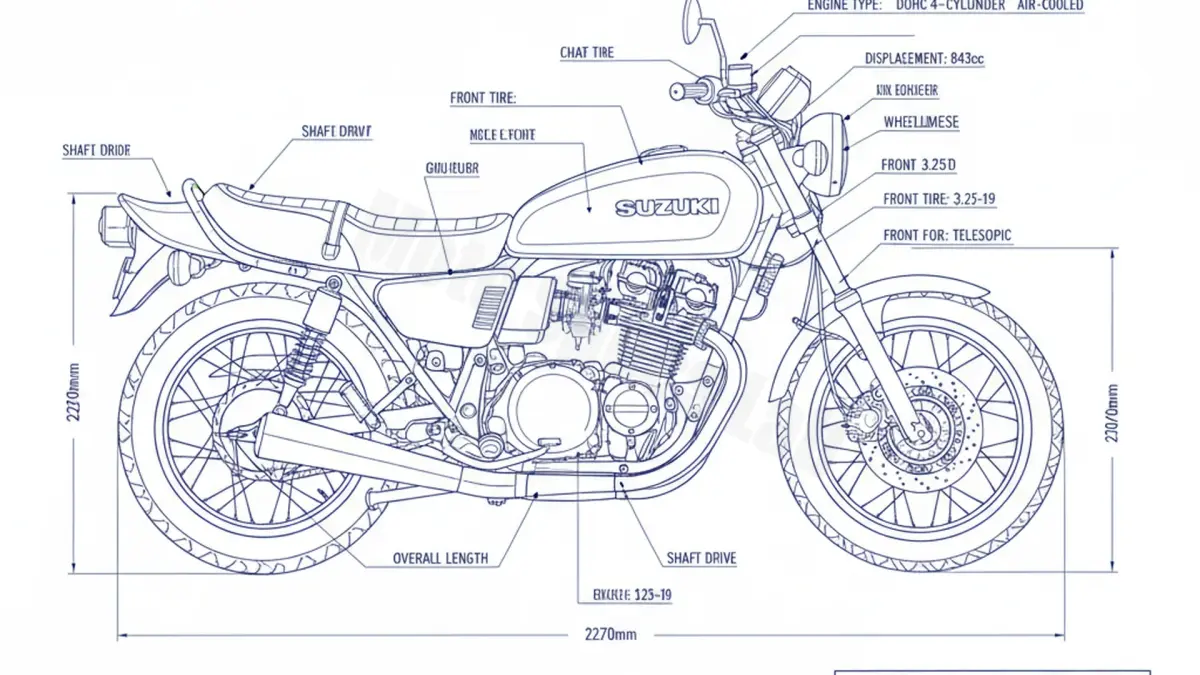
While most manufacturers in the late 1970s were struggling to balance performance with reliability, Suzuki achieved a masterstroke with the GS 850 GL. A unique historical engineering highlight of this machine is its hybrid DNA: Suzuki engineers took the proven, over-built bottom end of the GS1000 and mated it with a bored-out GS750 top end, then integrated a shaft-drive system that became legendary for its ‘bulletproof’ durability, making it one of the first Japanese motorcycles to truly challenge European touring dominance.
| Quick Specs: Suzuki GS 850 GL | |
|---|---|
| Production Years | 1979 – 1983 |
| Engine Type | Air-cooled, 4-cylinder, DOHC |
| Oil Capacity | 3.2 L (SAE 10W-40 API SE/SF) |
| Spark Plug | NGK B8ES (0.6-0.7 mm gap) |
| Battery | YB14L-A2 |
| Tire Size (Front) | 100/90-19 57H |
| Tire Size (Rear) | 130/90-16 67H |
Technical Review: The ‘Bulletproof’ Tourer
The GS 850 GL (GS850B) represents the pinnacle of Suzuki’s early 80s ‘L’ series (Low-seat/Custom styling). From a technical perspective, the GS850 series was revolutionary because it addressed the primary weakness of high-mileage bikes of the era: chain maintenance. By utilizing a spiral-bevel gear shaft drive, Suzuki provided a maintenance-free final drive that could handle the 77+ horsepower generated by the DOHC inline-four engine.
The ‘GL’ variant specifically featured the ‘custom’ look with a 16-inch rear wheel, leading-axle front forks, and pull-back handlebars. Despite its heavy curb weight, the low center of gravity and the smooth power delivery of the CV carburetors made it a favorite for long-distance touring.
Maintenance Protocol & Fluid Specifications
Engine Lubrication
To maintain the integrity of the plain-bearing crankshaft, MotoSpecsLab recommends high-quality mineral or semi-synthetic SAE 10W-40 oil meeting API SE or SF standards. The total capacity is 3.2 Liters. Given the air-cooled nature of the GS850B, frequent oil changes (every 3,000 miles) are critical to prevent thermal breakdown.
Ignition and Electrical
The ignition system relies on NGK B8ES spark plugs. For optimal combustion efficiency and throttle response, the electrode gap must be precisely set between 0.6 mm and 0.7 mm. The electrical system is supported by a YB14L-A2 lead-acid battery; owners should regularly check electrolyte levels as the charging systems on these vintage Suzukis can be demanding.
Handling and Tire Management
The GS 850 GL uses a staggered wheel setup that defines its cruiser-tourer handling characteristics. The front 19-inch wheel (100/90-19 57H) provides stability, while the 16-inch rear (130/90-16 67H) offers the classic ‘low-rider’ aesthetic. Proper inflation is vital for shaft-drive bikes to prevent ‘jacking’ effects during acceleration.
- Front Pressure: 2.0 bar (28 psi)
- Rear Pressure (Solo): 2.0 bar (28 psi)
- Rear Pressure (Dual/Loaded): 2.5 bar (36 psi)
Frequently Asked Questions
Does the GS 850 GL have a fuel gauge?
Yes, the GS 850 series was one of the first to feature a reliable electric fuel gauge and a gear position indicator, which were considered high-tech luxury features at the time of the GS850B release.
Is the shaft drive oil different from engine oil?
Yes. While the engine uses 10W-40, the final drive gear case requires a dedicated SAE 90 hypoid gear oil, which should be inspected at every oil change.