| Feature | Specification |
|---|---|
| Model Series | GR71A |
| Production Years | 1982 – 1984 |
| Engine Oil | SAE 10W-40 JASO MA2 (3.4 L) |
| Tire Dimensions | F: 100/90-19 / R: 120/90-18 |
| Tire Pressure | F: 2.0 bar / R: 2.3-2.8 bar |
| Battery Type | YB14L-A2 |
| Spark Plug | NGK DR8ES-L (0.7 mm gap) |
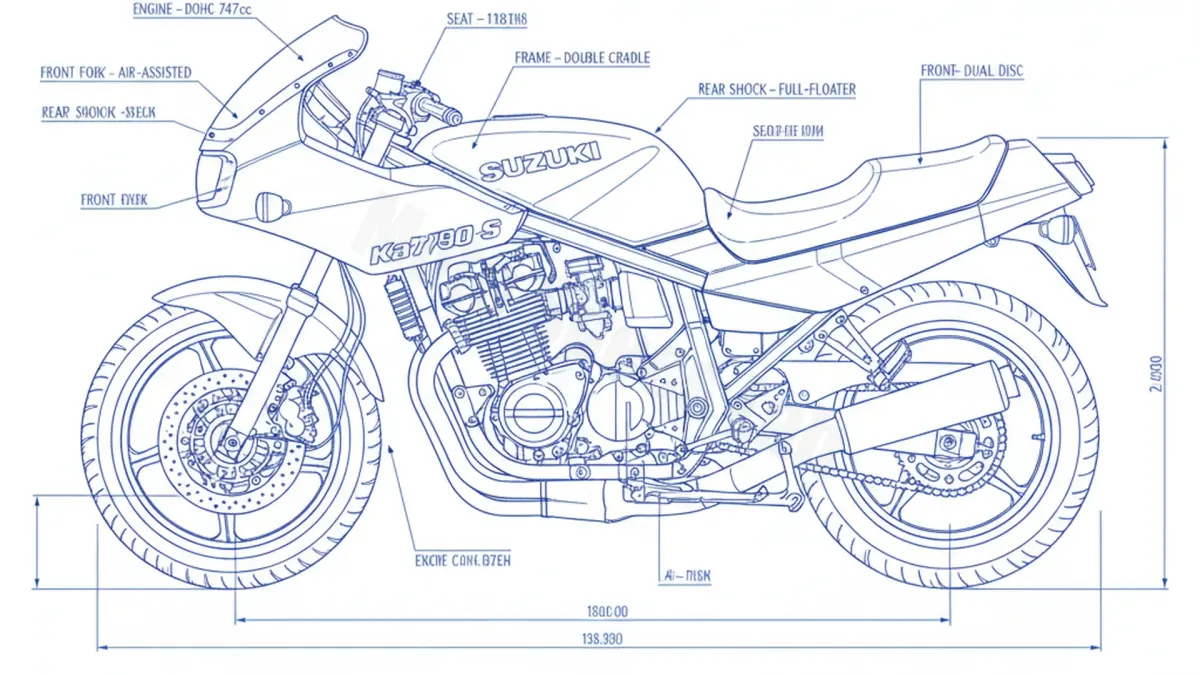
A unique engineering highlight of the Suzuki GSX 750 S Katana (GR71A) is its adoption of the Twin Swirl Combustion Chamber (TSCC) cylinder head. While the 1100cc variant garnered global headlines, the 750cc GR71A was the precision instrument of the Japanese domestic market, featuring a sophisticated Anti-Dive Fork (ANDF) system that utilized brake fluid pressure to stiffen the front suspension under heavy deceleration—a high-tech solution for the early 1980s dive issues inherent in long-travel telescopic forks.
Technical Overview: The Target Design Legacy
Designed by Hans Muth of Target Design, the Katana broke the mold of the ‘Universal Japanese Motorcycle’ (UJM). The GR71A variant specifically embodies the “silver sword” philosophy, balancing 16-valve performance with an aggressive, ergonomic silhouette. At MotoSpecsLab, we categorize this machine as a milestone in mass-centralization and aerodynamic integration.
Maintenance Guide & Fluid Specifications
Lubrication System
The air/oil-cooled inline-four requires 3.4 Liters of SAE 10W-40. To ensure clutch longevity and prevent slippage in the wet-sump system, always utilize oil meeting JASO MA2 standards. Given the age of these engines, mineral or semi-synthetic blends are often preferred to maintain seal integrity.
Ignition & Electrical
The ignition system relies on NGK DR8ES-L spark plugs. For optimal combustion efficiency, the gap must be precisely set to 0.7 mm. Electrical stability is provided by the YB14L-A2 lead-acid battery; owners should regularly check electrolyte levels due to the heat generated by the compact engine bay.
Chassis & Handling
The Katana’s handling is sensitive to tire choice. The 19-inch front and 18-inch rear configuration requires specific pressures for stability: 2.0 bar (29 psi) at the front and 2.3 bar (33 psi) at the rear for solo touring. If carrying a passenger, the rear must be increased to 2.8 bar (41 psi) to prevent sidewall deformation.
Expert Verdict
The GSX 750 S Katana GR71A remains a masterclass in industrial design. While the ANDF system requires meticulous bleeding during brake service, the mechanical robustness of the TSCC engine makes it one of the most reliable classic superbikes of its era. Proper adherence to the 10W-40 oil intervals is the single most important factor in preserving the cam-chain tensioner and valve train health.