| Component | Specification |
|---|---|
| Production Years | 1972–1977 |
| Engine Type | Three-cylinder, Two-stroke |
| Transmission Oil | SAE 10W-40 / 20W-40 (JASO-MA) (0.7 L) |
| Tires (F/R) | F: 3.25-19 / R: 4.00-18 |
| Tire Pressure | F: 25 psi / R: 28 psi |
| Spark Plug / Gap | NGK B8ES / 0.6 mm – 0.7 mm |
| Battery | 12N11-3A (YB11L-A) |
The Engineering Legend: Suzuki’s Ram Air System
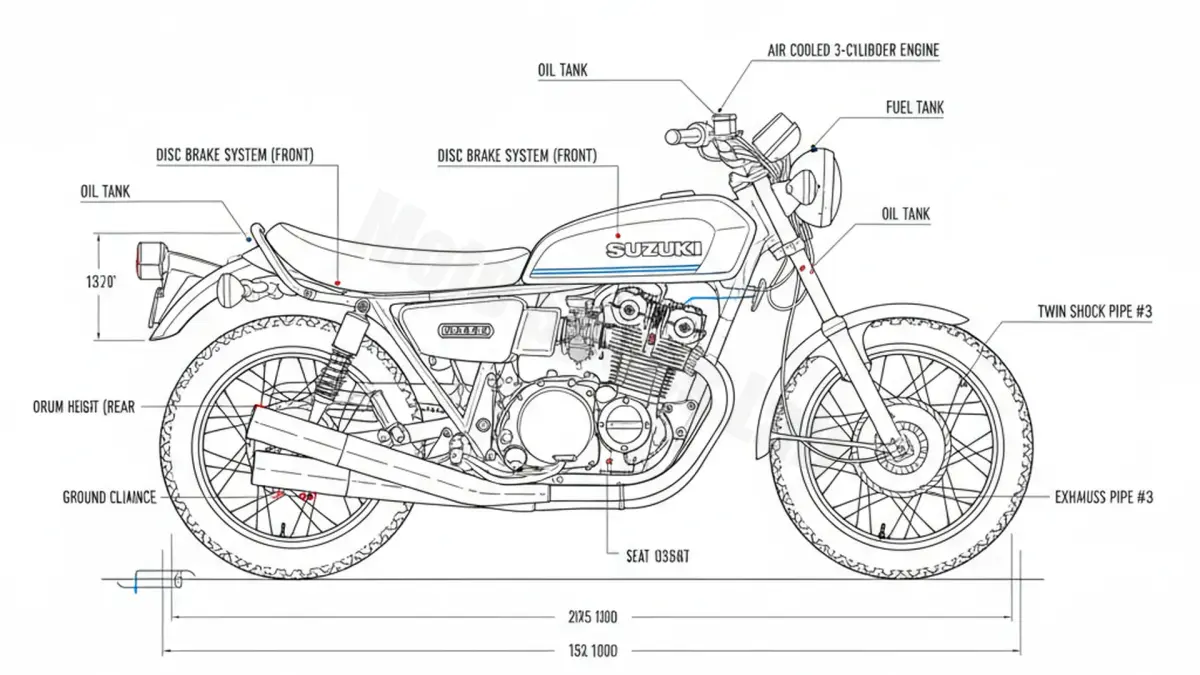
The Suzuki GT 550, affectionately known as the “Indy” in North America, holds a unique place in motorcycling history for its innovative Ram Air System. Unlike its competitors who struggled with cooling the center cylinder of transverse three-cylinder engines, Suzuki engineers developed a cast-aluminum shroud that sat atop the cylinder heads. This shroud utilized the motorcycle’s forward motion to force cool air over the fins, effectively mitigating the thermal expansion issues that plagued air-cooled triples of the 1970s. This engineering foresight allowed the GT 550 to maintain consistent performance during long-distance touring, a feat that solidified its reputation for reliability.
Technical Performance Analysis
The GT 550 was designed as a grand tourer rather than a raw sportbike. Its piston-port two-stroke engine delivered a smooth, linear power band, thanks in part to the Suzuki Recycle Injection System (SRIS). This system reduced visible smoke by collecting and re-burning residual oil and fuel from the bottom of the crankcase—a pioneering move toward environmental consciousness in the two-stroke era.
Maintenance Guide & Essentials
Lubrication and Transmission
For the gearbox, MotoSpecsLab recommends using a JASO-MA rated SAE 10W-40 or 20W-40 oil. The JASO-MA rating is critical to prevent clutch slippage. The refill capacity is relatively small at 0.7 liters, so frequent level checks are advised to ensure longevity of the gear sets.
Ignition and Electrical
The GT 550 relies on a three-set point ignition system. For optimal combustion, use NGK B8ES spark plugs. The gap must be precisely set between 0.6 mm and 0.7 mm. Given the age of these machines, maintaining the 12N11-3A (YB11L-A) battery at full charge is essential for reliable starting, as the electric starter demands significant current.
Chassis and Tires
The handling characteristics are classic 70s—stable in a straight line but requiring deliberate input in corners. To maintain the intended geometry, the front tire should be a 3.25-19 and the rear a 4.00-18. Recommended pressures for modern rubber on these rims are 25 psi (1.75 bar) for the front and 28 psi (2.0 bar) for the rear.
Editorial Verdict
The Suzuki GT 550 remains a pinnacle of mid-70s engineering. While it may not possess the aggressive bite of the Kawasaki triples, its sophisticated cooling system and smooth power delivery make it a superior choice for the classic enthusiast who values mechanical longevity and touring comfort. It is a testament to Suzuki’s “over-engineering” philosophy of the era.
Frequently Asked Questions
Q: Does the GT 550 require pre-mix fuel?
A: No. The GT 550 features an automatic oil injection system. Ensure the oil tank is filled with high-quality two-stroke injector oil.
Q: Why is the Ram Air cover important?
A: It is vital for cooling the center cylinder. Running the bike without the shroud can lead to overheating and potential piston seizure of the middle cylinder.
Q: What is the fuel capacity?
A: The standard tank holds approximately 15 liters (4.0 US gallons), providing a reasonable range for vintage touring.