| Component | Specification |
|---|---|
| Production Years | 1972 – 1982 |
| Engine Oil Type | SAE 10W-40 (JASO MA/MA2) |
| Oil Capacity | 0.5 Liters |
| Tire Size (Front/Rear) | 5.40-10 / 5.40-10 |
| Tire Pressure (Front/Rear) | 0.8 bar (11.4 psi) / 1.0 bar (14.5 psi) |
| Battery Type | 6N4-2A-4 (6 Volt) |
| Spark Plug | NGK BP6HS |
Engineering Heritage: The ‘VanVan’ Philosophy
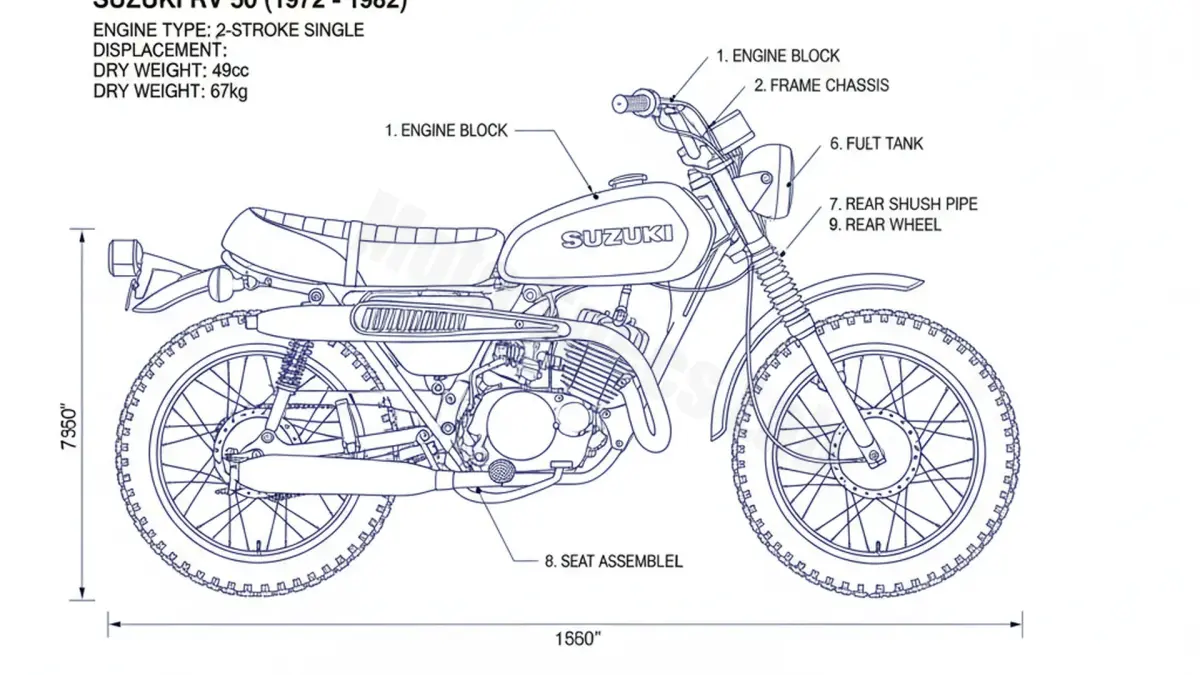
The Suzuki RV 50, affectionately known as the ‘VanVan’ (a Japanese term suggesting ‘more and more’ or ‘keep going’), was engineered with a unique objective: conquering terrain that would swallow a standard moped. Its most distinctive engineering highlight is the use of high-flotation balloon tires. These 5.40-10 units were not merely for aesthetics; they allowed the RV 50 to operate at extremely low pressures, providing a mechanical footprint capable of traversing soft sand, mud, and uneven beach terrain—a revolutionary concept for a 50cc machine in the 1970s.
Technical Review: Powerplant and Performance
At the heart of the RV 50 lies a robust 49cc air-cooled, two-stroke, single-cylinder engine. While modest in displacement, the engine’s torque curve was optimized for low-end grunt rather than top-end speed, facilitating its ‘all-terrain’ aspirations. The transmission is typically a 4-speed constant mesh system, which, when combined with the lightweight chassis, provides nimble handling in urban and off-road environments alike.
Maintenance Guide & Technical Protocols
To maintain the operational integrity of the Suzuki RV 50, adherence to factory-specified maintenance intervals is paramount, particularly given the age of these vintage machines.
1. Lubrication System
The transmission requires 0.5 liters of SAE 10W-40 oil. It is critical to use oil meeting JASO MA or MA2 standards to ensure the wet clutch does not slip. Even though it is a two-stroke, the gearbox oil should be changed every 3,000 km or annually to prevent metallic contamination.
2. Electrical and Ignition
The RV 50 utilizes a 6-volt electrical system, powered by a 6N4-2A-4 lead-acid battery. Owners should regularly check the electrolyte levels. For ignition, the NGK BP6HS is the standard heat-range plug. Ensure the gap is set to factory specifications (0.6–0.7mm) to prevent misfires under load.
3. Chassis and Tires
The balloon tires are the defining feature of the RV 50. Maintaining the correct pressure is vital for both safety and tire longevity. The front should be kept at 0.8 bar (11.4 psi), while the rear requires 1.0 bar (14.5 psi). Over-inflation will result in a harsh ride and reduced traction on loose surfaces, while under-inflation can lead to bead separation on the rim.
MotoSpecsLab Verdict
The Suzuki RV 50 remains a masterclass in ‘form follows function’ engineering. While its performance figures are modest by modern standards, its build quality and unique chassis design make it a highly collectible and functional piece of motorcycling history. Proper maintenance of the 6V system and correct tire pressures are the keys to keeping this vintage ‘sand-bike’ on the road for another fifty years.