| Specification | Data |
|---|---|
| Model Code | 47E (Global/EU) |
| Production Years | 1984 – 1985 |
| Engine Type | 1097cc, Inline-4, Air/Oil Cooled |
| Oil Type/Capacity | SAE 10W-40 (3.3 L) |
| Spark Plug | NGK DP8EA-9 |
| Front Tire | 120/80-16 60V (2.3 bar / 32 psi) |
| Rear Tire | 150/80-16 71V (2.5 bar / 36 psi) |
| Battery Type | YB14L-A2 |
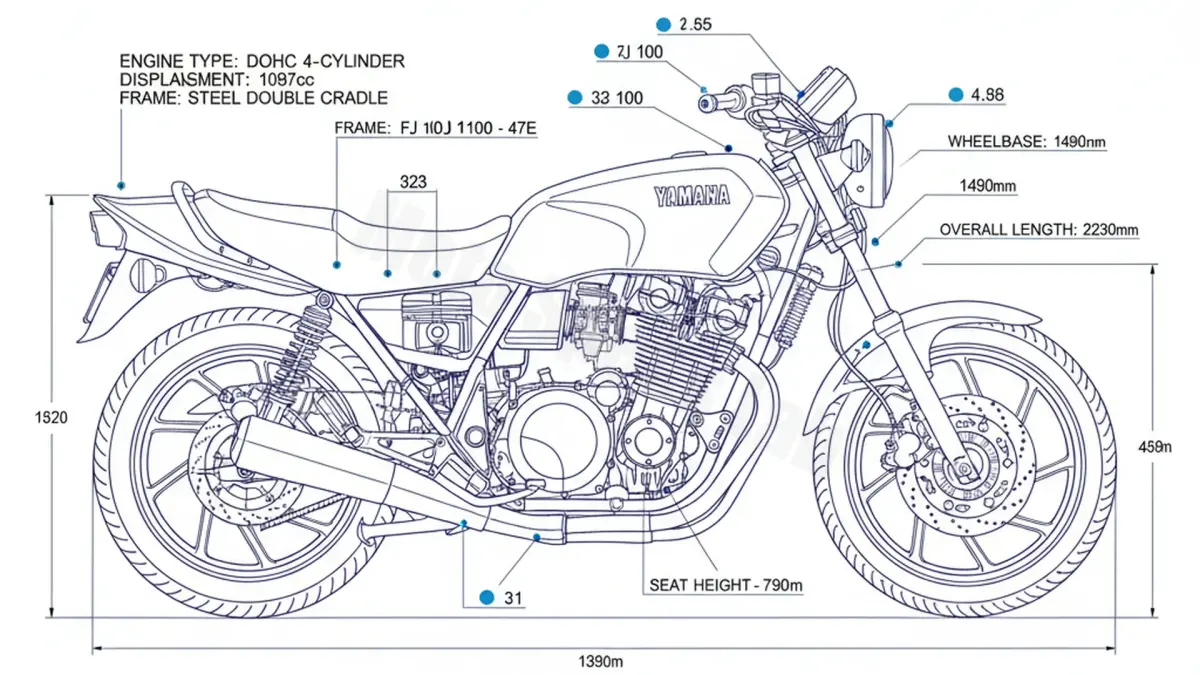
At MotoSpecsLab, we recognize the Yamaha FJ 1100 (47E) as a pivotal moment in motorcycle engineering. While its competitors were experimenting with complex liquid cooling and turbocharging, Yamaha focused on chassis rigidity. The FJ 1100 was the first production motorcycle to feature the ‘Lateral Frame Concept’—a perimeter steel frame that wrapped around the engine rather than going over it. This allowed for a lower center of gravity and unprecedented high-speed stability for a machine of its mass.
Engineering Deep Dive: The 1097cc Powerhouse
The heart of the 47E is a 16-valve, DOHC inline-four engine. Despite being air-cooled, Yamaha engineers utilized sophisticated oil-jet cooling for the piston crowns to manage heat. Delivering approximately 125 horsepower, the FJ 1100 was briefly the fastest production motorcycle in the world, capable of sub-11 second quarter-mile times. The use of 16-inch wheels both front and rear was a nod to the Grand Prix trends of the era, intended to sharpen steering response on a bike with a substantial 1,490mm wheelbase.
Maintenance Guide & Technical Requirements
To maintain the performance integrity of the FJ 1100, strict adherence to fluid and ignition specifications is required:
- Lubrication: The engine requires 3.3 liters of high-quality SAE 10W-40 semi-synthetic or mineral oil. Given the air-cooled nature of the 47E, frequent oil changes (every 5,000 km) are recommended to prevent thermal breakdown.
- Ignition: Use only NGK DP8EA-9 spark plugs gapped to 0.8–0.9mm. Incorrect heat ranges can lead to pre-ignition in the inner cylinders.
- Chassis & Tires: The 16-inch wheel configuration is sensitive to tire pressure. Maintain 2.3 bar (32 psi) in the front 120/80-16 and 2.5 bar (36 psi) in the rear 150/80-16 to avoid the ‘weaving’ sensation common in older sport-tourers.
- Electrical: The YB14L-A2 lead-acid battery is the standard fitment. Ensure the vent tube is properly routed to prevent acid damage to the swingarm.
The MotoSpecsLab Verdict
The Yamaha FJ 1100 (47E) remains a masterclass in ‘over-engineering.’ It successfully bridged the gap between pure sportbikes and trans-continental tourers. For collectors and enthusiasts, the 47E represents the purest form of the FJ lineage before the subsequent 1200cc models shifted the focus more toward touring comfort than raw performance.
Frequently Asked Questions (FAQ)
Q: What is the correct tire pressure for the FJ 1100?
A: For the 47E model, the front tire should be set to 2.3 bar (32 psi) and the rear to 2.5 bar (36 psi).
Q: How much oil does the Yamaha FJ 1100 take?
A: A standard oil and filter change requires 3.3 liters of SAE 10W-40 oil.
Q: What is the battery code for the 1984-1985 model?
A: The specified battery is the YB14L-A2.