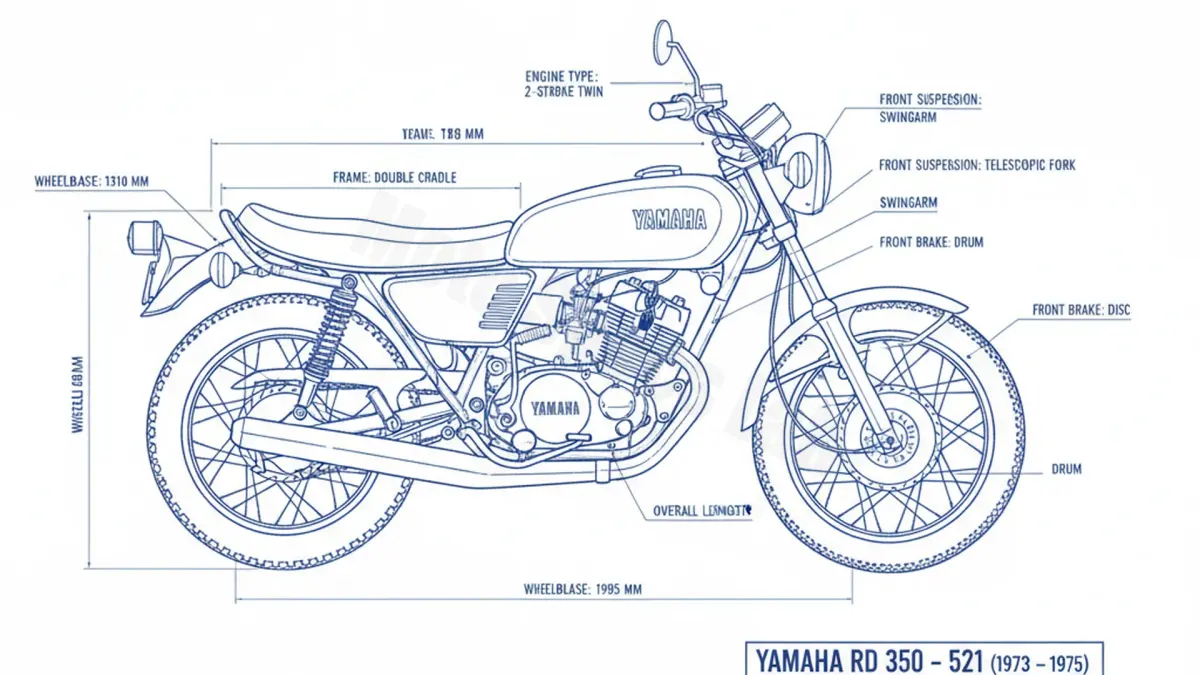
| Feature | Specification |
|---|---|
| Production Years | 1973 – 1975 |
| Engine Type | Two-stroke, Parallel Twin, Reed Valve |
| Transmission Oil | SAE 10W-30 (1.4L Change / 1.5L Total) |
| Spark Plug | NGK B8HS (Gap: 0.6–0.7 mm) |
| Tire Size (F/R) | F: 3.00-18 4PR / R: 3.50-18 4PR |
| Battery | 12N5.5-3B (12V) |
The Yamaha RD 350 (521 series) holds a unique place in motorcycling history as the first mass-production motorcycle to utilize Torque Induction. This engineering breakthrough, featuring a seven-port cylinder design and reed valves, allowed the two-stroke engine to deliver a broader powerband and improved low-end response, effectively ending the era of ‘peaky’ and unpredictable two-stroke performance.
Technical Analysis: The 521 Engineering Paradigm
The 521 designation represents the refinement of Yamaha’s air-cooled twin technology. At its heart lies a 347cc engine that balances lightweight construction with high thermal efficiency. The Autolube system, a hallmark of Yamaha’s reliability during this era, ensured precise oil-to-fuel ratios, though it remains a critical point of inspection for modern collectors. The 521’s chassis was designed to handle the 39 horsepower output, providing a power-to-weight ratio that often embarrassed contemporary four-stroke machines with twice the displacement.
Maintenance Roadmap
1. Lubrication System
For the gearbox, MotoSpecsLab recommends SAE 10W-30 (Type SE or higher). When performing a standard oil change, the system requires 1.4 liters. If the engine has been completely disassembled for a rebuild, the total capacity is 1.5 liters. Ensure the motorcycle is level when checking the sight glass or dipstick.
2. Ignition and Electrical
Optimal combustion in the RD 350 depends heavily on the spark plug condition. Use NGK B8HS plugs. It is imperative to verify the electrode gap is precisely 0.6–0.7 mm to prevent misfires under high compression. The electrical system relies on a 12N5.5-3B battery; given the age of these machines, checking for harness degradation is a mandatory safety step.
3. Tires and Chassis Dynamics
The RD 350’s handling characteristics are sensitive to tire pressure. The factory-specified sizes are 3.00-18 for the front and 3.50-18 for the rear. For optimal stability, maintain the following pressures:
- Front: 1.8 bar (26 psi)
- Rear (Solo): 2.0 bar (28 psi)
- Rear (Pillion): 2.3 bar (32 psi)
Expert Verdict
The Yamaha RD 350 – 521 is a masterclass in two-stroke engineering. While it requires disciplined maintenance—particularly regarding its reed valves and lubrication timing—it offers a visceral riding experience that modern machines struggle to replicate. For the serious technician or collector, adhering to these factory specifications is the only way to preserve the ‘Giant Killer’ legacy of the 521.
Frequently Asked Questions
Q: Can I use modern synthetic oils in the RD 350?
A: While modern synthetics offer superior protection, ensure the oil is specifically rated for wet clutches to prevent slippage in the gearbox.
Q: How often should the spark plugs be checked?
A: Given the two-stroke nature of the engine, plugs should be inspected every 2,000 miles for carbon fouling or oil deposits.