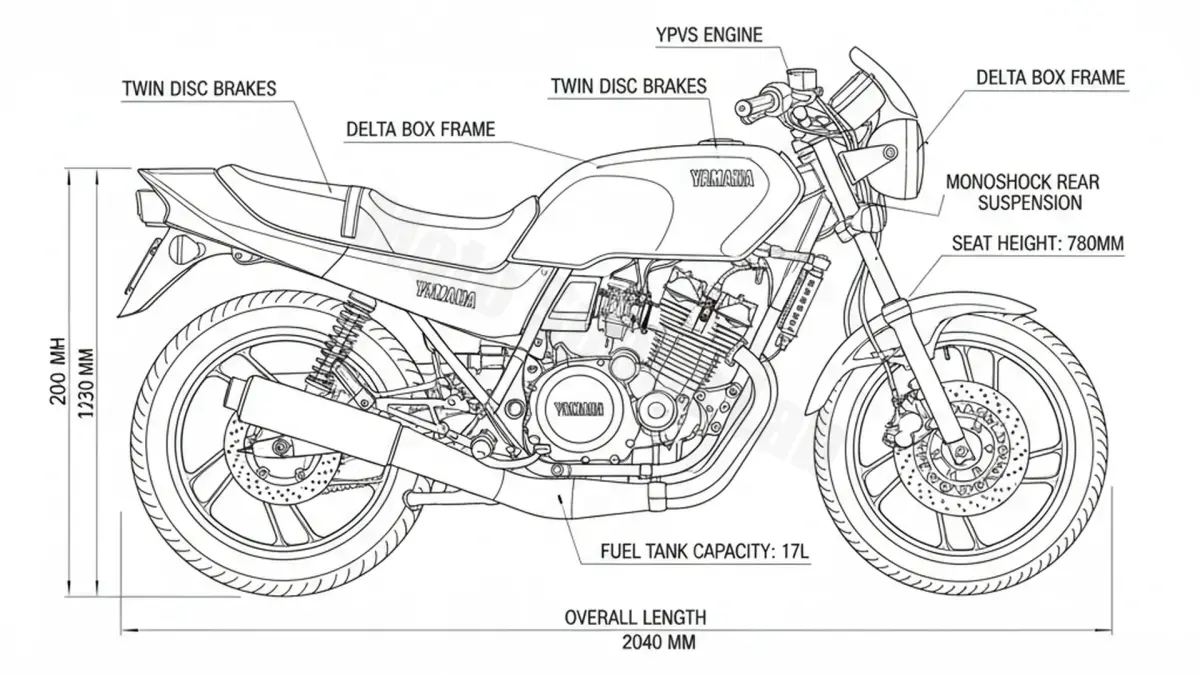
The 1WW generation of the Yamaha RD 350, produced between 1986 and 1989, stands as the final high-water mark for the platform in the European market. Unlike its predecessors, the 1WW featured the most sophisticated iteration of the Yamaha Power Valve System (YPVS), a mechanical marvel that allowed a high-revving two-stroke engine to maintain a surprisingly broad powerband by varying the exhaust port height based on engine RPM.
| Quick Specs: Yamaha RD 350 1WW | |
|---|---|
| Production Years | 1986 – 1989 |
| Engine Type | Liquid-cooled, Two-stroke, Parallel Twin |
| Gearbox Oil | SAE 10W-30 or 10W-40 (1.2L Change / 1.5L Dry) |
| Tires (F/R) | F: 90/90-18 51H / R: 110/80-18 58H |
| Spark Plug | NGK BR9ES |
| Battery | YB5L-B |
| Tire Pressure (Solo) | F: 2.0 bar / R: 2.3 bar |
Engineering Overview
The 1WW model (often referred to as the ‘F2’ for the fully faired version or ‘N2’ for the naked variant) represented a significant refinement in both thermal management and chassis stability. The 347cc engine was paired with a revised exhaust system and Mikuni carburetors, optimized to deliver approximately 59-63 HP in its unrestricted form. The integration of the YPVS was critical; by rotating a drum in the exhaust port, Yamaha engineers could optimize gas flow for low-end torque without sacrificing the explosive top-end rush the RD series was famous for.
Maintenance & Technical Specifications
Lubrication System
For the gearbox, MotoSpecsLab recommends high-quality SAE 10W-30 or 10W-40 oil meeting API SE standards or higher. During a standard oil change, the 1WW requires 1.2 liters, though a completely dry engine (after a full rebuild) will necessitate 1.5 liters. Consistent monitoring of the separate 2-stroke autolube tank is mandatory to prevent catastrophic engine seizure.
Ignition and Electrical
The 1WW utilizes a YB5L-B battery and relies on NGK BR9ES spark plugs. Given the high-revving nature of the two-stroke twin, ensure the plug gap is set correctly and inspect for carbon fouling regularly, as rich oil mixtures can lead to misfires.
Chassis and Handling
Equipped with 18-inch wheels, the RD 350 1WW requires specific tire pressures to maintain its legendary agility. For solo riders, maintain 2.0 bar (28 psi) in the front and 2.3 bar (33 psi) in the rear. If carrying a passenger, the rear pressure should be increased to 2.8 bar (40 psi) to handle the additional load and prevent sidewall deformation.
Expert Verdict
The RD 350 1WW remains a benchmark for lightweight performance. Its power-to-weight ratio remains competitive even by modern standards, provided the YPVS cables are correctly tensioned and the cooling system is free of scale. For collectors and enthusiasts, the 1WW is the definitive ‘Giant Killer’ of the late 80s.