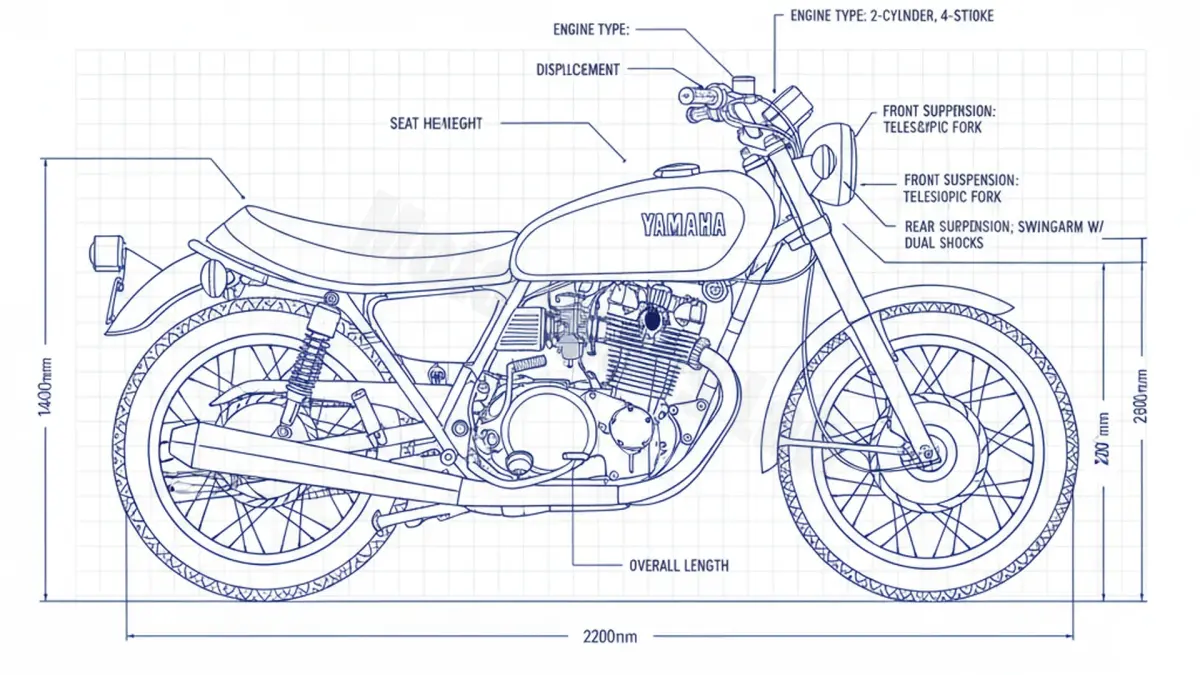
| Attribute | Specification |
|---|---|
| Production Years | 1973-1974 |
| Engine Type | 743cc SOHC Parallel Twin |
| Oil Requirement | SAE 10W-30 (SE) or 20W-40 (3.0 L) |
| Tire Dimensions | F: 3.50-19 / R: 4.00-18 |
| Tire Pressure | F: 1.8 bar (26 psi) / R: 2.0 bar (28 psi) |
| Spark Plug | NGK B8ES |
| Battery Type | YB14L-A2 |
The Yamaha TX 750 holds a unique position in motorcycling history as the first mass-production motorcycle to utilize an “Omni-Phase” balancer system. In an era where large-displacement parallel twins were notorious for bone-shaking vibrations, Yamaha attempted to solve the harmonic imbalance with two counter-rotating shafts. This engineering audacity was designed to provide the smoothness of a four-cylinder engine with the narrow profile and torque characteristics of a twin.
Technical Engineering Overview
At the heart of the TX 750 is a 743cc SOHC air-cooled engine. While the Omni-Phase system was revolutionary, it presented early thermal challenges. The balancer weights, spinning through the oil in the sump, could cause aeration (frothing) at high RPMs, leading to lubrication issues in early 1973 models. Yamaha addressed this with an enlarged oil cooler and deeper sump in later iterations, making the 1974 models and updated 1973 units highly capable vintage tourers.
Maintenance & Operational Standards
For the modern collector, maintaining the TX 750 requires strict adherence to fluid specifications to preserve the integrity of the balancer chain and internal bearings.
Lubrication System
The engine requires 3.0 Liters of high-quality oil. While the original manual suggests SAE 10W-30 or 20W-40 (SE grade), modern enthusiasts often opt for 20W-50 motorcycle-specific mineral oils to provide better shear stability for the balancer chain assembly.
Chassis & Tires
The TX 750 utilizes a traditional 19-inch front and 18-inch rear wheel setup. Maintaining the correct pressure is vital for the bike’s stability, as it is a heavy machine (approx. 230kg wet). We recommend 1.8 bar (26 psi) in the front and 2.0 bar (28 psi) in the rear for solo riding.
Electrical & Ignition
Ensuring a crisp combustion cycle depends on the NGK B8ES spark plugs. Given the twin-carburetor setup (Mikuni Solex), consistent spark is essential for balancing the cylinders. The electrical system is supported by a YB14L-A2 battery, which provides the necessary cold cranking amps for the electric starter.
MotoSpecsLab Verdict
The Yamaha TX 750 was ahead of its time. While its reputation was initially marred by early mechanical teething, it remains a testament to Yamaha’s willingness to innovate. When properly maintained with modern lubricants and updated components, the TX 750 offers one of the smoothest vintage riding experiences of the 1970s.