| Specification | Data |
|---|---|
| Production Years | 1974-1996 |
| Engine Oil | SAE 10W-30 (Type SE/SF) |
| Oil Capacity | 0.7 L – 0.8 L |
| Tires (Front/Rear) | F: 2.75 – 21 / R: 4.00 – 18 |
| Tire Pressure | F: 1.0 bar / R: 1.2 bar |
| Spark Plug | NGK B6ES (Twin-Shock) / BPR5ES (Monoshock) |
| Battery | None / 6N2-2A-4 (S models) |
The Yamaha TY 250 remains a cornerstone of trials history, largely because it was the first Japanese trials bike developed in collaboration with a world champion—Mick Andrews. Unlike its contemporaries, the TY 250 (specifically the 1974 ‘A’ model) featured a unique ‘cantilever’ frame design and engine porting that prioritized low-end torque over peak horsepower, setting the blueprint for the modern trials machine.
Engineering Evolution: From Twin-Shock to Monoshock
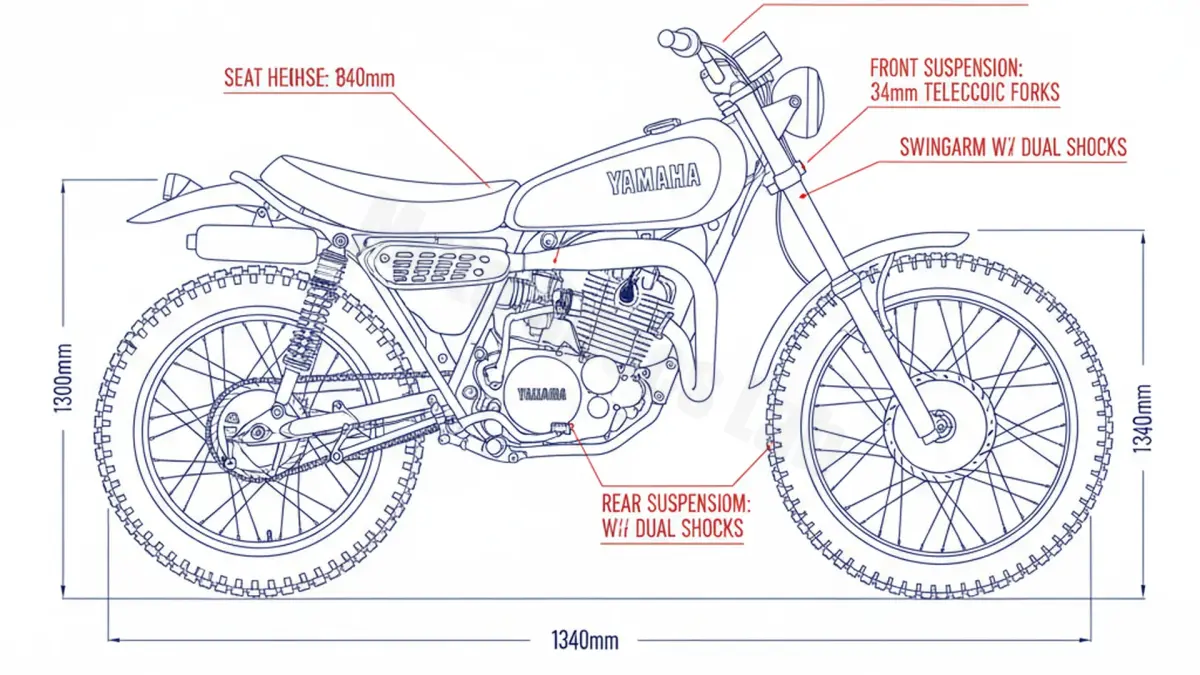
Over its two-decade production run, the TY 250 evolved through two distinct architectural phases. The early units (1974-1983) utilized a classic twin-shock rear suspension setup, prized today for its vintage aesthetic and linear response. In 1984, Yamaha revolutionized the platform with the TY 250R Monoshock, which introduced a rising-rate rear suspension and a significantly lighter chassis, allowing riders to tackle more vertical obstacles.
Maintenance Guide & Technical Specifications
Lubrication and Transmission
The TY 250 utilizes a 2-stroke engine, but the transmission and clutch require a high-quality SAE 10W-30 (Type SE/SF) oil. For a standard drain and refill, the capacity sits between 0.7 L and 0.8 L. Maintaining clean oil is critical, as trials riding involves high-frequency clutch slipping which can contaminate the lubricant faster than traditional trail riding.
Ignition and Spark Plugs
Ignition requirements vary significantly between the generations. The vintage Twin-Shock models typically utilize an NGK B6ES plug, which handles the heat of the air-cooled fins effectively. The later Monoshock variants, often tuned for different compression ratios, require an NGK BPR5ES. Always check the gap to ensure consistent firing at low RPMs.
Tires and Traction Management
Traction is the primary objective of any trials bike. The TY 250 uses a standard trials sizing: 2.75 – 21 on the front and 4.00 – 18 on the rear. For general use, MotoSpecsLab recommends 1.0 bar (14.5 psi) in the front and 1.2 bar (17.5 psi) in the rear. However, for competitive trials, these pressures are often dropped significantly to increase the contact patch.
MotoSpecsLab Editorial Verdict
The Yamaha TY 250 is an exceptional piece of engineering that bridged the gap between European dominance and Japanese reliability in the trials world. Whether you are restoring a 1974 434-series or maintaining a late-90s monoshock, the bike’s simplicity and robust parts availability make it an ideal candidate for both collectors and active vintage competitors.