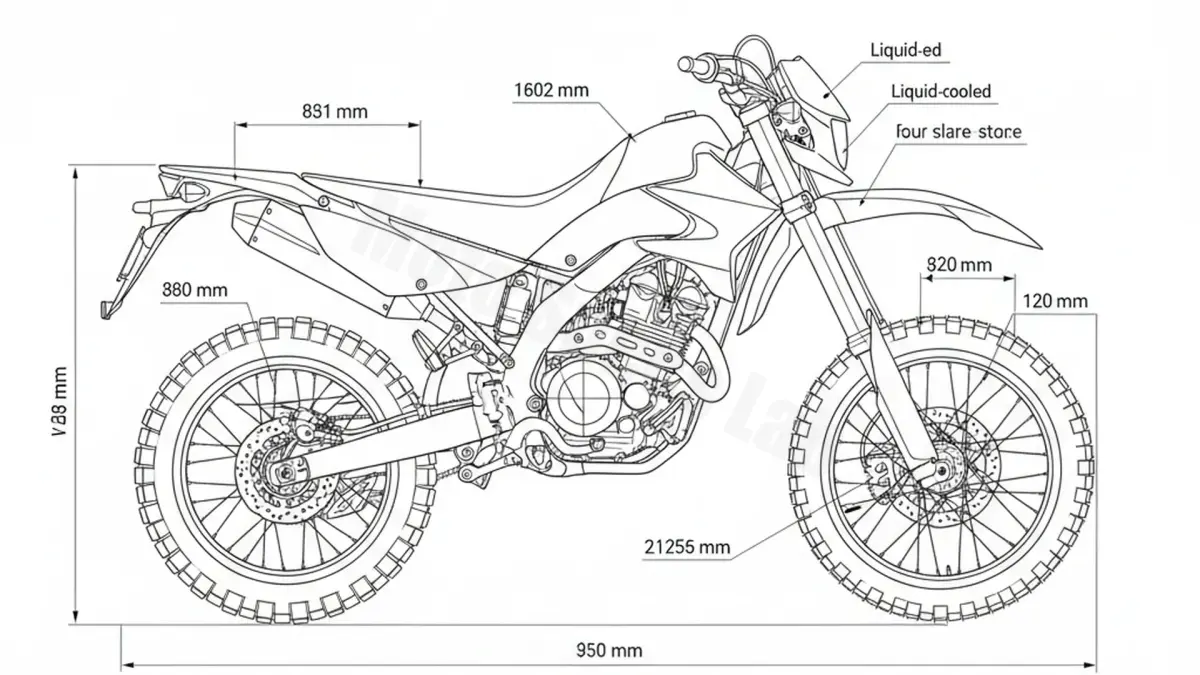
| Specification | Data Value |
|---|---|
| Production Years | 2009–2017 |
| Engine Oil | SAE 10W-40 API SG/JASO MA (1.0 L) |
| Spark Plug | NGK CR9E |
| Battery Type | YTZ7S |
| Front Tire | 80/90-21 M/C 48P |
| Rear Tire | 110/80-18 M/C 58P |
| Tire Pressure (F/R) | 1.5 bar (22 psi) / 1.5 bar (22 psi) |
A notable engineering highlight of the Yamaha WR 125 R (DE071) is its high-performance DNA; it utilizes a liquid-cooled, 4-valve engine architecture sharing significant design philosophy with the YZF-R125, including a forged aluminum piston and a ceramic-composite plated cylinder. This makes it one of the most technologically advanced 125cc dual-sport powerplants of its era.
Technical Overview: The DE071/22B7 Platform
The WR 125 R was designed to bridge the gap between urban commuting and light off-road exploration. Unlike many budget-oriented 125cc machines, the DE071 chassis utilizes a full-sized steel double-cradle frame, providing the rigidity and ergonomics of a much larger machine. This makes it a favorite for taller riders entering the A1 category.
Engine and Performance Analysis
The fuel-injected SOHC engine is tuned for a linear power delivery. While it reaches the legal 11kW (15HP) limit for the A1 license, its strength lies in its reliability and thermal management. The high-compression ratio (11.2:1) necessitates the use of the NGK CR9E spark plug to handle the heat cycles effectively. Owners should note that the 1.0-liter oil capacity is relatively small, making regular level checks critical for engine longevity.
Maintenance and Fluid Specifications
For optimal clutch performance and engine protection, MotoSpecsLab recommends a high-quality SAE 10W-40 oil meeting JASO MA standards. Given the dual-sport nature of the bike, the air filter should be inspected more frequently if used in dusty environments. The YTZ7S battery provides excellent cold-cranking amps in a compact form factor, essential for the fuel injection system’s initial priming.
Chassis and Handling
Equipped with a 21-inch front wheel and an 18-inch rear, the WR 125 R offers genuine off-road geometry. The recommended tire pressure of 1.5 bar (22 psi) for both front and rear is a balanced setting for mixed-surface riding. For pure street use, some riders may opt for a slight increase (up to 1.7 bar) to improve turn-in response, though the factory specification remains the benchmark for versatility.
Conclusion
The Yamaha WR 125 R remains a premium benchmark in the small-capacity dual-sport segment. Its robust build quality and sophisticated engine ensure it holds its value remarkably well. Adhering to the maintenance specs—specifically the 1.0L oil capacity and CR9E plug—is key to maintaining its high-revving performance.