| Quick Specs: Yamaha WR 125 X | |
|---|---|
| Production Years | 2009 – 2017 |
| Engine Oil | 1.0 L (SAE 10W-40 API SG / JASO MA) |
| Tires (F/R) | 110/70-17 / 140/70-17 |
| Tire Pressure | F: 2.0 bar / R: 2.25 bar |
| Spark Plug | NGK CR9E (0.7–0.8 mm gap) |
| Battery | YTZ7S |
A unique engineering highlight of the Yamaha WR 125 X is its shared DNA with the legendary YZF-R125. Unlike many competitors in the learner-legal category that utilized air-cooled, low-tech powerplants, the WR 125 X (DE072) was built around a sophisticated liquid-cooled, 4-valve SOHC engine featuring fuel injection. This high-revving architecture allowed it to sit comfortably at the 11kW (15hp) limit while maintaining a reliability profile usually reserved for larger displacement machines.
Technical Review: MotoSpecsLab Analysis
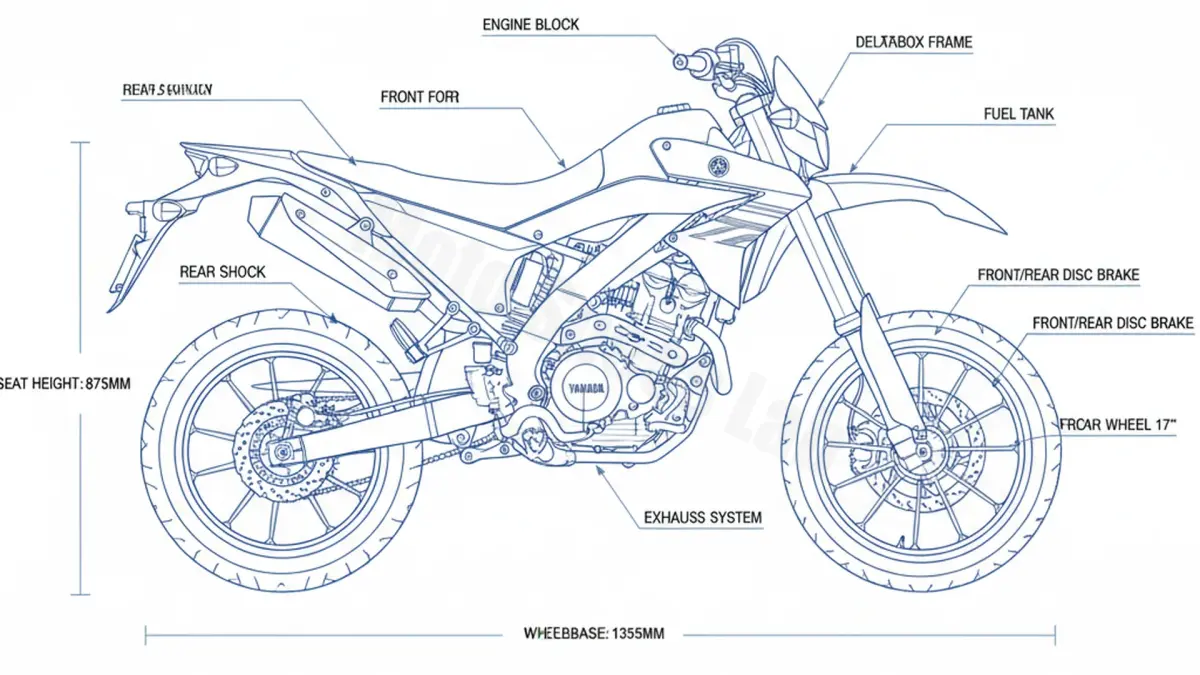
The WR 125 X represents the pinnacle of Yamaha’s small-capacity supermoto development. Its chassis—a robust semi-double cradle frame—provides exceptional torsional rigidity, which is critical for the flickable nature of a supermoto. With a seat height of 920mm, it offers a commanding view of the road, though it remains a tall order for shorter riders. The inclusion of 17-inch Excel rims and a 298mm front wave disc brake highlights Yamaha’s commitment to premium componentry over budget-friendly alternatives.
Maintenance Guide
Lubrication System
For the DE072 engine, oil quality is paramount. It requires exactly 1.0 liter of SAE 10W-40 oil. To ensure the wet clutch operates without slipping, the oil must meet JASO MA standards. We recommend a high-quality semi-synthetic or full synthetic for high-RPM operation.
Ignition and Electrical
The WR 125 X utilizes the NGK CR9E spark plug. Maintaining the correct gap of 0.7–0.8 mm is vital for cold-start reliability and fuel efficiency. The electrical system is powered by a compact YTZ7S battery; given the lack of a kickstarter, keeping this battery on a tender during winter storage is highly recommended.
Wheel and Tire Setup
The supermoto stance is achieved via a 110/70-17 front and a 140/70-17 rear tire. For optimal handling and tire longevity, pressures should be maintained at 2.0 bar (29 psi) in the front and 2.25 bar (33 psi) in the rear. Deviating from these pressures significantly impacts the bike’s ability to ‘tip-in’ to corners.
Editor’s Verdict
The Yamaha WR 125 X remains a sought-after model in the used market due to its over-engineered engine and premium build quality. While heavier than some modern competitors, its stability and “big bike” feel make it a superior choice for both urban commuting and weekend canyon carving.