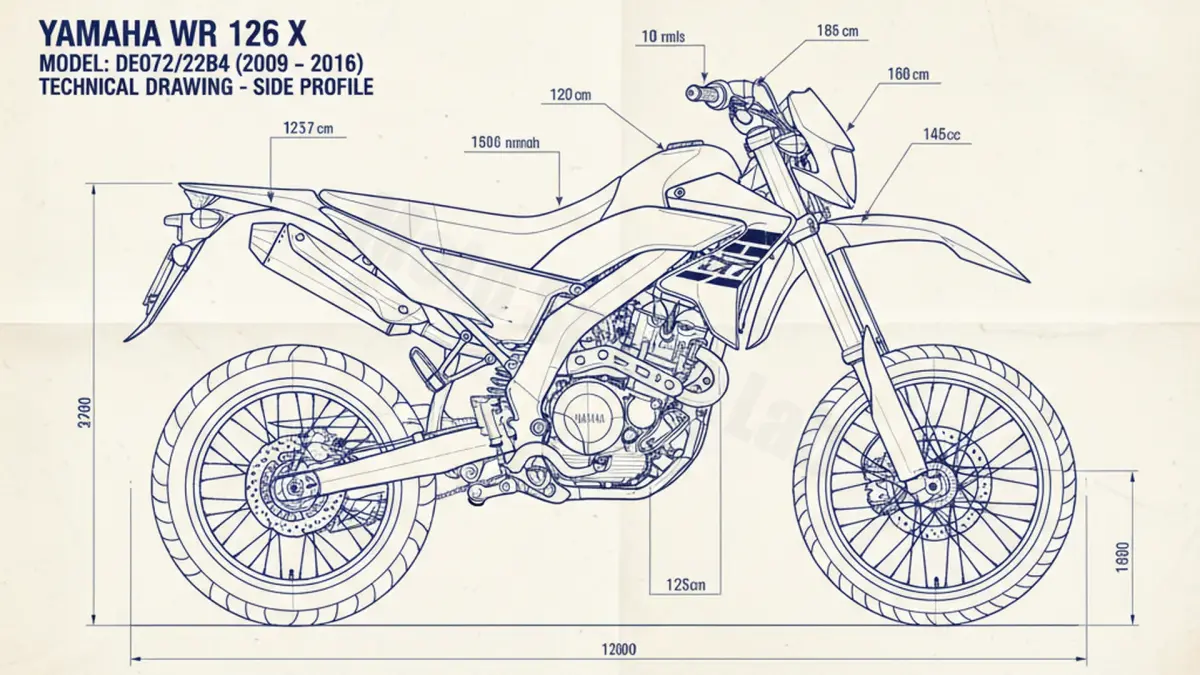
| Component | Specification |
|---|---|
| Production Years | 2009 – 2016 |
| Engine Oil | SAE 10W-40 (API SG+, JASO MA) – 1.0 Liter |
| Spark Plug | NGK CR9E (0.7–0.8 mm gap) |
| Tires (F/R) | 110/70-17 M/C 54H / 140/70-17 M/C 66H |
| Battery | YTZ7S (12V Maintenance Free) |
A defining moment in small-displacement engineering, the Yamaha WR 125 X (DE072/22B4) shares its high-revving heart with the legendary YZF-R125. Unlike many of its contemporaries that utilized air-cooled, low-tech units, the WR 125 X introduced a liquid-cooled, SOHC 4-valve engine featuring a forged aluminum piston and a ceramic-composite plated cylinder. This race-derived technology ensured superior heat dissipation and durability, allowing the 125cc single to thrive at high RPMs without the typical performance fade associated with entry-level supermotos.
Technical Architecture and Performance
The DE072 chassis is built around a robust steel semi-double-cradle frame, designed to withstand the rigors of urban commuting and light stunt riding. The fuel-injected engine delivers a linear power curve, peaking at the 11kW (15 hp) limit for A1 license compliance. Maintenance on this unit is straightforward but critical; the liquid cooling system requires regular inspection to prevent the high-compression engine from overheating during prolonged high-speed use.
Maintenance Essentials
To maintain peak performance, MotoSpecsLab recommends the following service intervals and specifications:
- Lubrication: Use 1.0L of high-quality 10W-40 synthetic oil. The JASO MA certification is mandatory to ensure the wet clutch operates without slippage.
- Ignition: The NGK CR9E spark plug should be inspected every 6,000 km. Ensure the electrode gap is strictly between 0.7 and 0.8 mm to maintain optimal combustion efficiency.
- Electrical: The YTZ7S battery is compact but sensitive to deep discharge. If the bike is stored for more than two weeks, a trickle charger is highly recommended.
Chassis and Handling
Equipped with 17-inch Excel alloy rims, the WR 125 X demands specific tire pressures to maintain its flickable nature. Running the 110/70 front and 140/70 rear tires at 2.0 bar (29 psi) provides the ideal contact patch for cornering. For riders carrying luggage or a passenger, the rear pressure should be increased to 2.3 bar (33 psi) to prevent carcass deformation and uneven wear.
Editorial Review
From a technical perspective, the WR 125 X remains one of the most over-engineered 125cc motorcycles of its era. Its seat height (920mm) may be intimidating for shorter riders, but it offers a commanding view of traffic and exceptional ground clearance. While the weight is slightly higher than some minimalist competitors, the stability provided by the chassis geometry and the reliability of the 22B engine make it a premier choice for enthusiasts who value longevity and build quality over raw lightness.
Frequently Asked Questions
Q: How often should I change the oil?
A: Yamaha recommends every 6,000 km, but for urban use with frequent stop-start cycles, 3,000 km intervals will significantly extend engine life.
Q: Can I use a different spark plug?
A: The NGK CR9E is the factory standard. While Iridium variants (CR9EIX) offer better fouling resistance, the standard plug is perfectly adequate if the gap is correctly set.