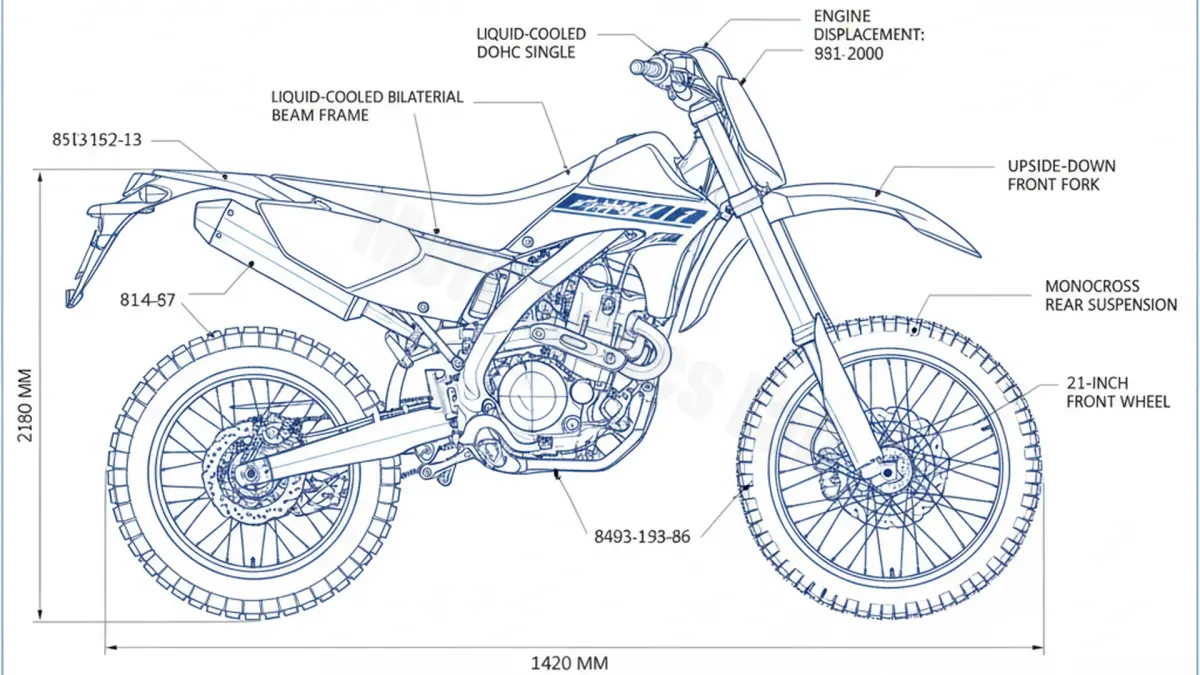
| Attribute | Specification |
|---|---|
| Production Years | 2008 – 2020 |
| Engine Oil | SAE 10W-40 API SG+, JASO MA (1.3L / 1.4L with filter) |
| Front Tire | 80/100-21 M/C 51P |
| Rear Tire | 120/80-18 M/C 62P |
| Tire Pressure | 1.5 bar (22 psi) Front & Rear |
| Battery Type | YTZ7S |
| Spark Plug | NGK CR9EK |
Engineering Legacy: The Titanium-Valved Trail Pioneer
The Yamaha WR 250 R, internal designation DG201, remains a landmark in dual-sport engineering. Unlike typical 250cc trail bikes of its era, the WR250R was not a detuned motocrosser but a ground-up design featuring a high-compression (11.8:1) engine equipped with titanium intake valves and a ceramic-plated cylinder. This engineering choice allowed for a 10,000 RPM redline while maintaining an industry-leading valve adjustment interval of 26,000 miles (42,000 km), effectively bridging the gap between high-performance competition machines and low-maintenance commuters.
Technical Performance Analysis
At the heart of the DG201 chassis is a semi-double-cradle frame using cast and forged aluminum sections with steel down-tubes. This hybrid approach provides the rigidity required for aggressive off-road maneuvers while retaining the compliance necessary for highway stability. The fuel-injected 250cc powerplant delivers a linear power curve, optimized by the EXUP (Exhaust Ultimate Power) valve system, which modulates exhaust back-pressure to enhance low-end torque without sacrificing top-end over-rev.
Maintenance Guidelines & Fluid Specifications
To maintain the high-revving integrity of the WR 250 R, adherence to fluid specifications is critical. The engine requires a high-quality SAE 10W-40 oil meeting JASO MA standards to ensure the wet clutch operates without slippage. For standard oil changes, 1.3 liters are required; however, if the oil filter is replaced—which MotoSpecsLab recommends every 3,000 miles—the capacity increases to 1.4 liters.
Chassis and Electrical Systems
The electrical system is powered by the compact YTZ7S battery, which must be kept at peak charge to support the fuel injection pump during startup. Ignition is handled by the NGK CR9EK plug, a dual-ground electrode design that ensures flame propagation stability at high RPMs. For the drivetrain, the 80/100-21 and 120/80-18 tire combination should be maintained at 1.5 bar (22 psi) for mixed-use riding, though pressures may be lowered for technical single-track applications.
Expert Verdict
The Yamaha WR 250 R remains the gold standard for small-displacement dual-sports. Its combination of a high-tech engine, fully adjustable long-travel suspension (270mm), and a robust aluminum frame makes it a premier choice for riders seeking a “forever bike” that handles both the Trans-America Trail and the daily commute with equal aplomb.
Frequently Asked Questions
Q: How often should I change the oil?
A: While the manual suggests longer intervals, for mixed off-road use, changing the oil every 3,000 miles (5,000 km) is recommended to preserve the titanium valve train.
Q: Can I use 10W-50 oil?
A: Yes, in extremely hot climates, a JASO MA 10W-50 is acceptable, but 10W-40 is the factory standard for all-around performance.