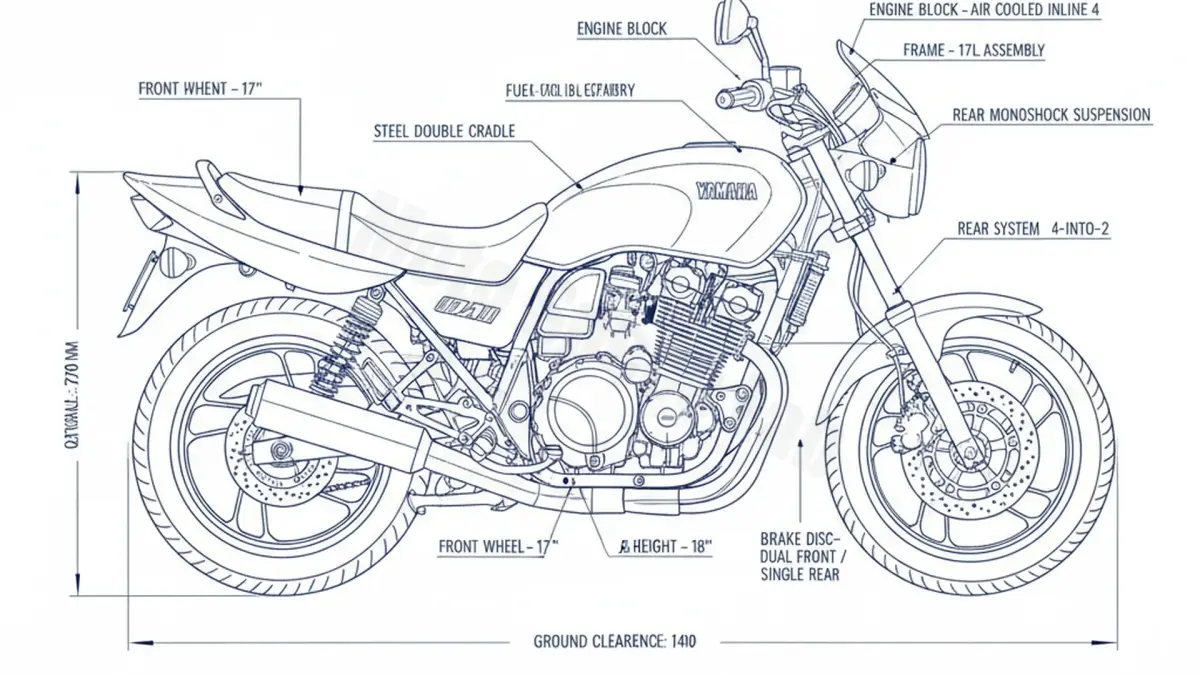
| Component | Specification |
|---|---|
| Engine Model | 598cc Air-Cooled Inline-4 (3KM Variant) |
| Production Years | 1989 – 1991 |
| Engine Oil | SAE 10W-40 / 20W-40 (API SE/SF/SG; JASO MA) |
| Oil Capacity | 2.3L (Periodic) / 2.5L (Filter) / 2.9L (Dry) |
| Tire Dimensions | F: 90/90-18 51H / R: 110/90-18 61H |
| Tire Pressure | F: 2.0 bar / R: 2.25 – 2.5 bar |
| Battery Type | YB12AL-A / YB12AL-A2 |
| Spark Plug | NGK DR8ES-L (Gap: 0.6 – 0.7 mm) |
Engineering Overview & Historical Context
The Yamaha XJ 600 (3KM) represents the final evolution of the original XJ series before the introduction of the ‘Diversion’ (S-model). A significant engineering highlight of this specific era was Yamaha’s commitment to a narrow engine profile. By mounting the alternator behind the cylinder block rather than on the end of the crankshaft, Yamaha engineers achieved a remarkably slim chassis for an inline-four, significantly enhancing lean angle clearance and aerodynamic efficiency—a design philosophy that would influence mid-weight sport-tourers for decades.
Technical Review: Performance and Reliability
The 3KM variant is highly regarded for its mechanical simplicity and robust air-cooled architecture. Delivering approximately 72 horsepower in its unrestricted form, the engine is known for a linear power delivery and a distinct mechanical character. The 18-inch wheels provide stable tracking, though they limit modern tire choices compared to 17-inch counterparts. At MotoSpecsLab, we categorize the 3KM as a ‘Modern Classic’ that offers a pure mechanical connection, devoid of the electronic complexities found in later iterations.
Maintenance Guide
Lubrication System
For optimal clutch performance and engine longevity, use a high-quality mineral or semi-synthetic 10W-40 or 20W-40 oil meeting JASO MA standards. The 3KM is sensitive to oil levels; always verify the level via the sight glass with the bike on its center stand. A standard oil change requires 2.3 liters, while a filter change increases the requirement to 2.5 liters.
Ignition & Electrical
The 3KM utilizes NGK DR8ES-L spark plugs. Maintaining a precise gap of 0.6 – 0.7 mm is critical for consistent cold starts and preventing high-RPM misfires. The electrical system relies on the YB12AL-A lead-acid battery; given the age of these machines, ensuring clean ground connections is a priority for preventing charging system failure.
Chassis & Tires
The narrow tire profiles (90/90-18 front and 110/90-18 rear) are essential for maintaining the bike’s intended flickability. Running pressures of 2.0 bar (front) and 2.25-2.5 bar (rear) ensures the correct contact patch, preventing the ‘heavy’ steering sensation often reported when pressures drop even slightly.
MotoSpecsLab Editorial Verdict
The Yamaha XJ 600 (3KM) is a testament to the longevity of Japanese air-cooled engineering. While it lacks the refinement of the later Diversion models, it offers a raw, engaging riding experience. For the DIY mechanic, it is one of the most accessible 600cc multi-cylinder bikes ever produced, provided the owner adheres to strict oil and valve clearance intervals.
Frequently Asked Questions
Q: Can I use synthetic oil in my 1990 XJ 600?
A: Yes, provided it is JASO MA rated to protect the wet clutch. However, many owners find that semi-synthetic 10W-40 provides the best balance of protection and shift quality for this vintage engine.
Q: Why is my XJ 600 3KM difficult to start after sitting?
A: This is often due to fuel evaporation in the carburetors or fouled NGK DR8ES-L plugs. Ensure your battery (YB12AL-A) is fully charged, as the ignition system requires a strong voltage drop to fire the coils effectively during cranking.