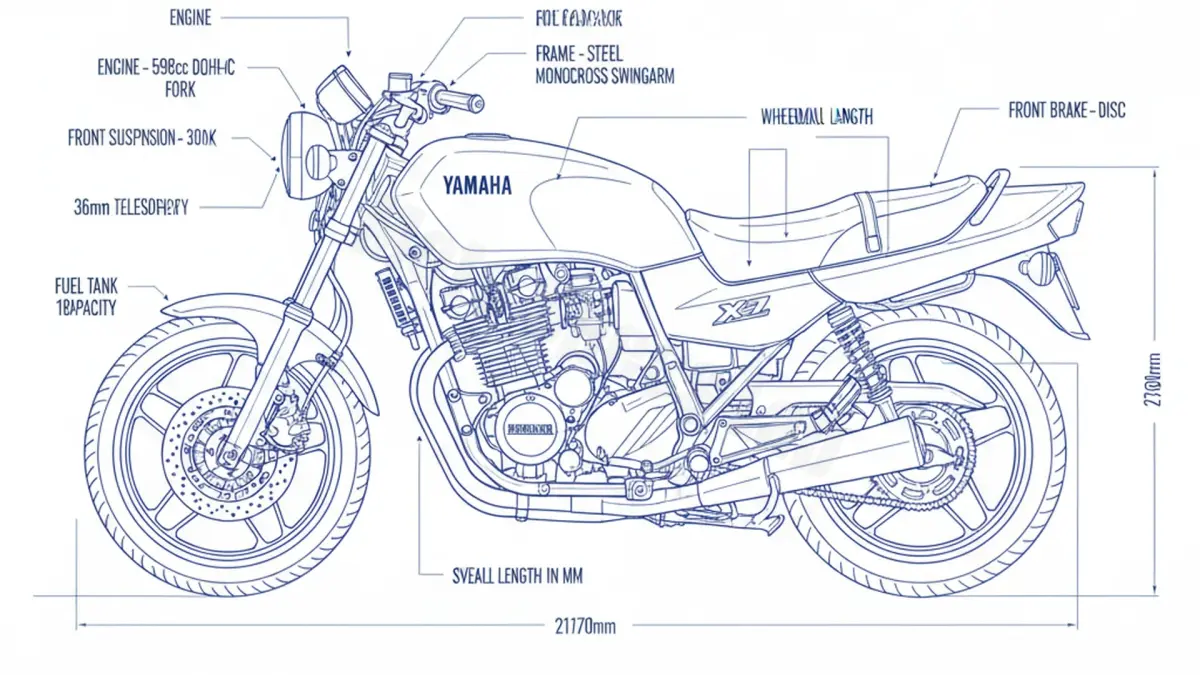
| Parameter | Specification |
|---|---|
| Production Years | 1984–1991 |
| Engine Type | Air-cooled, 4-stroke, Inline-4, DOHC |
| Engine Oil | SAE 10W-40 (2.5 L) |
| Tire Sizes | F: 90/90-18 51H / R: 110/90-18 61H |
| Tire Pressure | F: 2.0 bar / R: 2.25 bar |
| Battery | YB12AL-A |
| Spark Plug | NGK DR8ES-L (0.6–0.7 mm gap) |
Engineering Highlight: The Mono-Cross Revolution
The Yamaha XJ 600 (51J) holds a distinguished place in motorcycling history as the first Japanese 600cc inline-four to incorporate a mono-cross rear suspension system. This engineering choice bridged the gap between the utilitarian commuters of the 1970s and the high-performance sportbikes of the late 1980s. By centralizing mass and providing a rising-rate leverage ratio, the 51J offered a level of chassis composure that was previously unheard of in the middleweight segment.
Technical Performance Analysis
Equipped with a 598cc DOHC engine, the 51J produced approximately 72 horsepower in its unrestricted form. The engine is characterized by its narrow profile, achieved through the placement of the alternator behind the cylinder block rather than on the crankshaft ends. This design choice allowed for greater lean angles and a more aerodynamic silhouette.
Maintenance Guide & Essentials
Lubrication System
For optimal engine longevity, MotoSpecsLab recommends using 2.5 liters of SAE 10W-40 motor oil. Given the air-cooled nature of this engine, it is imperative to use oil meeting JASO MA standards to ensure the wet clutch does not slip under high thermal loads.
Ignition and Electrical
The 51J utilizes NGK DR8ES-L spark plugs. For smooth idling and efficient combustion, the electrode gap must be precisely set between 0.6 and 0.7 mm. Electrical stability is maintained by a YB12AL-A lead-acid battery; however, modern AGM equivalents are often used by restorers for better vibration resistance.
Chassis and Tires
The handling characteristics are highly sensitive to tire pressure. To maintain the intended geometry, the front 90/90-18 tire should be kept at 2.0 bar (29 psi) and the rear 110/90-18 at 2.25 bar (33 psi). Over-inflation can lead to a harsh ride, while under-inflation significantly degrades the feedback through the narrow front forks.
The MotoSpecsLab Verdict
The Yamaha XJ 600 (51J) remains a masterclass in balanced engineering. It is robust, relatively simple to maintain, and provides a raw mechanical connection that modern fuel-injected bikes often lack. For the enthusiast, it represents the pinnacle of the air-cooled middleweight era.