| Feature | Specification |
|---|---|
| Production Years | 2015 – 2016 |
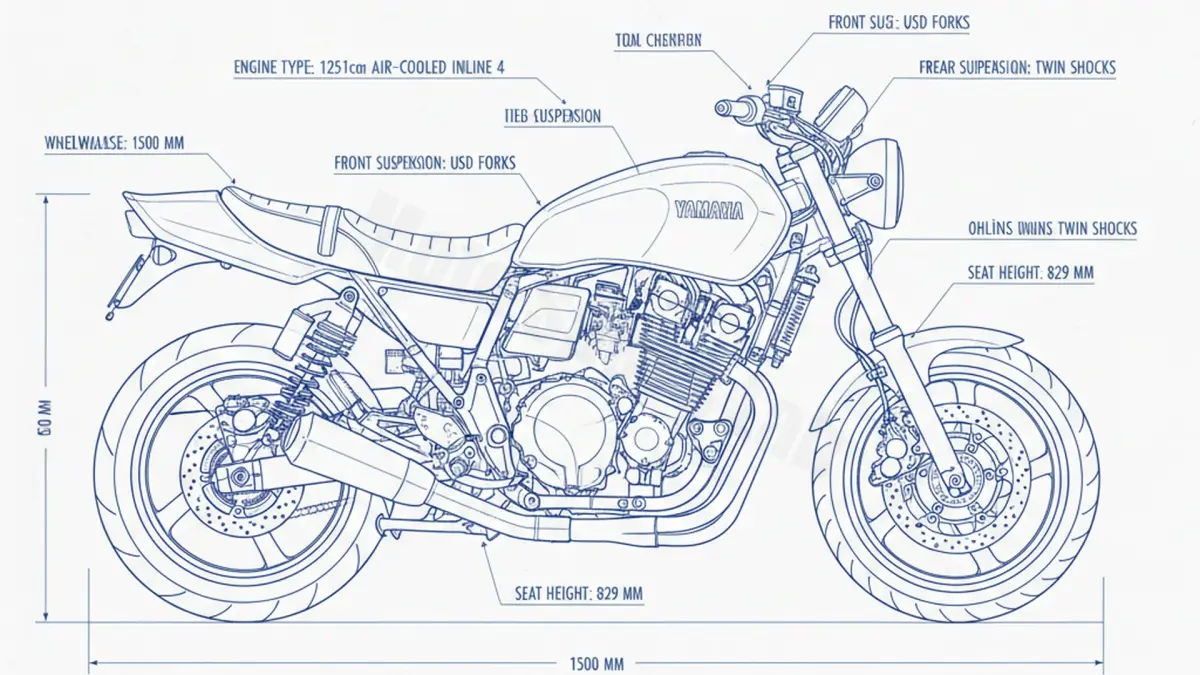
| Engine Type | 1,251cc Air-cooled, 4-stroke, DOHC, Inline-4 |
| Engine Oil | SAE 10W-40 / 20W-50 (4.15 L) |
| Spark Plug | NGK DPR8EA-9 |
| Battery | YTZ14S |
| Front Tire | 120/70 ZR 17 (2.5 bar / 36 psi) |
| Rear Tire | 180/55 ZR 17 (2.9 bar / 42 psi) |
Did you know? The Yamaha XJR 1300 Racer represents the absolute pinnacle of air-cooled engineering, utilizing a power unit whose architectural DNA can be traced back over three decades to the legendary FJ1100 of 1984. It is one of the last high-capacity, air-cooled inline-fours ever produced, making it a definitive collector’s item for those who value mechanical purity over digital complexity.
Technical Review: The RP19 Evolution
The RP19 ‘Racer’ variant, launched in 2015, was Yamaha’s response to the growing ‘Yard Built’ custom movement. While the standard XJR 1300 provided a muscular street presence, the Racer added a carbon fiber bikini cowl, carbon front fender, and aluminum clip-on handlebars to create a factory-custom Café Racer silhouette. Underneath the aesthetic upgrades lies the massive 1,251cc engine, delivering 98 horsepower and a staggering 108 Nm of torque, characterized by a seamless, linear power delivery that modern liquid-cooled engines struggle to replicate.
Maintenance Essentials
Engine Lubrication
The air-cooled nature of the RP19 means oil plays a critical role in thermal management. For standard temperate climates, a high-quality SAE 10W-40 synthetic or semi-synthetic oil is recommended. In hotter regions, 20W-50 provides better viscosity stability. The total capacity with a filter change is 4.15 Liters. Ensure the oil meets JASO MA standards to protect the wet clutch system.
Ignition and Electrical
To maintain the smooth idle the XJR is famous for, the NGK DPR8EA-9 spark plugs should be inspected every 6,000 miles. Electrical reliability is anchored by the YTZ14S battery; given the high compression and displacement, a healthy battery is essential for the starter motor to overcome the engine’s inertia.
Chassis and Tires
The Racer’s handling is significantly influenced by tire choice. The standard 120/70 ZR 17 front and 180/55 ZR 17 rear setup requires precise pressures: 2.5 bar (36 psi) front and 2.9 bar (42 psi) rear. Deviating from these pressures can lead to ‘heavy’ steering or premature cupping of the front tire due to the bike’s 240kg+ wet weight.
Editor’s Verdict
The Yamaha XJR 1300 Racer is not about lap times; it is about the visceral connection between rider and machine. It requires diligent maintenance—specifically regarding oil quality and valve clearances—but rewards the owner with a timeless riding experience and a soundtrack that modern Euro-spec bikes simply cannot match. At MotoSpecsLab, we consider the RP19 one of the most significant ‘Modern Classics’ of the 21st century.