| Specification | Value |
|---|---|
| Model Series | Yamaha XJR 1300 – RP06 |
| Production Years | 2002 – 2003 |
| Engine Oil | SAE 10W-40 JASO MA (3.35 L) |
| Tire Size (F/R) | 120/70 ZR 17 / 180/55 ZR 17 |
| Tire Pressure (F/R) | 2.5 bar (36 psi) / 2.9 bar (42 psi) |
| Battery Type | GT14B-4 |
| Spark Plug | NGK DPR8EA-9 |
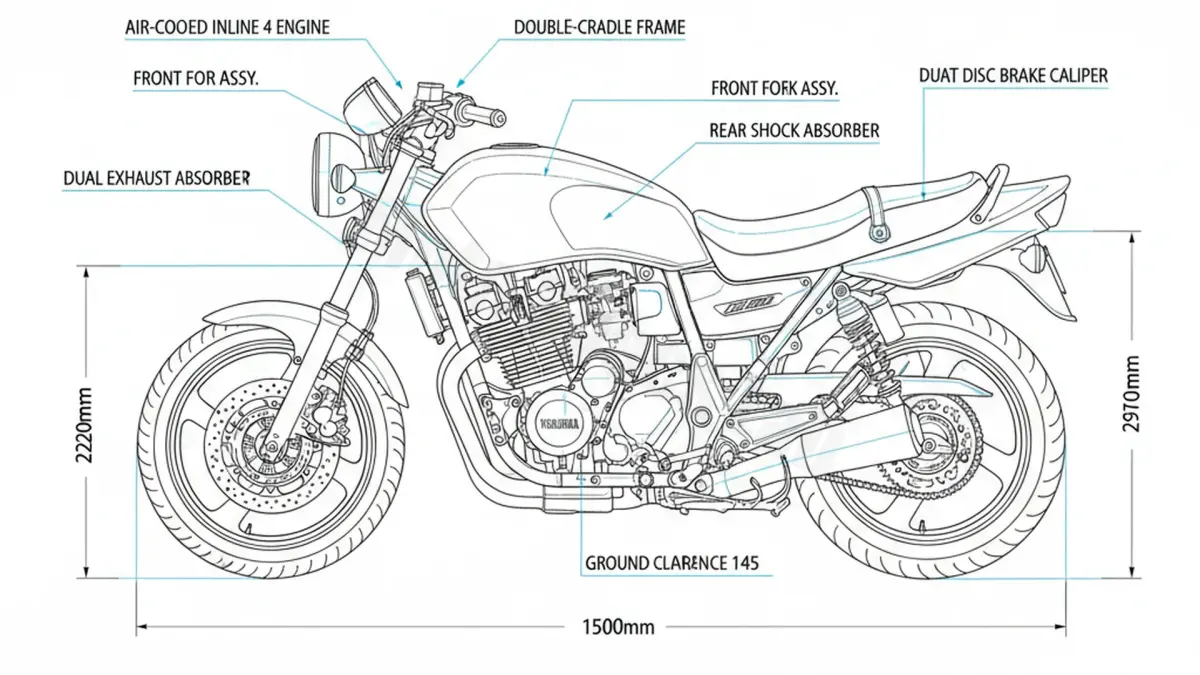
The Yamaha XJR 1300 RP06 holds a special place in motorcycling history as the final iteration of the series to utilize the legendary Mikuni BSR37 carburetors before the global shift toward fuel injection. This specific generation represents the pinnacle of mechanical purity, offering a linear throttle response that modern electronics often struggle to replicate. At its heart lies the air-cooled, 1,251cc inline-four engine—a direct descendant of the FJ1100 mill—renowned for its bulletproof reliability and massive low-end torque.
Engineering Overview
The RP06 update brought significant refinements over the previous RP02. Yamaha engineers focused on weight reduction and handling agility. The RP06 introduced a narrower fuel tank and a revised seat profile, improving rider ergonomics. Most notably, the suspension was upgraded with high-specification Öhlins rear shocks as standard, ensuring that the heavy muscle bike maintained composure through high-speed sweepers. The braking system, featuring the ‘Blue Spot’ Sumitomo calipers derived from the YZF-R1, provides exceptional stopping power for a machine of this mass.
Maintenance Guide & Technical Specs
For the home mechanic or professional technician, the RP06 is a joy to work on due to its accessible layout. Maintaining the air-cooled architecture is straightforward, though attention must be paid to oil quality to manage thermal loads.
- Lubrication: Use a high-quality 10W-40 JASO MA semi-synthetic or synthetic oil. The capacity is 3.35 liters. Given the air-cooled nature, regular intervals (every 6,000 km) are recommended.
- Ignition: The NGK DPR8EA-9 plugs should be checked for gap consistency. The RP06 is sensitive to spark health for smooth idling.
- Electrical: The GT14B-4 battery is essential; ensure terminals are clean as the large displacement engine requires significant cranking amps.
- Tires: Maintaining 2.5 bar front and 2.9 bar rear is critical for preventing ‘cupping’ on the front tire, a common issue with heavier naked bikes.
Editorial Review: MotoSpecsLab Verdict
The XJR 1300 RP06 is the quintessential ‘Big Naked’. It doesn’t pretend to be a supersport; it is a celebration of torque and presence. On the road, the engine is the star—pulling cleanly from 2,000 RPM in top gear. While the 5-speed gearbox may seem dated, the spread of power is so wide that a 6th gear is rarely missed.
Pros: Timeless aesthetics, massive torque, and the prestige of the Öhlins rear suspension.
Cons: High fuel consumption when pushed and significant wind blast at speeds over 130 km/h.
Frequently Asked Questions
What is the recommended tire pressure for the RP06?
For optimal handling and tire longevity, Yamaha recommends 2.5 bar (36 psi) for the front and 2.9 bar (42 psi) for the rear.
Is the RP06 fuel injected?
No, the RP06 (2002-2003) is the last of the carbureted models. Fuel injection was introduced in later generations (RP19).
Which battery does the XJR 1300 RP06 use?
The standard battery for this model is the GT14B-4.