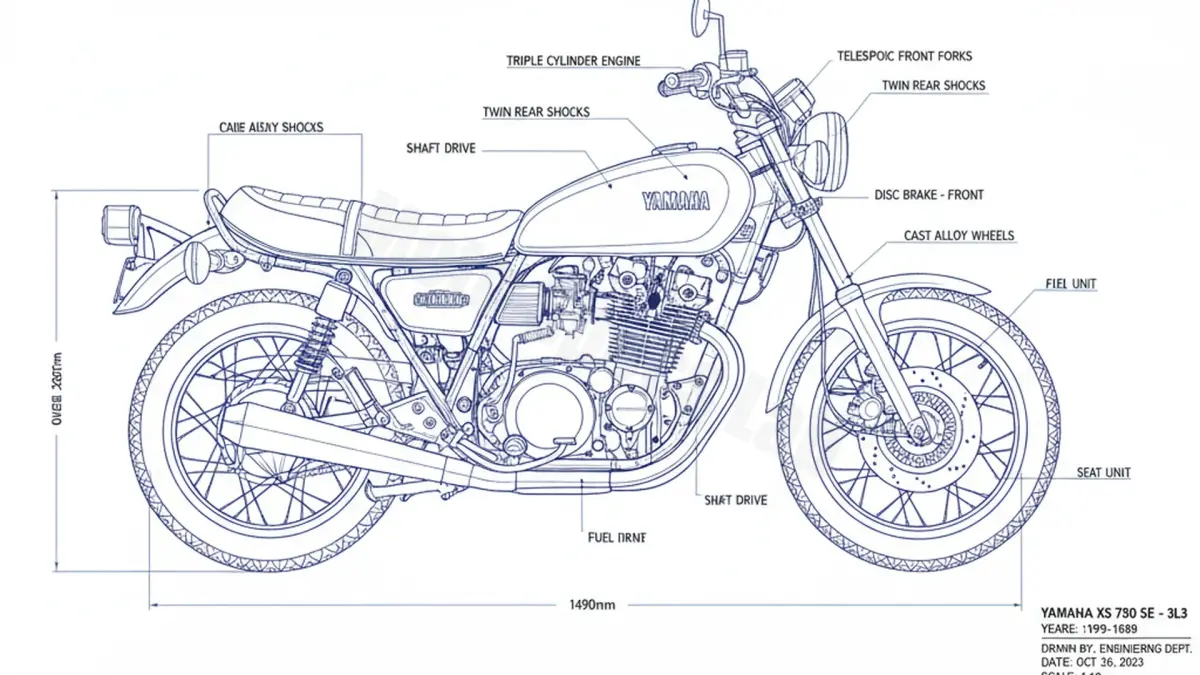
While most Japanese manufacturers in the late 1970s were locked in a four-cylinder arms race, Yamaha took a sophisticated detour with the XS 750 series. A little-known engineering highlight of the 3L3 ‘Special’ (SE) model is its 120-degree crankshaft configuration, which provided a unique exhaust note and primary balance that rivaled the smoothness of contemporary BMW boxers, while offering the power density of a multi-cylinder machine.
| Category | Specification |
|---|---|
| Model Code | 3L3 (Special Edition) |
| Production Years | 1979 – 1980 |
| Engine Type | 747cc, 3-Cylinder, 4-Stroke, DOHC |
| Oil Grade | SAE 10W-40 or 20W-50 (API SE+) |
| Oil Capacity | 3.0L (Periodic) / 3.2L (Filter) / 3.5L (Total) |
| Tire Size (Front) | 3.25 – 19 54H |
| Tire Size (Rear) | 130/90 – 16 67H |
| Tire Pressure (F/R) | 2.0 bar (28 psi) / 2.25 bar (32 psi) |
| Battery Type | YB14L-A2 |
| Spark Plug | NGK BP7ES (0.7 – 0.8 mm gap) |
Technical Review: The ‘Special’ Evolution
The 1979-1980 XS 750 SE (3L3) represented the pinnacle of Yamaha’s triple-cylinder development before the displacement bump to 850cc. Unlike the standard ‘E’ models, the ‘SE’ or ‘Special’ introduced the custom-cruiser aesthetic to the triple platform, featuring a teardrop tank, stepped seat, and a 16-inch rear wheel that significantly altered the center of gravity and low-speed maneuverability.
From a technical standpoint, the 3L3 benefited from the refined electronic ignition system and improved vacuum-operated fuel petcocks which corrected issues found in earlier 2D and 3J models. The shaft drive remains a hallmark of this machine, providing a maintenance-free experience compared to the chain-driven competitors of the era, though it does introduce the characteristic ‘shaft-jacking’ effect under hard acceleration.
Maintenance Guide & Vital Signs
Lubrication System
The XS 750 is sensitive to oil shear due to its high-revving DOHC nature and shared gearbox reservoir. We recommend a high-zinc 20W-50 mineral oil for warmer climates to protect the flat-tappet cam followers. Ensure you account for the 3.2-liter requirement when changing the element-style filter, as the housing retains a significant volume of old lubricant.
Ignition & Electrical
The YB14L-A2 battery is essential for providing the cold cranking amps required to overcome the triple’s compression. If the bike struggles to start, verify the spark plug gap of the NGK BP7ES units. A gap wider than 0.8 mm can strain the aging ignition coils, leading to intermittent misfires under load.
Chassis & Tires
The transition to a 16-inch rear tire (130/90-16) on the SE model provides a ‘fat’ look but requires strict adherence to the 2.25 bar (32 psi) pressure rating to prevent wallowing in high-speed corners. The front 19-inch wheel maintains directional stability, but ensure the 3.25-19 tire is not swapped for an oversized metric equivalent, as this can lead to heavy steering.
Summary
The Yamaha XS 750 SE 3L3 remains a connoisseur’s choice. It offers a mechanical soul that four-cylinder bikes often lack, combined with the reliability of Japanese engineering. Regular oil changes and attention to the unique triple-carburetor synchronization are the keys to keeping this 120-degree wonder on the road.