| Component | Specification |
|---|---|
| Production Years | 1980 – 1981 |
| Engine Oil | SAE 20W-40 JASO MA2 (3.5 L) |
| Front Tire | 3.25-19 54H (2.0 bar / 28 psi) |
| Rear Tire | 4.00-18 64H (2.25 bar / 32 psi) |
| Spark Plug | NGK BP7ES (Gap: 0.7 – 0.8 mm) |
| Battery | YB14L-A2 |
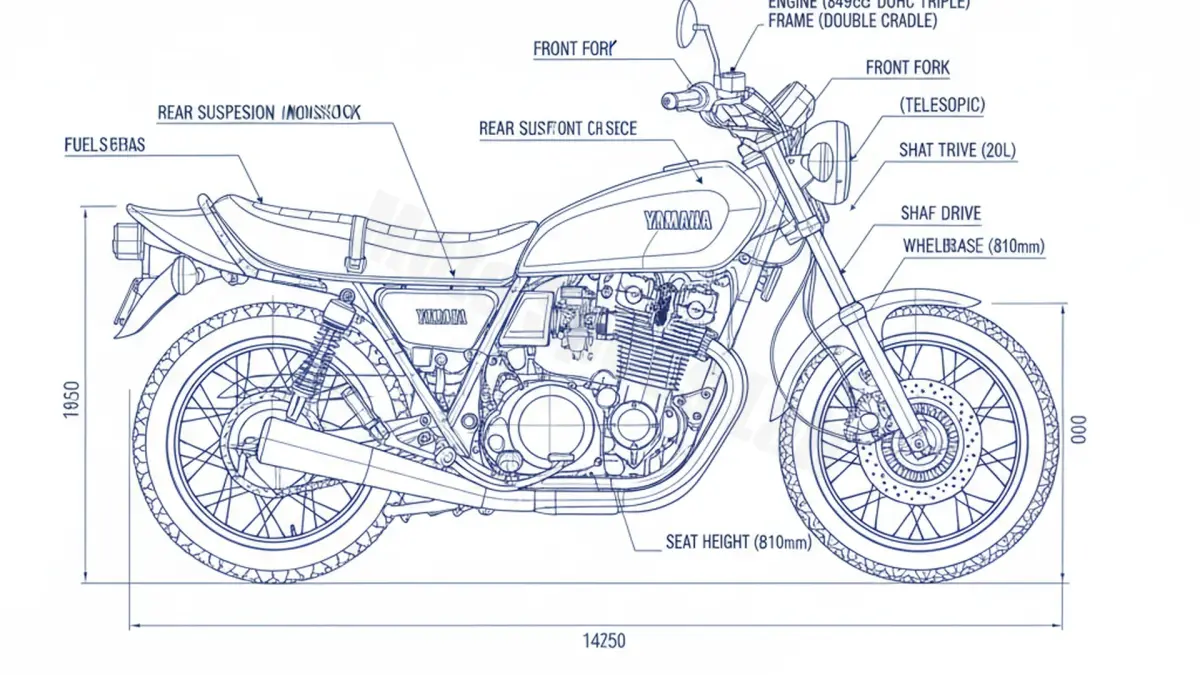
While the late 1970s were dominated by the ‘Universal Japanese Motorcycle’ (UJM) inline-four formula, the Yamaha XS 850 (4E2) represents a sophisticated engineering detour. A unique historical highlight of the XS 850 is its 120-degree crankshaft arrangement; unlike the 180-degree twins of the era, the Triple’s firing order provided a primary balance and an exhaust note that was—and remains—distinctly melodic, often described as a ‘half-Porsche’ growl.
Technical Overview: The 4E2 Evolution
The 4E2 model, produced between 1980 and 1981, was the final and most refined iteration of Yamaha’s three-cylinder shaft-drive platform. Displacement was increased from the predecessor’s 750cc to 826cc via a larger bore, addressing the torque deficit often cited in the earlier models. This engine was paired with a maintenance-free shaft drive, positioning the XS 850 as a premium ‘gentleman’s express’ or a high-speed touring machine rather than a raw street brawler.
The 4E2 specifically featured improved oil cooling—a critical update—with an external oil cooler often found on these models to mitigate the heat generated by the middle cylinder, a common pain point in air-cooled triples.
Maintenance Guide & Service Requirements
1. Lubrication System
The XS 850 is sensitive to oil quality due to its shared sump and high-stress transmission gears. We recommend SAE 20W-40 JASO MA2 to ensure the wet clutch does not slip while providing adequate shear stability for the shaft drive output gears. Total capacity is 3.5 Liters.
2. Ignition & Electrical
For optimal combustion, NGK BP7ES plugs are mandatory. Ensure the gap is set precisely between 0.7 and 0.8 mm. The electrical system relies on the YB14L-A2 battery; given the age of these machines, checking the charging system’s stator output is a vital part of seasonal maintenance, as the Hitachi regulators on the 4E2 can degrade over time.
3. Chassis & Tires
Handling on the XS 850 is heavily dependent on tire pressure. Using the factory-spec 3.25-19 front and 4.00-18 rear tires, maintain 2.0 bar and 2.25 bar respectively. Modern compound tires in these vintage sizes significantly improve the bike’s tendency to ‘stand up’ during mid-corner braking.
Editorial Verdict
The Yamaha XS 850 – 4E2 remains a masterclass in characterful engineering. It offers a mechanical soul that contemporary fours lacked. For the modern collector, it represents a high-value entry into vintage touring, provided the owner respects the specific maintenance needs of its unique three-cylinder architecture.