| Component | Specification |
|---|---|
| Engine Type | 890cc Liquid-cooled, DOHC, 3-cylinder; 4 valves per cylinder |
| Oil Requirement | 10W-40 API SG/JASO MA2 (3.2 L capacity) |
| Tire Dimensions | F: 120/70 ZR 17 / R: 180/55 ZR 17 |
| Tire Pressure | F: 2.5 bar (36 psi) / R: 2.9 bar (42 psi) |
| Battery | YTZ10S |
| Spark Plug | NGK LMAR9G-9 |
Engineering Heritage: The Deltabox Evolution
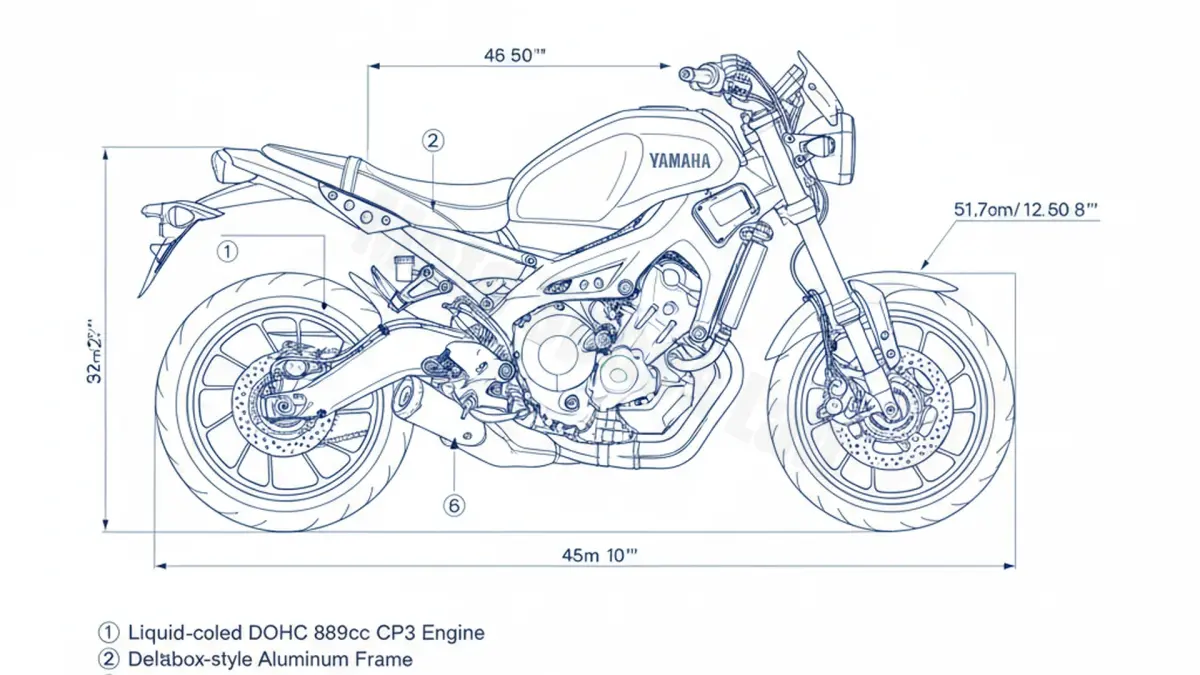
The Yamaha XSR 900 (XSR900/25) represents a masterclass in ‘Faster Sons’ philosophy. While many retro bikes focus solely on aesthetics, the XSR900 is built upon a unique engineering highlight: the 2022+ chassis utilizes a Controlled Filling (CF) die-cast aluminum Deltabox frame. This frame is significantly stiffer than its predecessor, featuring varied section thicknesses to optimize rigidity and feedback, a direct technological lineage from the Christian Sarron-era Sonauto Yamaha GP racers of the 1980s.
CP3 Powertrain Analysis
At the heart of the XSR900 is the legendary 890cc Crossplane 3 (CP3) engine. This powerplant utilizes a 120-degree crank pin offset, providing a linear torque delivery and a distinct triple-cylinder howl. For the XSR900/25 generation, the engine features increased displacement and optimized fuel injection, resulting in a broader powerband. To maintain this precision machinery, MotoSpecsLab recommends strictly adhering to the 10W-40 JASO MA2 oil specification to ensure the wet-clutch and integrated gearbox remain lubricated under high thermal loads.
Maintenance Roadmap
Lubrication and Filtration
The total oil capacity is 3.2 liters. When performing a standard oil and filter change, ensure the drain bolt is torqued to factory specifications to prevent damage to the aluminum crankcase. Use only high-quality synthetic oils meeting API SG standards to protect the high-revving valve train.
Ignition and Electrical
The XSR900 utilizes the high-performance NGK LMAR9G-9 spark plugs. These long-reach plugs are essential for efficient combustion within the compact pent-roof combustion chamber. Electrical stability is managed by the YTZ10S battery; given the bike’s advanced 6-axis IMU and electronic rider aids, maintaining a healthy voltage is critical to prevent sensor errors.
Chassis and Contact Patch
Handling precision is highly dependent on tire pressure. The factory-recommended 36 psi front and 42 psi rear are optimized for the chassis’s rigidity. Deviating from these pressures significantly alters the bike’s tip-in characteristics and mid-corner stability.
Frequently Asked Questions
What is the recommended spark plug for the XSR900?
The manufacturer specifies the NGK LMAR9G-9 for optimal heat dissipation and ignition reliability.
How much oil does the XSR900/25 take during a change?
The system requires 3.2 liters of 10W-40 JASO MA2 oil when changing the filter.
What are the factory tire pressures?
For standard road use, the front should be set to 2.5 bar (36 psi) and the rear to 2.9 bar (42 psi).