| Feature | Specification |
|---|---|
| Production Years | 1985 – 2000 |
| Engine Type | 346cc, 4-stroke, Air-cooled, DOHC, 4-valve |
| Oil Type | SAE 10W-30 or 20W-40 (JASO MA) |
| Oil Capacity | 1.3L (Periodic) / 1.5L (Filter) / 1.6L (Dry) |
| Tires (F/R) | 3.00-21 51P / 110/90-18 58P |
| Tire Pressure | 1.5 bar (22 psi) Front & Rear |
| Spark Plug | NGK DR8ES-L (Gap: 0.6–0.7 mm) |
| Battery | YB3L-B (12V) |
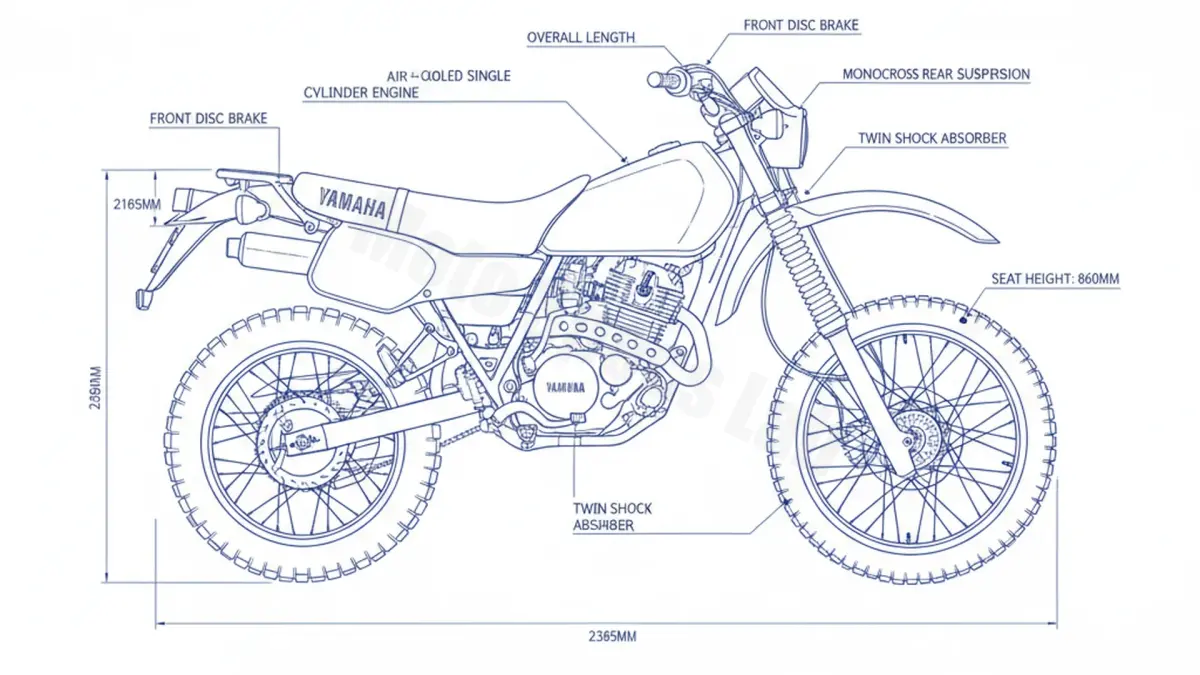
The Yamaha XT 350 (55V) stands as a landmark in dual-sport engineering, most notably for introducing the Yamaha Dual Intake System (YDIS). Unlike conventional single-carburetor setups of its era, the XT 350 utilized a staged twin-carburetor configuration: a primary Teikei carburetor for low-to-mid RPM throttle response and a secondary vacuum-actuated unit that opened at higher loads. This innovative approach allowed the 346cc thumper to deliver smooth low-end torque while maintaining a surprisingly wide powerband for a mid-sized air-cooled engine.
Engineering Overview
At the heart of the 55V is a Double Overhead Cam (DOHC) four-valve engine. This was a significant step up from the SOHC designs typical of the 1980s, offering better valve control and efficiency at high RPMs. The 6-speed transmission further enhanced its versatility, making it one of the few mid-range dual-sports capable of sustained highway speeds without excessive vibration or engine strain.
Maintenance Guide & Technical Specifications
Lubrication System
The XT 350 relies on a wet-sump lubrication system. For optimal clutch performance and engine longevity, use a JASO MA compliant oil to prevent clutch slippage.
- Periodic Change: 1.3 Liters
- With Filter Replacement: 1.5 Liters
- Total Dry Capacity: 1.6 Liters
Ignition and Electrical
The ignition timing is handled by a CDI system, which is generally maintenance-free. However, the spark plug (NGK DR8ES-L) should be inspected every 3,000 miles. Ensure the gap is precisely 0.6–0.7 mm to prevent misfires under high compression. The 12V electrical system is powered by a compact YB3L-B battery; given the kickstart-only nature of the 55V, battery health is primarily critical for lighting and signal stability.
Chassis and Tires
The 21-inch front and 18-inch rear wheel combination is the gold standard for off-road stability. For mixed-use riding, maintain a pressure of 1.5 bar (22 psi). If tackling heavy sand or technical trails, pressures can be dropped slightly, but rim locks are recommended if going below 15 psi to prevent tube shearing.
Editor’s Verdict
The Yamaha XT 350 – 55V remains a favorite for enthusiasts who value mechanical simplicity and lightweight agility. While the YDIS carburetor system requires precise synchronization to function correctly, the reward is a machine that punches well above its weight class in both technical trails and rural commuting. It is a masterclass in ’80s over-engineering that remains relevant for the modern vintage rider.