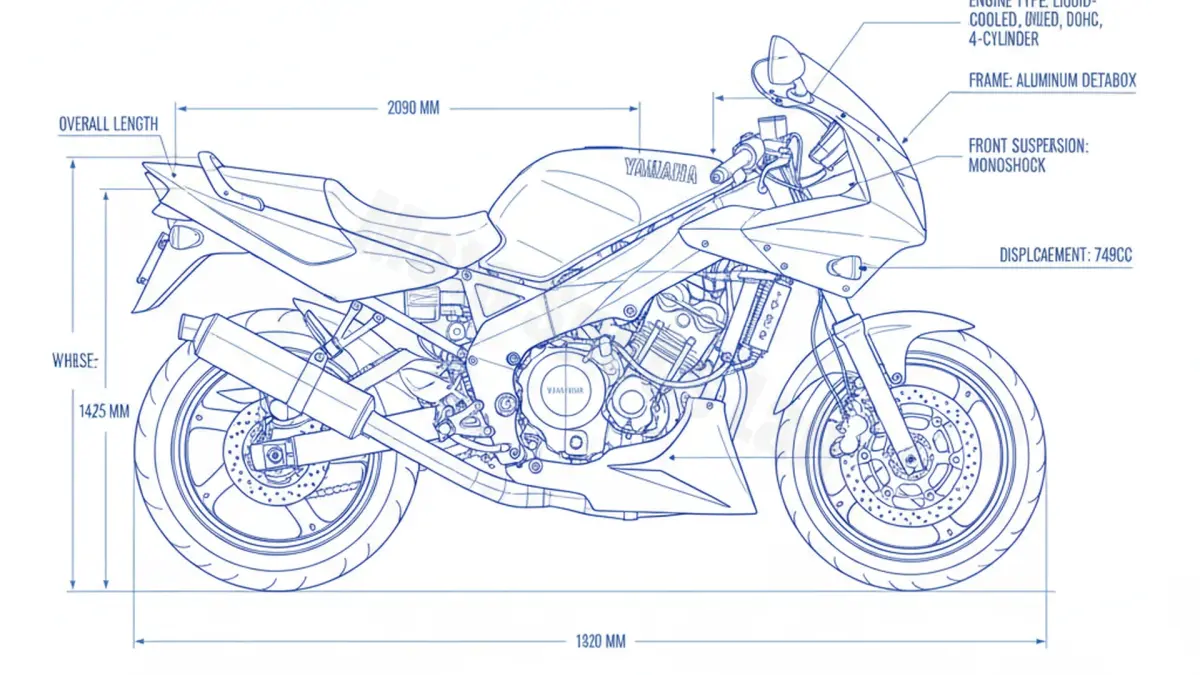
| Attribute | Specification |
|---|---|
| Production Years | 1993 – 1998 |
| Engine Type | 749cc, Liquid-cooled, 20-valve DOHC Inline-4 |
| Oil Capacity | 3.5 L (SAE 10W-40 JASO MA2) |
| Tire Size | F: 120/70 ZR 17 | R: 180/55 ZR 17 |
| Tire Pressure | F: 2.25 bar (33 psi) | R: 2.50 bar (36 psi) |
| Spark Plug | NGK CR9E (Gap: 0.7–0.8 mm) |
| Battery | YTX12-BS |
Historical Engineering Highlight: The Yamaha YZF 750 R (4HN) remains a landmark in motorcycling history as the first production machine to successfully integrate the 20-valve “Genesis” cylinder head with the EXUP (Exhaust Ultimate Power Valve) system specifically optimized for the 750cc class. While its rivals struggled with the compromise between mid-range torque and top-end power, the 4HN utilized its variable exhaust geometry to dominate the World Superbike (WSBK) landscape, proving that high-revving track performance did not have to sacrifice street rideability.
Technical Deep Dive: The 4HN Architecture
At the heart of the YZF 750 R is a liquid-cooled, four-cylinder engine featuring Yamaha’s signature five-valve-per-cylinder layout (three intake, two exhaust). This design allowed for a more efficient combustion chamber shape and increased valve area compared to traditional four-valve setups. The 4HN variant is particularly noted for its robust Deltabox aluminum frame, which provided a level of torsional rigidity that set the standard for the mid-90s superbike era.
Braking and Suspension
One of the most striking technical features of the 4HN was the inclusion of six-piston Nissin brake calipers as standard equipment—a rarity for the time. These were paired with 320mm floating discs, offering immense stopping power. The suspension featured fully adjustable 41mm inverted Kayaba forks, allowing riders to fine-tune the front-end geometry for specific track conditions.
Maintenance Guide: Keeping the Legend Alive
Maintaining a 4HN requires precision, particularly regarding its lubrication and cooling systems, which are critical for the high-revving 20-valve head.
1. Lubrication System
The YZF 750 R requires 3.5 Liters of high-quality synthetic or semi-synthetic SAE 10W-40 oil. It is imperative to use oil that is JASO MA2 certified to ensure the wet clutch does not slip under high load. Oil changes should occur every 6,000 km (approx. 4,000 miles) or annually.
2. Ignition and Spark Plugs
The engine utilizes NGK CR9E spark plugs. Given the high compression ratio, the electrode gap must be strictly maintained between 0.7 and 0.8 mm. Fouled plugs are common if the bike is used primarily for short city trips, as the engine requires reaching operating temperatures to self-clean the 20 valves.
3. Chassis and Tires
For optimal handling, the 4HN should be fitted with 120/70 ZR 17 front and 180/55 ZR 17 rear tires. Maintaining the correct pressure is vital for the Deltabox frame’s feedback: 2.25 bar (33 psi) at the front and 2.50 bar (36 psi) at the rear.
Editor’s Verdict
The Yamaha YZF 750 R (4HN) is more than just a 90s sportbike; it is a precision instrument of the homologation era. While it requires more diligent maintenance than a modern machine—particularly regarding the EXUP valve lubrication and valve clearances—the rewards are a visceral, mechanical connection to the road that few modern bikes can replicate.
Frequently Asked Questions (FAQ)
Q: How often should the EXUP valve be serviced?
A: It is recommended to inspect and lubricate the EXUP valve every 10,000 km to prevent the cables from seizing due to heat cycling.
Q: Can I use a different battery than the YTX12-BS?
A: While lithium alternatives exist, the YTX12-BS provides the necessary cold cranking amps (CCA) required for the 750cc high-compression starter motor.