| Specification | Value |
|---|---|
| Model Code | RJ151 |
| Production Years | 2008–2009 |
| Engine Oil | SAE 10W-40, API SG+, JASO MA (2.6 L) |
| Tire Size (F/R) | 120/70 ZR 17 / 180/55 ZR 17 |
| Tire Pressure (F/R) | 2.5 bar (36 psi) / 2.9 bar (42 psi) |
| Spark Plug | NGK CR10EK |
| Battery | YTZ10S |
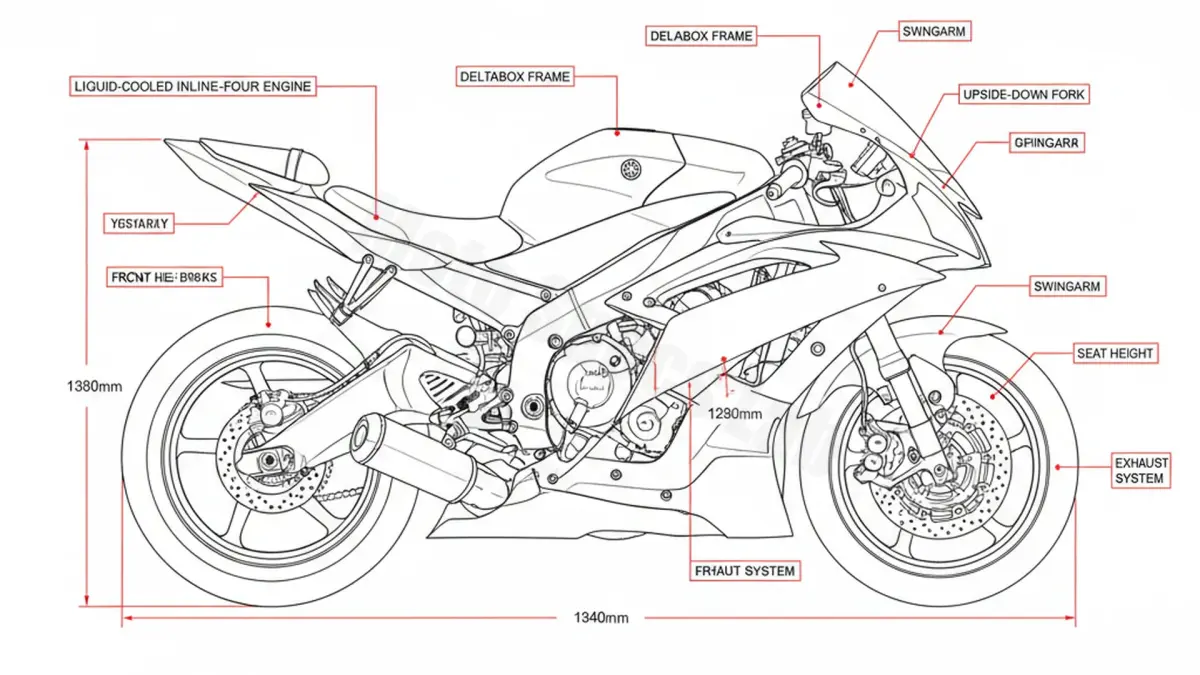
The Yamaha YZF-R6 RJ151 represents a pivotal moment in supersport history. It was the first production 600cc motorcycle to utilize a magnesium subframe, a high-cost material choice aimed at aggressive mass centralization and reducing the bike’s polar moment of inertia. This engineering feat, combined with the introduction of the Yamaha Chip Controlled Intake (YCC-I), allowed the RJ151 to deliver a powerband that felt significantly broader than its predecessor, despite its screaming 16,000+ RPM ceiling.
Technical Engineering Deep Dive
Building upon the foundational success of the RJ11, the RJ151 featured over 50 engine refinements. The compression ratio was increased to 13.1:1, requiring high-octane fuel and precise ignition timing. The YCC-I system electronically adjusts the length of the intake funnels at 13,700 RPM, optimizing both low-end torque and peak horsepower. From a chassis perspective, the RJ151’s frame was stiffened at the head pipe and swingarm pivot to improve front-end feedback during high-speed corner entry.
Maintenance Guide for Professionals
Lubrication System
For the RJ151, Yamaha specifies 2.6 liters of engine oil when changing the filter. To maintain the integrity of the wet clutch system, use SAE 10W-40 that meets JASO MA standards. Using oils with friction modifiers (energy conserving) can lead to clutch slippage under high loads.
Ignition and Electrical
The RJ151 utilizes NGK CR10EK dual-ground electrode spark plugs. These are designed to withstand the extreme thermal loads of a high-compression engine. The electrical system is powered by a YTZ10S battery; given the high compression ratio, a healthy battery is critical for consistent starting.
Chassis and Contact Patch
Optimal handling is achieved with a 120/70-17 front and 180/55-17 rear tire. For street use, Yamaha recommends 2.5 bar (36 psi) in the front and 2.9 bar (42 psi) in the rear. Track enthusiasts should note that these pressures are intended for maximum load stability; track-specific pressures will vary significantly based on compound and ambient temperature.
Verdict
The RJ151 remains one of the most focused track tools ever built. Its uncompromising ergonomics and high-revving nature make it a specialist machine that rewards precision. Proper adherence to the technical specifications outlined above is essential for maintaining its razor-sharp performance characteristics.