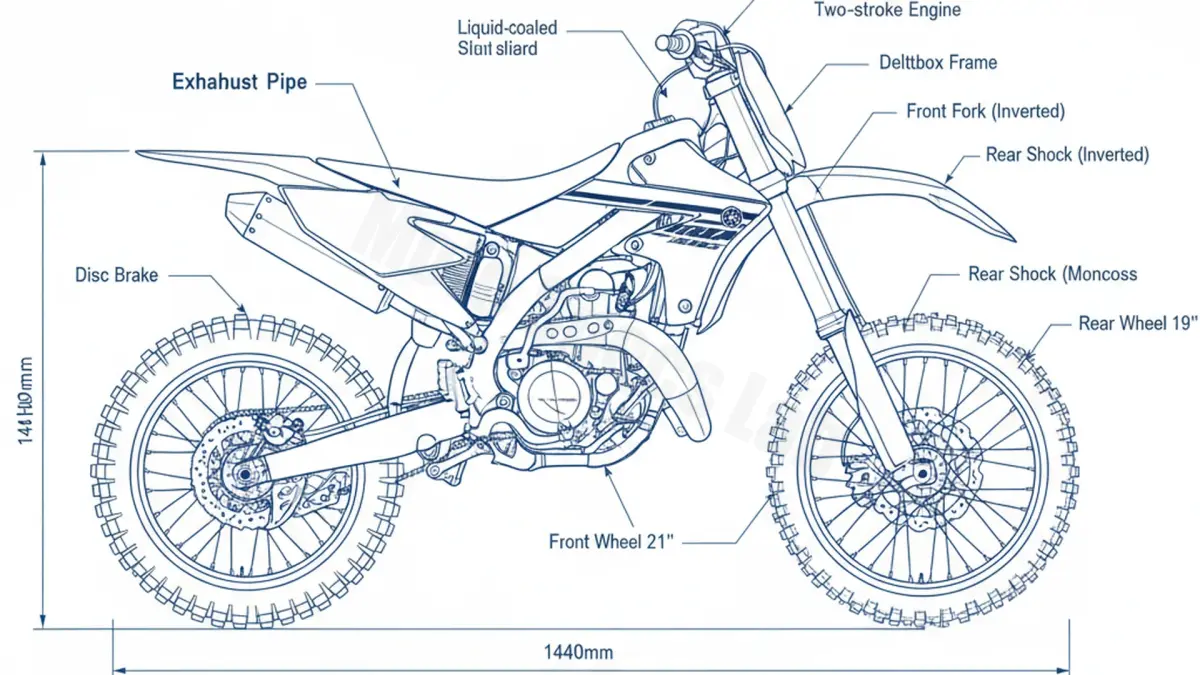
| Quick Specs: 2013 Yamaha YZ 125 | |
|---|---|
| Model Code | CE16C / 1SRN |
| Engine Type | 124cc 2-stroke, liquid-cooled, reed-valve induced |
| Transmission Oil | 0.66 L (10W-30) |
| Spark Plug | NGK BR9EG |
| Front Tire | 80/100-21 51M (15 psi) |
| Rear Tire | 100/90-19 57M (15 psi) |
The Yamaha YZ 125 holds the prestigious title of being the longest-running production motocross bike in history, having been in continuous production since 1974. The 2013 iteration (CE16C/1SRN) represents the peak of Yamaha’s refinement of the aluminum semi-double-cradle frame, a chassis so well-engineered that it remained the benchmark for handling in the 125cc class for over a decade.
Engineering Excellence: The CE16C Platform
At MotoSpecsLab, our analysis of the CE16C platform highlights the synergy between the lightweight chassis and the high-revving 124cc power plant. Unlike its four-stroke counterparts, the 2013 YZ 125 offers a power-to-weight ratio that rewards aggressive riding and precise gear selection. The 1SRN variant maintains the legendary KYB Speed-Sensitive System (SSS) front forks, which provide industry-leading damping characteristics across a wide range of terrain.
Maintenance & Fluid Requirements
To maintain peak performance and prevent premature wear of the internal components, adherence to the following fluid specifications is critical:
- Transmission Lubrication: Use 0.66 Liters of Yamalube 4 (10W-30) or an equivalent SAE 10W-30 Type SE motor oil. Regular changes after every 5 hours of competitive use are recommended.
- Ignition System: The NGK BR9EG is the essential spark plug for this high-compression engine. Ensure the gap is checked regularly to prevent fouling under heavy load.
- Cooling System: As a liquid-cooled two-stroke, the YZ 125 requires a high-quality ethylene glycol-based coolant to prevent cavitation and overheating during high-RPM operation.
Chassis and Tire Management
Handling precision on the 2013 YZ 125 is highly dependent on tire condition and pressure. The factory recommends a balanced 1.0 bar (15 psi) for both the 80/100-21 front and 100/90-19 rear tires. While riders may adjust slightly for track conditions (lower for sand, higher for hard-pack), staying within 2 psi of the factory recommendation ensures the integrity of the sidewall under heavy cornering loads.
FAQ
What is the fuel-to-oil premix ratio?
While specifications can vary based on the oil brand, Yamaha typically recommends a 30:1 ratio using high-quality 2-stroke racing oil for the YZ 125.
How often should the top-end be serviced?
For competitive racing, the piston and rings should be inspected every 7.5 to 10 hours of operation. For recreational riding, this interval can be extended, but compression tests should be performed regularly.
Does the 2013 YZ 125 have a battery?
No, the YZ 125 is a pure kick-start motocross machine and does not utilize a battery or an electric starter system.