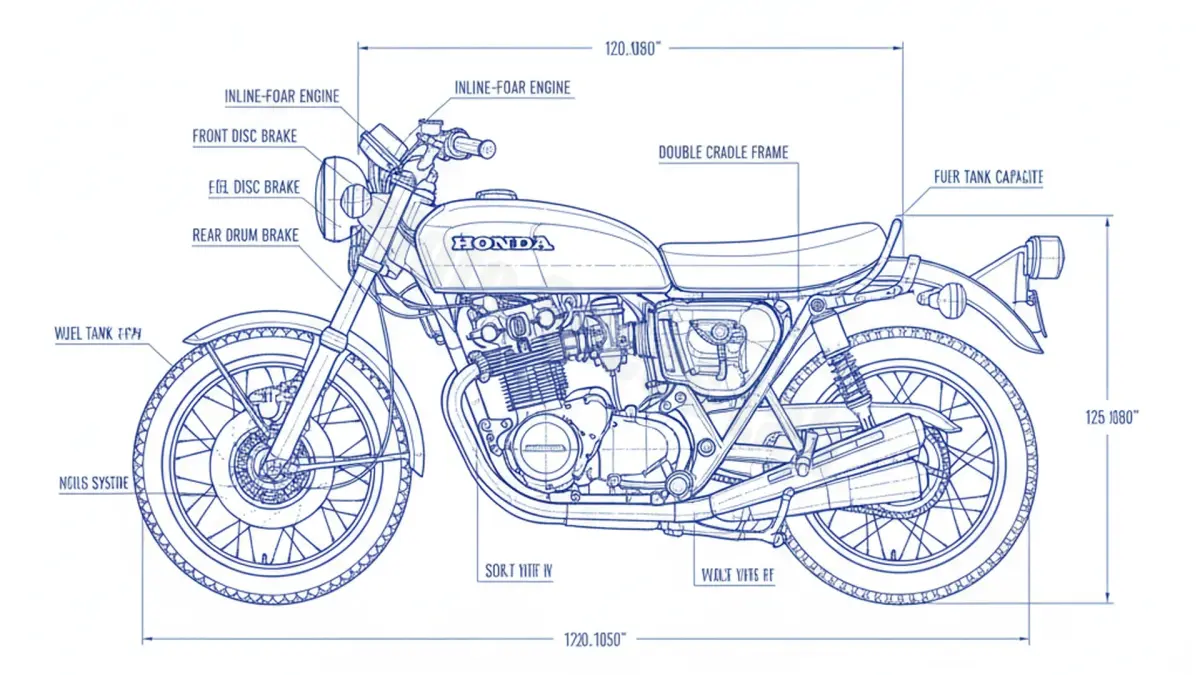
| Quick Specs: Honda CB 750 F1/F2 | |
|---|---|
| Production Years | 1975–1978 |
| Engine Oil | SAE 10W-40 (JASO-MA) (3.5 L Dry / 3.0 L Refill) |
| Tire Size | F: 100/90-19 / R: 120/90-18 |
| Tire Pressure | F: 2.0 bar (28 psi) / R: 2.25-2.8 bar (32-40 psi) |
| Battery | YB14L-A2 (12N14-3A) |
| Spark Plugs | NGK D8EA (D9EA for high-speed F2) |
While the original 1969 CB750K0 defined the modern motorcycle, the Honda CB 750 F1 and F2 (CB750F/G) models represent the absolute zenith of the SOHC (Single Over Head Cam) inline-four era. A unique engineering highlight of the F2 model was its factory-painted black engine and significantly enlarged valves—features that pushed the aging SOHC design to produce nearly 73 horsepower, a remarkable feat for the late 1970s before the DOHC transition.
Technical Engineering Overview
The F1 (1975-1977) brought a sleeker, more aggressive ‘supersport’ aesthetic to the CB750 line, featuring a 4-into-1 exhaust system and a rear disc brake, correcting one of the primary criticisms of the early K-series. However, it was the 1977-1978 F2 (G) that truly pushed technical boundaries. Honda engineers revised the cylinder head, increased valve sizes, and utilized more aggressive cam timing to compete with the emerging multi-cylinder threats from Kawasaki and Suzuki.
Maintenance & Service Guide
Lubrication System
The CB 750 F-series utilizes a dry-sump lubrication system. For optimal protection of the plain bearings and the primary drive chain, use a high-quality SAE 10W-40 mineral or semi-synthetic oil meeting JASO-MA standards. Ensure you check the oil level while the bike is upright after a short warm-up period. A standard oil change requires 3.0 liters, whereas a full engine teardown requires 3.5 liters.
Ignition and Electrical
The electrical system relies on the YB14L-A2 (12N14-3A) battery. For standard riding, the NGK D8EA spark plug is the factory specification. However, for the high-performance F2 (G) model, especially during sustained high-speed touring or track use, the colder NGK D9EA is recommended to prevent pre-ignition and manage the higher combustion chamber temperatures.
Chassis and Tires
The F-series moved toward more modern metric sizing. The 100/90-19 front and 120/90-18 rear combination provides a stable contact patch. Maintaining correct pressure is critical for handling: 2.0 bar (28 psi) at the front and 2.25 bar (32 psi) at the rear. If carrying a passenger or heavy luggage, the rear pressure must be increased to 2.8 bar (40 psi) to prevent sidewall deformation.
The MotoSpecsLab Verdict
The Honda CB 750 F1/F2 remains a cornerstone of vintage motorcycling. While the F2 offers the most power of the SOHC family, it requires diligent maintenance of its valve clearances and cam chain tensioners to ensure longevity. For the collector or enthusiast, these models offer the perfect bridge between classic 60s style and 80s performance engineering.