| Parameter | Specification |
|---|---|
| Model Code | 4UN (European Market) |
| Production Years | 1995 – 1999 |
| Engine Type | 849cc Parallel Twin, 270° Crankshaft |
| Oil Capacity | 3.5 L (with filter) |
| Spark Plug | NGK DPR8EA-9 |
| Battery | GT12B-4 |
| Front Tire | 120/60 ZR 17 |
| Rear Tire | 160/60 ZR 17 |
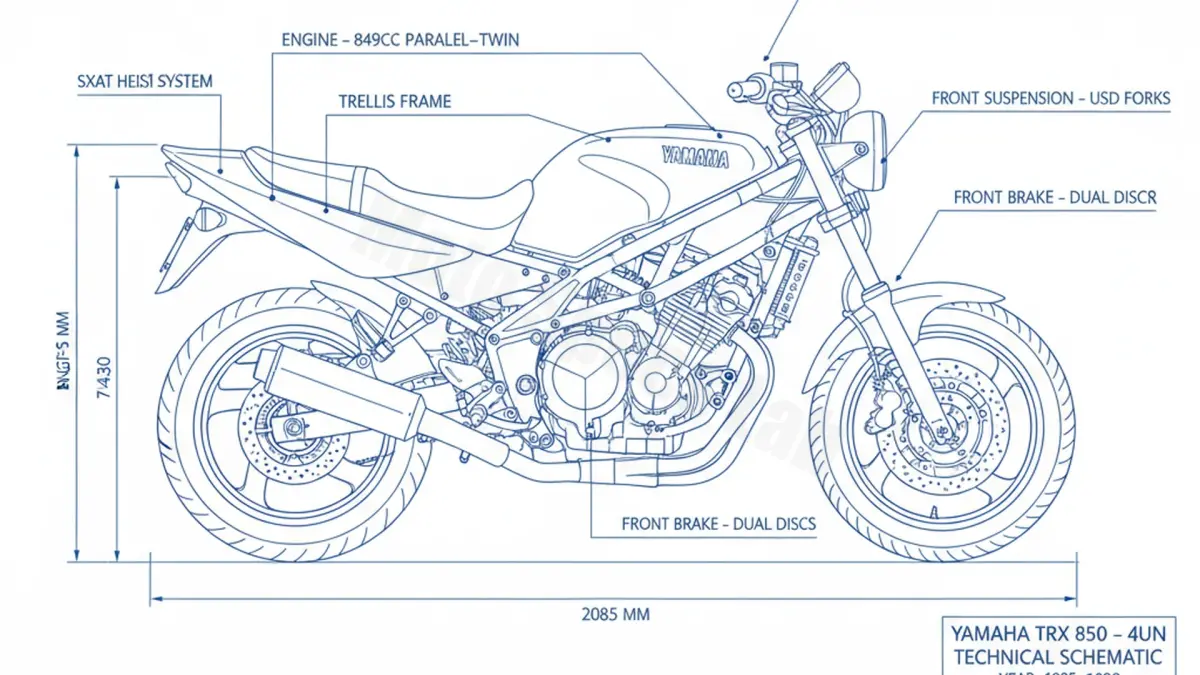
The Yamaha TRX 850 occupies a unique position in motorcycling history as the first production motorcycle to feature a 270-degree crankshaft. This engineering innovation, often referred to as a ‘crossplane’ concept today, was designed to eliminate the inertial torque fluctuations of a traditional 180-degree twin, effectively mimicking the firing order and power delivery of a 90-degree V-twin. This gave the TRX 850 its signature ‘thump’ and exceptional rear-wheel traction, long before the technology became a staple of the YZF-R1 series.
Engineering Deep Dive: The 4UN Chassis and Powerplant
While the Japanese domestic market received the earlier iterations, the 4UN designation typically refers to the European-spec models. The heart of the machine is a liquid-cooled, 10-valve DOHC engine. Unlike the TDM 850 from which it was derived, the TRX was housed in a lightweight tubular steel trellis frame, a clear nod to Italian design influences of the era. The result was a narrow, agile chassis that offered superb feedback through high-speed sweepers.
Maintenance Essentials
To maintain the mechanical integrity of the 270-degree engine, strict adherence to lubrication and ignition standards is required. The dry-sump lubrication system requires careful monitoring of oil levels.
- Engine Oil: Use a high-quality mineral or semi-synthetic SAE 10W-40 or 20W-40. Ensure it meets API SE, SF, or SG and JASO MA specifications to protect the wet clutch. A full change with a filter requires 3.5 liters.
- Ignition: The 4UN utilizes NGK DPR8EA-9 spark plugs. Proper gapping is essential for the unique firing intervals of this engine.
- Electrical: The GT12B-4 battery is standard. Given the TRX’s age, ensure the charging system is outputting correctly to prevent premature battery failure.
Wheels, Tires, and Handling
The TRX 850’s handling is sensitive to tire choice and pressure. The factory-specified sizes are a 120/60 ZR 17 front and a 160/60 ZR 17 rear. While modern riders often experiment with a 120/70 front for increased stability, the 120/60 provides the quick turn-in the bike was designed for.
Recommended Pressures:
Front: 2.25 bar (33 psi)
Rear: 2.50 bar (36 psi)
The MotoSpecsLab Verdict
The Yamaha TRX 850 (4UN) remains a connoisseur’s choice. It offers the character of a Ducati with the legendary reliability of 1990s Yamaha engineering. For owners, the key to longevity lies in frequent oil changes and maintaining the vacuum synchronization of the twin Mikuni carburetors. It is not just a motorcycle; it is a milestone in crankshaft evolution.