| Component | Specification |
|---|---|
| Engine Oil | SAE 5W-40, API SJ / JASO MA2 (3.0 L) |
| Tires (Front/Rear) | 120/70 ZR 17 / 180/55 ZR 17 |
| Tire Pressure (F/R) | 2.5 bar (36.3 psi) / 2.9 bar (42.1 psi) |
| Battery | YTX14-BS (12V / 12Ah) |
| Spark Plug | NGK DCPR8E (Gap: 0.8 mm – 0.9 mm) |
Engineering Highlight: The Counter-Balance Revolution
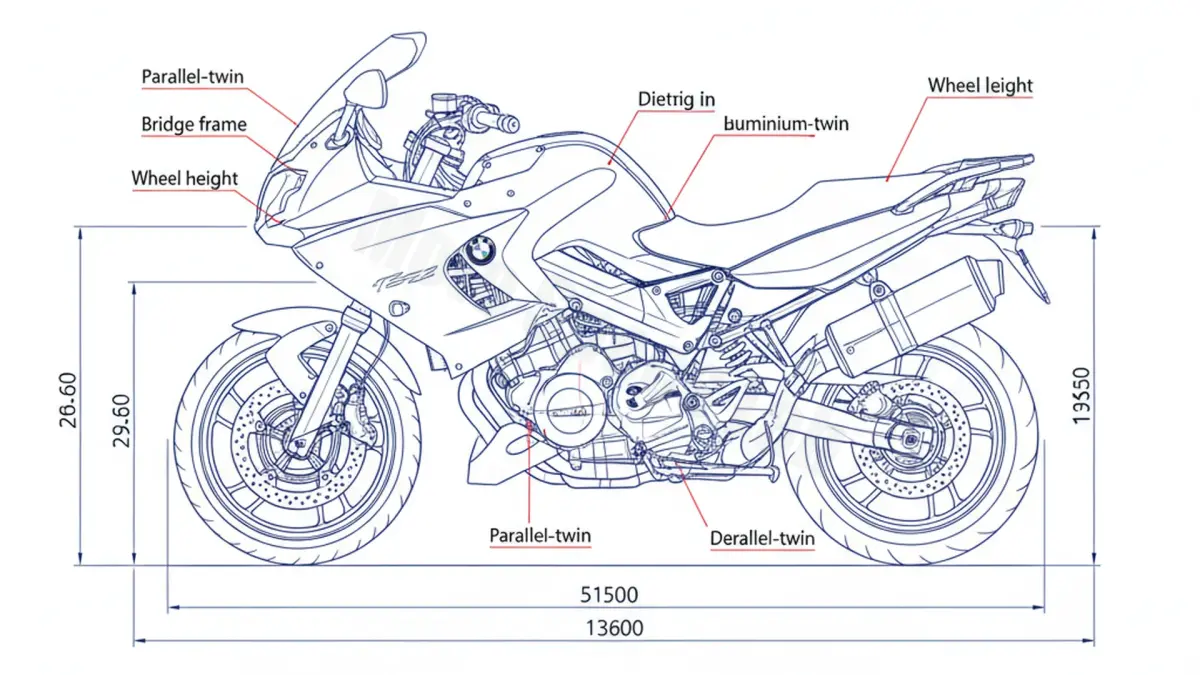
The BMW F 800 GT (0B53) is not merely a middleweight tourer; it is a masterclass in vibration management. While most parallel twins utilize a balance shaft, the Rotax-built 798cc engine in this Euro 4 iteration employs a unique third connecting rod. This rod is attached to a balance weight that moves in the opposite direction of the pistons, effectively mimicking the primary balance of a 180-degree boxer engine without the lateral bulk. For the 11/2016 update, BMW integrated a refined E-Gas (Ride-by-Wire) system to meet stringent Euro 4 emissions while smoothing out the throttle response—a critical upgrade for long-distance touring stability.
Powertrain & Fluid Dynamics
Maintaining the 0B53 requires precision in lubrication. The 3.0-liter capacity of SAE 5W-40 (JASO MA2) is vital for the integrated wet clutch and gearbox. Given the high-revving nature of the 90hp twin, using oil with the correct shear stability (API SJ or higher) ensures the longevity of the valvetrain. We recommend oil changes every 10,000 km or annually to prevent sludge buildup in the balance-rod channels.
Chassis & Road Contact
The F 800 GT’s handling is highly sensitive to tire pressure. To maintain the neutral steering characteristics of the aluminum bridge frame, the 120/70 ZR 17 front must be kept at 2.5 bar, while the 180/55 ZR 17 rear requires 2.9 bar. Under-inflation leads to heavy steering and accelerated cupping of the front tire, a common complaint among owners who neglect weekly pressure checks.
Electrical System & Ignition
The transition to Euro 4 introduced more complex onboard electronics. The YTX14-BS battery is the heart of this system; if the voltage drops below 12.4V, the ABS and traction control sensors may throw intermittent codes. For ignition, the NGK DCPR8E plugs must be gapped precisely between 0.8 mm and 0.9 mm. A wider gap can strain the ignition coils, while a narrower gap may lead to incomplete combustion and carbon fouling, especially under the leaner fueling maps required by Euro 4 standards.
Maintenance Summary
As the Editor-in-Chief of MotoSpecsLab, I categorize the F 800 GT as a high-reliability machine provided the belt drive and cooling system are inspected regularly. The 0B53 represents the pinnacle of the F-series evolution, offering a sophisticated balance of mechanical ingenuity and electronic refinement.