| Component | Specification |
|---|---|
| Engine Oil | SAE 10W-40 (API SF/SG, JASO MA/MA2) – 3.3 Liters |
| Tires (Front/Rear) | 120/70 ZR 17 / 190/50 ZR 17 |
| Tire Pressure | F: 2.5 bar (36 psi) / R: 2.9 bar (42 psi) |
| Battery | YT12A-BS |
| Spark Plugs | NGK CR9E (Gap: 0.7 – 0.8 mm) |
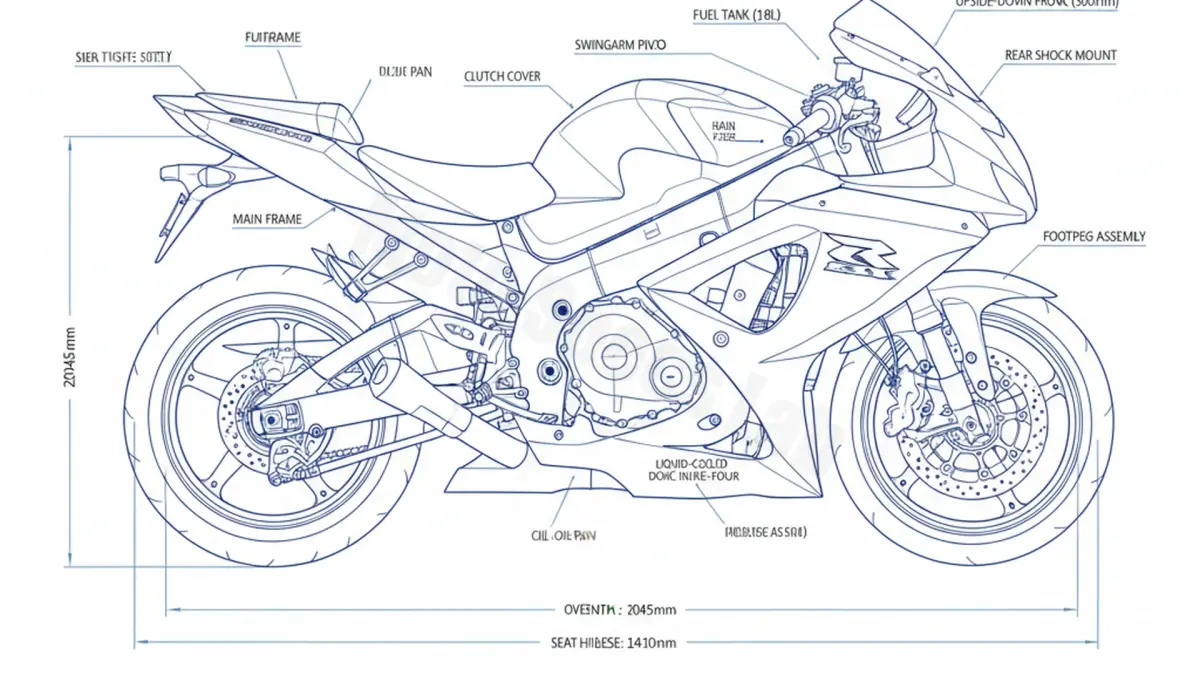
Engineering Highlight: The 2003 Suzuki GSX-R 1000 (K3) marked a pivotal moment in superbike history as the first production Suzuki to adopt radial-mount brake calipers and a 32-bit ECU. This generation utilized titanium-coated stanchions and a significantly lighter frame (reduced by 0.6kg) compared to its predecessor, cementing its reputation as the most agile liter-bike of the early 2000s.
Technical Overview
The WVBZ designation covers the 2003 and 2004 models, representing a major refinement over the original K1/K2 series. The engine was redesigned with new internal ventilation holes between the cylinders to reduce pumping losses, alongside the introduction of titanium valves and a 4-into-2-into-1 titanium exhaust system. These changes resulted in a more linear power delivery and a higher redline, pushing the output to approximately 162 hp.
Maintenance Guide
Lubrication System
For the GSX-R 1000 K3/K4, the oil capacity is 3.3 liters when changing the filter. MotoSpecsLab recommends using a high-quality fully synthetic 10W-40 oil meeting JASO MA2 standards to ensure optimal clutch performance and gearbox protection under high-stress conditions.
Ignition and Electrical
The electrical system relies on the YT12A-BS battery. It is critical to maintain the spark plug gap of the NGK CR9E units at precisely 0.7 to 0.8 mm. Fouled plugs in this model often lead to low-end hesitation, a common symptom of the aggressive fuel mapping used in the early 32-bit ECUs.
Chassis and Handling
The 190/50 rear tire profile provides a stable contact patch, though many track enthusiasts opt for a 190/55 for quicker turn-in. Ensure pressures are strictly maintained at 2.5 bar (front) and 2.9 bar (rear) for street use to prevent uneven tire wear and maintain the integrity of the WVBZ’s razor-sharp handling characteristics.
Expert Verdict
The K3/K4 generation remains a favorite among purists for its lack of electronic rider aids like traction control or ABS, offering a raw, mechanical connection between the throttle and the rear wheel. Its robust engine architecture makes it a preferred platform for privateer racing even two decades after its release.